
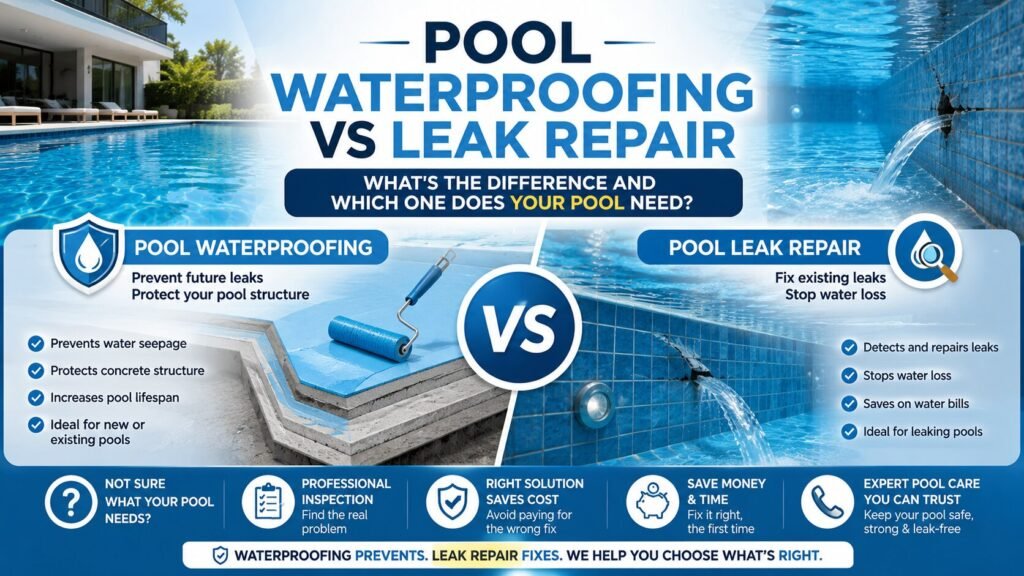
Pool leak repair targets a specific, identifiable source of water loss such as a cracked fitting, a failed pipe joint, or a hairline crack in the shell. Pool waterproofing replaces the protective membrane beneath the pool tiles to stop water migrating through the pool structure broadly. Leak repair fixes a defined fault. Waterproofing addresses the system that prevents structural water loss. When a specific leak source is confirmed, repair is the right call. When water loss is diffuse and no single source is found, failed waterproofing is almost always the cause.
This is one of the most common points of confusion for Singapore pool owners. A pool is losing water. The question is whether it needs a targeted repair or a full waterproofing job. These are very different in scope, cost, and how long the fix lasts. Choosing the wrong one costs money and leaves the real problem unsolved.
What is Pool Leak Repair?
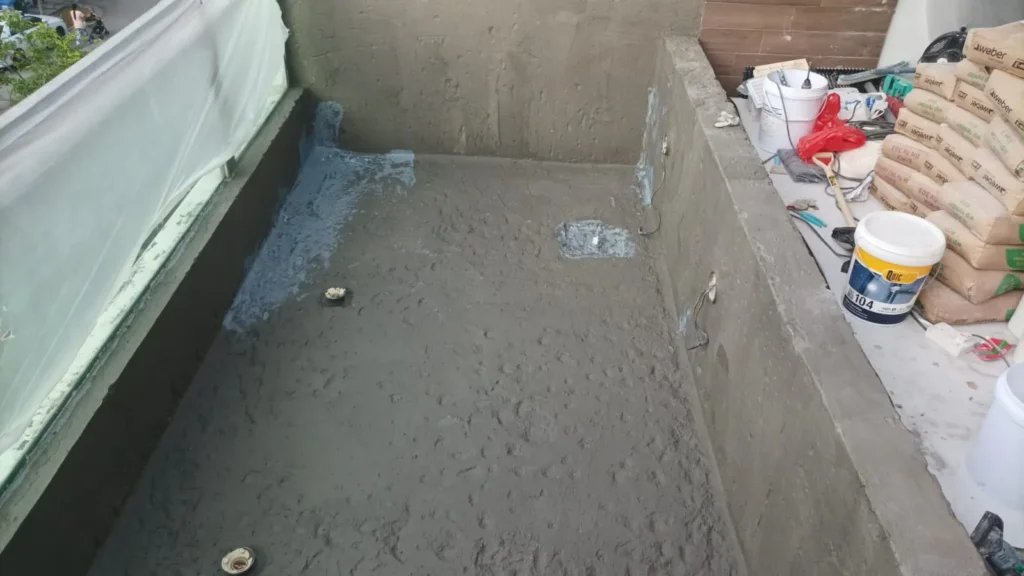
Pool leak repair is the targeted fix of a specific, confirmed source of water loss. It could be a cracked skimmer body, a failed sealant around a return jet, a fracture in an underground pipe, or a hairline crack in the pool shell. Leak repair is precise work at a known location. It does not involve replacing the waterproofing membrane across the whole pool unless the membrane itself is confirmed as the leak source in a specific area. Leak repair starts with detection. You cannot repair a leak without first confirming exactly where it is coming from. This is why professional leak detection visits always precede repair work.
Common pool leak repair scopes in Singapore include:
- Skimmer body reseal at the junction with the pool shell
- Return jet or fitting reseal where sealant has degraded
- Crack injection using epoxy or polyurethane into a confirmed structural crack
- Underground pipe section replacement at the confirmed fault location
- Light niche conduit reseal where water is tracking through the conduit path
- Pump seal or equipment fitting replacement for plant room side leaks
Each of these is a discrete, targeted repair. The pool is not drained in full for most fitting repairs. Underground pipe repairs require localised excavation. Structural crack repairs require the pool to be drained and the crack surface dried before injection. For the full range of leak repair methods and costs, See Our Pool Leak Detection and Repair Singapore service page.
What is Pool Waterproofing?
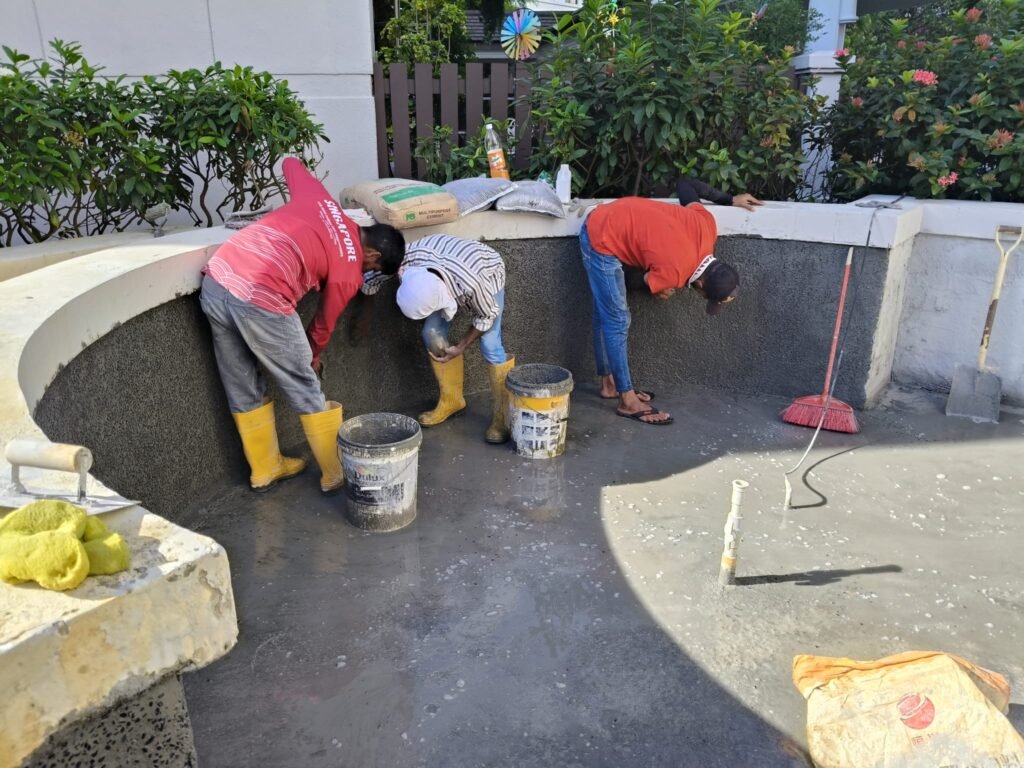
Pool waterproofing is the application of a new protective membrane to the pool shell beneath the tiles. It is not a surface repair. It requires full pool drainage, complete tile removal across all surfaces, substrate preparation, crack repairs where needed, membrane application in the correct number of coats to the specified thickness, a 24 to 48 hour flood test before tiling, and full retiling with new tiles and grout. Waterproofing is the replacement of the system that prevents water from migrating through the pool structure.
Waterproofing is not something done on top of existing tiles. The membrane sits beneath the tiles and bonds directly to the pool shell. Any product applied over existing tiles is a surface coating, not structural waterproofing. The full waterproofing process takes 2 to 4 weeks for a standard residential pool. The membrane must cure fully before flood testing, and flood testing must pass before tiling begins. For the full process, system types, and costs, See Our Pool Waterproofing Singapore service page.
The Core Difference: Specific Source vs Broad Membrane Failure
The key question is whether the water loss has a single identifiable source or whether water is escaping broadly through the pool structure with no specific fault point. A specific identifiable source, such as a confirmed skimmer crack or a pressure-tested pipe failure, means targeted repair is the right scope. Diffuse water loss with no specific source confirmed after full detection testing almost always means the waterproofing membrane has failed and water is passing through the pool shell broadly.
Think about it this way. A leak repair fixes a hole in the wall. Waterproofing replaces the wall’s protective coating. If there is one specific hole, you fix the hole. If the wall material has become porous throughout and water is seeping through everywhere, you replace the coating. Both situations cause water loss. The symptoms can look identical from above the waterline. But the correct fix is completely different.
When Leak Repair Is the Right Answer
Leak repair is the right choice when a specific, confirmed source of water loss is identified during professional detection. This includes fitting seal failures, confirmed structural cracks at known locations, pressure-tested underground pipe faults, and equipment-side plumbing leaks. If the detection process confirms a discrete fault point and the pool is not broadly losing water through the shell, targeted repair addresses the problem without the cost and downtime of full waterproofing. Situations that call for leak repair rather than waterproofing:
Fitting seal failure at a specific point
Dye testing during the detection visit shows dye being pulled sharply into the gap around a skimmer opening, return jet, or main drain cover. The sealant at that specific fitting has failed. Resealing or replacing that fitting resolves the leak. The pool does not need to be retiled or have its membrane replaced.
Confirmed underground pipe fault
Pressure testing shows one plumbing line is losing pressure. Acoustic detection narrows the fault location along that pipe run. The fault is a fractured joint or pipe section at a known location. Excavating at that point and replacing the failed section resolves the leak. Waterproofing is not involved.
Isolated structural crack
A single crack in the pool shell is visible and has been confirmed as a water loss point using dye testing. Crack injection at that specific location seals the crack. If the surrounding shell and waterproofing membrane are intact, no broader waterproofing work is needed.
Equipment-side plumbing leak
Wet marks at the pump seal, a cracked filter body, or a leaking union fitting at the equipment pad are all equipment-side leaks. These are repaired at the plant room. The pool structure is not involved. In all these cases, repair is precise, faster, and significantly cheaper than full waterproofing. The repair holds because the specific fault has been identified and fixed.
When Waterproofing Is the Right Answer
Waterproofing is needed when the pool is consistently losing water beyond normal evaporation and no specific leak source is confirmed after full detection testing including pressure testing, dye testing, and visual inspection. This pattern means water is escaping through the pool structure broadly rather than through a single fault. The waterproofing membrane beneath the tiles has failed and water is migrating through the pool shell. No targeted repair addresses this because there is no single fault to fix. Waterproofing is also needed in these situations:
Tiles are detaching broadly across the pool
When tiles come off across multiple sections of the pool without physical cause, the adhesive bond has failed broadly from sustained moisture exposure from below. This means the waterproofing membrane has been failing long enough for water to reach and undermine the adhesive throughout the pool. A repair of individual tiles does not address the membrane failure driving the detachment.
Efflorescence appears widely across pool surfaces
White chalky mineral deposits on pool walls or floor are caused by water carrying dissolved salts through the concrete as it migrates outward. Widespread efflorescence means water movement through the shell is happening broadly, not at a single point.
The pool has had repeated leak repairs that have not held
A pool that has needed the same type of repair repeatedly, particularly tile replacement or fitting reseals in the same areas, has an underlying waterproofing failure that no surface repair is addressing. The membrane has failed. The repairs mask the symptom temporarily.
Pool is over 12 to 15 years old with no waterproofing history
At this age, even a pool with no current water loss symptoms should have the waterproofing membrane assessed. If the membrane is confirmed to be degraded or failed, proactive waterproofing before tile failure begins is significantly cheaper than responding after it does.
When You Need Both: Leak Repair and Waterproofing Together
This is more common than many pool owners expect, particularly on older Singapore pools. A pool might have a confirmed skimmer body crack that is causing measurable water loss. Detection and repair of that crack is warranted. But if the pool is also 14 years old, has a history of tile detachment in other areas, and shows efflorescence on the lower walls, the skimmer crack is not the only problem. The waterproofing membrane has likely also degraded across the pool. Repairing only the skimmer in this scenario fixes one fault but leaves the broader membrane failure unaddressed. The pool will continue to lose water through the shell even after the skimmer is repaired. Within 12 to 18 months, more tiles will detach.
The right approach is to confirm both the specific fault and the broader membrane condition during the detection visit, then address both in the same project scope. If the pool is already going to be drained for the skimmer repair, adding waterproofing and retiling at the same time avoids a second drainage cycle and produces a pool reset to full condition. This combined approach costs more than a simple skimmer reseal but significantly less than doing each scope separately at different times.
The Detection Visit Determines Everything
Neither scope should be committed to without a professional detection visit first. The detection visit is what separates an accurate repair from an expensive guess.
A proper detection visit for a pool losing water includes:
- Bucket test to confirm and quantify water loss beyond evaporation
- Visual inspection of the pool shell, all fittings, and equipment
- Dye testing at all penetration points including skimmers, returns, drains, and light niches
- Pressure testing of all plumbing lines to identify any underground faults
- Acoustic detection to locate any confirmed underground pipe faults
- Tap test across all tiled surfaces to assess waterproofing and adhesive bond condition
- Water level monitoring comparison between pump-on and pump-off periods
- Written report of all findings with recommended scope
If the detection finds a specific source: repair that source. If the detection finds no specific source and water loss continues: the waterproofing membrane has failed and full waterproofing is required. If both are found: address both in one project. This process is what our team follows on every leak detection visit across Singapore. For full details on what the visit involves, see our Pool Leak Detection and Repair Singapore service page.
Cost Comparison: Leak Repair vs Waterproofing
Understanding the cost difference helps frame the decision clearly.
Pool leak repair costs in Singapore:
| Repair Type | Estimated Cost (SGD) |
| Fitting reseal (skimmer, return, drain) | SGD 150 to SGD 500 |
| Structural crack injection | SGD 300 to SGD 1,500 |
| Underground pipe section replacement | SGD 500 to SGD 4,000 |
| Equipment-side plumbing repair | SGD 150 to SGD 600 |
Pool waterproofing costs in Singapore:
| Waterproofing Scope | Estimated Cost (SGD) |
| Targeted waterproofing repair (small area) | SGD 1,500 to SGD 4,000 |
| Full waterproofing with standard tile retile | SGD 8,000 to SGD 18,000 |
| Full waterproofing with premium tiles | SGD 15,000 to SGD 30,000+ |
For the full waterproofing cost breakdown, see our blog: How Much Does Pool Waterproofing Cost in Singapore?
For the full leak repair cost breakdown, see our blog: How Much Does Pool Leak Detection and Repair Cost in Singapore?
Common Mistakes That Cost Singapore Pool Owners Money
Repairing fittings on a pool that needs waterproofing
The fitting repair resolves one water loss point. The pool continues losing water through the membrane. The owner calls back within 6 months. A second repair visit. Then a third. Each repair costs SGD 300 to SGD 500. After three rounds, the pool still has the same underlying problem and SGD 1,500 has been spent on fixes that did not address it.
Waterproofing a pool that only needed a fitting reseal
A pool shows water loss. The contractor recommends full waterproofing without conducting a detection visit. The pool is drained, tiles removed, membrane replaced, retiled. Cost: SGD 15,000. The skimmer crack was the only source. A SGD 300 reseal would have resolved it. This scenario is less common but happens when contractors skip detection and go straight to the most expensive recommendation.
Skipping detection and choosing a scope based on cost
A pool owner receives two quotes: one for repairs at SGD 2,000 and one for full waterproofing at SGD 16,000. They choose the cheaper option without confirming which scope is actually needed. If the pool needed waterproofing, the repair holds for 12 months then fails. If it needed repair, the waterproofing was unnecessary. Detection is the investment that makes the right choice clear.
Getting the Right Assessment
If your pool is losing water and you are not sure whether you need leak repair or waterproofing, the right first step is a professional detection visit. At Infinity Pool Services, we carry out full detection visits across Singapore for residential and condo pools. We use pressure testing, dye testing, acoustic detection and surface assessment to identify the leak source accurately before recommending any scope of work. We give you a written report and a separate fixed quotation. You know exactly what was found and exactly what the fix will cost before committing to anything. We serve Bukit Timah, Sentosa Cove, Tanglin, Novena, Serangoon Gardens and Katong East Coast. Book a Free Inspection: infinitypool.com.sg/contact or call +65 8301 9006
Frequently Asked Questions
What is the difference between pool waterproofing and pool leak repair?
Pool leak repair fixes a specific, confirmed source of water loss such as a failed fitting seal, a cracked pipe, or an isolated crack in the shell. Pool waterproofing replaces the protective membrane beneath the tiles to stop water migrating through the pool structure broadly. Repair is targeted at a known fault. Waterproofing addresses systemic membrane failure.
How do I know if my pool needs leak repair or waterproofing?
A professional detection visit using pressure testing, dye testing, and acoustic detection will confirm whether a specific fault exists. If a fault is confirmed, repair that fault. If no specific source is found after full detection and the pool is still losing water, the waterproofing membrane has failed and waterproofing is required. The detection visit is the only reliable way to distinguish between the two.
Can you waterproof a pool without fixing the leaks first?
No. Any active structural cracks must be repaired before a waterproofing membrane is applied. Applying membrane over an unrepaired crack produces a membrane that fails at the crack line quickly. Structural repairs are a standard part of the waterproofing preparation process, not an optional extra.
Is pool waterproofing the same as a leak repair?
No. Pool waterproofing is a comprehensive renovation of the pool’s protective membrane system beneath the tiles. It requires tile removal, substrate preparation, membrane application, flood testing, and retiling. Leak repair is a targeted fix at a specific, confirmed fault point. They address different problems at different layers of the pool.
How much does pool leak repair cost compared to waterproofing?
Targeted leak repairs in Singapore cost SGD 150 to SGD 4,000 depending on the fault type. Full pool waterproofing with retiling costs SGD 8,000 to SGD 18,000 for a standard residential pool. The correct scope depends entirely on what the detection visit confirms, not on which option costs less.
What happens if I repair a pool leak that was actually a waterproofing failure?
The repair addresses one point but water continues to escape through the failed membrane elsewhere in the pool. The pool keeps losing water. More repairs are needed. Each round of repair adds cost without solving the underlying problem. Most pool owners in this situation eventually arrive at full waterproofing after spending significantly more on repeated repairs.
Does pool leak repair include waterproofing?
Not usually. Targeted leak repair addresses a specific fault. If the repair involves an area where the waterproofing membrane is exposed, a localised waterproofing repair may be included. But full re-waterproofing of the whole pool is a separate scope that is only recommended when the detection confirms broad membrane failure.
Can a pool need both leak repair and waterproofing at the same time?
Yes, and this is common on older pools. A pool may have a confirmed specific fault such as a skimmer crack alongside a broadly degraded waterproofing membrane. The most cost-effective approach is to address both in one project while the pool is drained, rather than two separate projects with two drainage cycles.
How long does pool leak repair take compared to waterproofing?
Targeted leak repairs take 1 to 3 days for most residential pool faults. Full waterproofing takes 2 to 4 weeks from drainage to refill, accounting for substrate preparation, membrane application, curing, flood testing, and retiling.
Why is professional detection important before choosing between leak repair and waterproofing?
Professional detection identifies the actual source of water loss before any money is committed to a repair scope. Without detection, both options are guesses. A detection visit using pressure testing, dye testing, and acoustic equipment costs SGD 150 to SGD 450. It saves pool owners from paying for the wrong fix, which in the worst case means spending SGD 1,500 on repeated repairs before arriving at the SGD 15,000 waterproofing job that was always the right answer.