
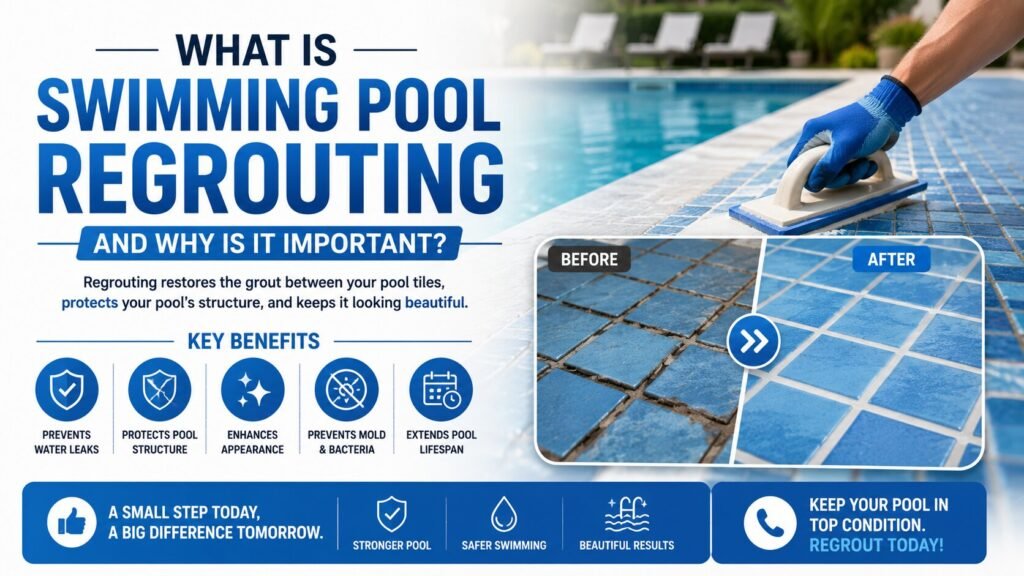
Swimming pool regrouting is the process of removing deteriorated grout from the joints between pool tiles and replacing it with fresh, waterproof grout. Grout degrades over time from pool chemicals, UV exposure, and thermal cycling. When it fails, water infiltrates behind the tiles, weakens the adhesive bond, and begins to damage the waterproofing layer beneath. Regrouting stops this process before it reaches that level of damage.
If you have a pool in Singapore, you have probably heard the term regrouting. You may have noticed grout lines that look darker than they used to, or sections where the grout appears to be crumbling or missing. You may have been told your pool needs regrouting but are not quite sure what that actually means or whether it is urgent. This guide answers all of that clearly.
What is Pool Grout and What Does It Do?
Pool grout is the material that fills the joints between tiles on the walls, floor, and steps of a swimming pool. Its job is to create a watertight seal between each tile so water cannot get behind the tiled surface. Without intact grout, every joint between tiles is an open channel through which water can travel behind the tile and into the layers beneath.
Grout in a swimming pool is not the same as standard bathroom or kitchen grout. Pool grout must withstand constant water immersion, chlorine or salt water chemical exposure, UV radiation, and Singapore’s daily thermal cycling between cooler nights and hot afternoons. Standard grout would degrade very quickly in these conditions. The two main types of pool grout used in Singapore are:
Cement-based waterproof grout: The most common and most affordable option. It is applied as a paste, cures to a solid finish, and provides a reasonable waterproof seal when first applied. Over time, cement grout is susceptible to chemical degradation from chlorine, staining from algae and mineral deposits, and micro-cracking from thermal movement.
Epoxy grout: A two-component system that cures to a hard, chemically resistant, non-porous finish. Epoxy grout performs significantly better in pool conditions than cement grout. It resists chlorine, salt water, and staining, and does not support algae growth in the joints. It costs more to supply and apply but lasts considerably longer in Singapore pool conditions.
What Does Pool Regrouting Involve?
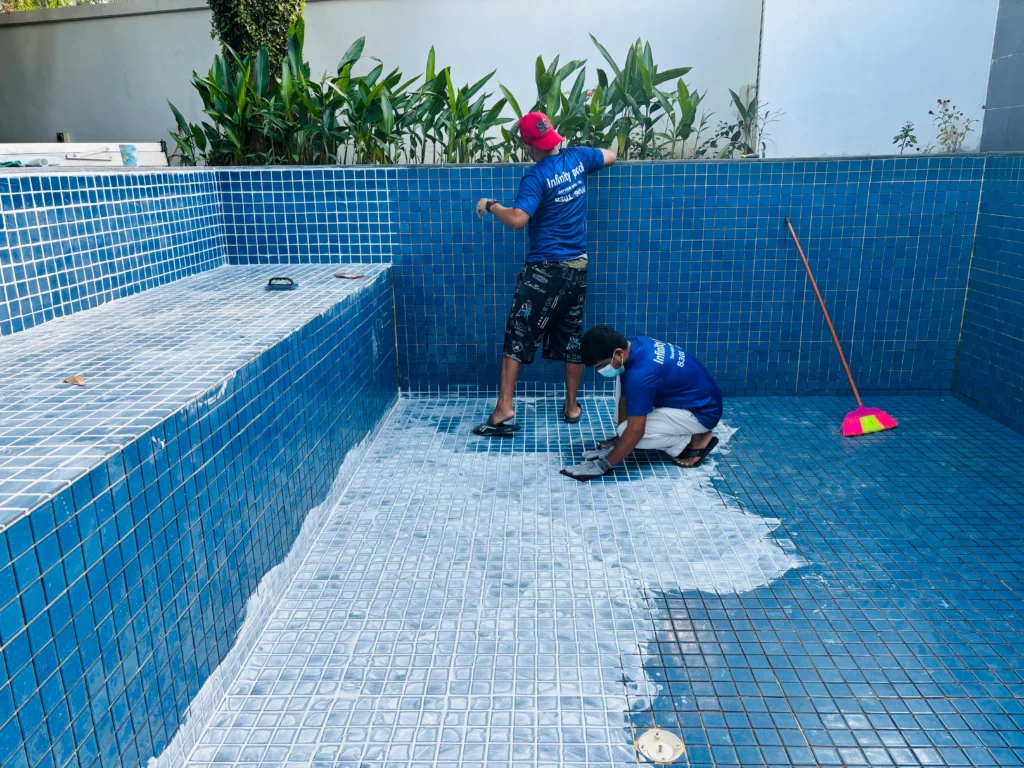
Pool regrouting involves draining the pool, mechanically grinding or raking all deteriorated grout out of every tile joint across the pool surfaces, cleaning the exposed joints thoroughly, packing fresh pool-grade waterproof grout into all joints, allowing the grout to cure for the required period, and refilling the pool. The tiles themselves are not touched. The process restores the watertight seal between tiles without disturbing the pool structure beneath. Here is the full sequence in practice:
Pool draining
The pool must be fully or partially drained to expose the tile surfaces that need to be regrouted. Work cannot be done on submerged tiles.
Old grout removal
All deteriorated grout is removed from the joints using a grout saw, an angle grinder with a grout removal disc, or an oscillating multi-tool. The goal is to remove all failing material down to the tile edges without chipping or cracking the tiles. This takes patience and proper tool selection matched to the tile size and joint width.
Joint cleaning
Exposed joints are cleaned with brushes and appropriate cleaning agents to remove algae, calcium deposits, old adhesive residue, and dust. The joint must be clean and free of loose material for the new grout to bond correctly.
New grout application
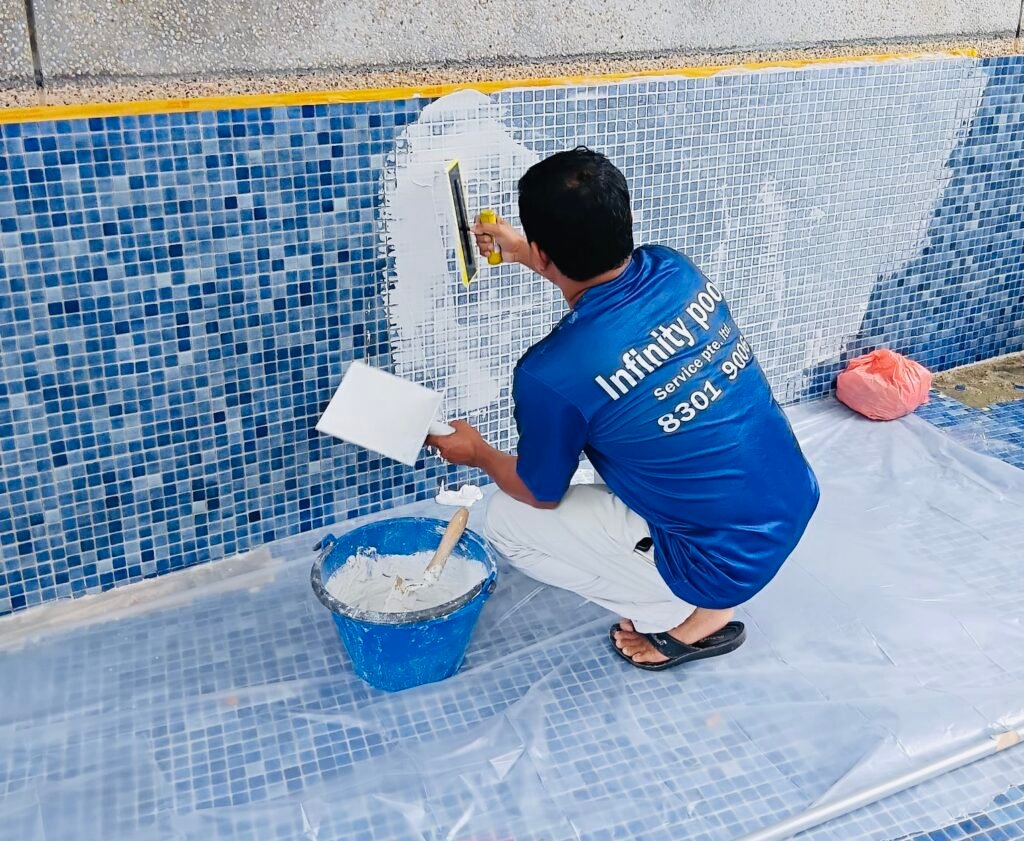
Fresh pool-grade grout is mixed to the correct consistency and packed firmly into all joints using a grout float, working at a diagonal angle to the tile surface. Joints are packed fully with no voids or air pockets.
Surface cleaning
Excess grout is removed from tile faces before it hardens. This requires attention to timing because epoxy grout in particular hardens quickly in Singapore’s heat.
Curing
The new grout is allowed to cure for the period specified by the manufacturer before the pool is refilled. Most pool-grade grouts require 24 to 72 hours of cure time. Refilling too early softens uncured grout and weakens the joint.
Refill and water chemistry rebalancing
The pool is refilled and water chemistry is tested and adjusted. New grout can slightly affect pH in the short term, particularly cement-based grouts, so water balance should be checked within 24 to 48 hours of refilling. For full details on the regrouting service at Infinity Pool Services, Visit Our Swimming Pool Regrouting service page.
Why Pool Regrouting Is Important
Pool regrouting is important because grout is the only barrier preventing water from entering behind the tiles. Once grout fails, water moves through the joints and begins to attack the tile adhesive and waterproofing membrane beneath. This starts a chain of damage: adhesive weakens, tiles detach, waterproofing is breached, and the pool structure is progressively damaged. Timely regrouting stops this chain at the first link, before any of the more expensive damage occurs. This sequence of damage is worth understanding clearly because it explains why regrouting is maintenance, not a cosmetic task.
Stage 1: Grout deterioration
Grout joints crack, erode, or fall out of the joint. This is the normal result of age, chemical exposure, and thermal cycling. At this point, the damage is only to the grout. The tiles are still bonded. The waterproofing beneath is still intact.
Stage 2: Water infiltration through joints
Water from the pool enters the open joints and contacts the back of the tiles, the tile adhesive, and the waterproofing membrane below. In Singapore’s climate, this infiltration happens continuously when the pool is in use.
Stage 3: Adhesive weakening
Sustained moisture contact softens the tile adhesive. The bond between tile and substrate weakens progressively. Tiles begin to sound hollow when tapped because a small void has formed between the tile and the adhesive beneath.
Stage 4: Tile detachment
The tile adhesive can no longer hold the tile against the substrate. Thermal expansion during hot days creates movement the weakened bond cannot resist. The tile lifts and eventually detaches.
Stage 5: Waterproofing breach and ongoing damage
Once a tile detaches, pool water contacts the substrate directly with no adhesive or tile protection. Water pressure pushes through the substrate. If the waterproofing membrane beneath was already compromised by the prolonged moisture exposure, the pool begins losing water through the structure.
Regrouting at Stage 1 costs SGD 1,500 to SGD 6,000. Reaching Stage 5 without intervention typically requires a full waterproofing renovation costing SGD 12,000 to SGD 25,000 or more. The importance of regrouting is the prevention of that cost difference.
How Pool Grout Degrades in Singapore’s Climate
Singapore’s pool environment puts more stress on grout than most pool owners realise. Several factors specific to this climate accelerate grout degradation.
Chemical exposure
Pool water in Singapore contains chlorine or salt-generated chlorine to maintain sanitation. Chlorine at pool concentrations is a mild oxidiser that slowly breaks down the cement binder in standard pool grout over time. The effect is gradual but cumulative. Grout that is 6 to 8 years old in a well-maintained chlorine pool will typically show measurable degradation even with balanced water chemistry.
Pools with chronically high chlorine levels, or pools where the water chemistry has been allowed to run outside the ideal range, show faster grout degradation. Acidic water with pH below 7.0 is particularly aggressive on cement grout.
Epoxy grout is chemically resistant to chlorine and salt water and does not suffer this degradation mechanism. This is the primary practical reason why epoxy grout lasts significantly longer than cement grout in pool applications.
Thermal cycling
Singapore’s daily temperature range causes pool surfaces to expand and contract continuously. The pool tiles, adhesive, grout, and concrete shell all have slightly different thermal expansion coefficients. This means they expand and contract at slightly different rates through each daily cycle.
Over months and years, this differential movement causes micro-cracking in the grout at the edges of each joint. The cracks widen progressively, allowing water to enter more easily, which accelerates the chemical degradation process further.
UV exposure
The waterline tiles and any tiled surfaces above the water level are exposed to direct UV radiation in Singapore’s intense sun. UV breaks down the surface of cement grout, causing it to become brittle and powdery on the exposed face. This surface breakdown gradually widens joints and reduces the grout’s ability to seal effectively.
Algae and biological growth in joints
Algae and biofilm grow in grout joints where light and nutrients reach. In Singapore’s warm climate, algae growth in failing grout joints is rapid. Once algae establish in a joint, their root systems physically expand the micro-cracks in the grout, accelerating the breakdown. This is why discoloured, dark grout joints are often a sign of structural degradation rather than just a cosmetic issue.
Signs Your Pool Needs Regrouting
Your pool needs regrouting when grout joints are visibly cracking, crumbling, or missing in sections, when tiles tap solidly but joints are clearly deteriorated, when algae or dark staining appears specifically in the grout joints rather than on the tile faces, or when you can see daylight through a joint where grout has fallen out entirely. If tiles are already hollow when tapped, the problem has progressed beyond regrouting alone. Here is a practical checklist to assess your pool:
Visual grout inspection
Walk the full perimeter of the pool and look closely at every tile joint. Run your finger along joints in different areas. Sound grout feels solid and does not crumble under light pressure. Failing grout feels soft, gritty, or breaks away under finger pressure.
Look for missing grout sections
Areas where grout has completely fallen out of a joint leave a visible gap between tiles. These are high-priority areas because they represent open channels for water infiltration.
Check for discolouration patterns
Uniform surface staining across all tiles is a cleaning issue. Dark staining concentrated specifically in the grout lines, particularly if it reappears quickly after cleaning, indicates biological growth in deteriorating grout.
Tap test on tiles
Tap tiles firmly across all pool surfaces. Solid tiles produce a dense, flat sound. A hollow-sounding tile has separated from its adhesive. If tiles are hollow, the problem has progressed beyond regrouting, and a professional assessment is needed to determine the correct scope.
Check water level stability
If grout failure is the primary issue and the waterproofing beneath is still intact, the pool will not typically show significant water loss beyond normal evaporation. Consistent water loss beyond evaporation suggests the problem has progressed to waterproofing failure, which requires a different scope of work. See our guide on Pool Waterproofing vs Regrouting to understand the distinction.
How Long Does Pool Grout Last in Singapore?
Cement-based pool grout in Singapore typically lasts 4 to 7 years before significant deterioration requires regrouting. Epoxy grout lasts 8 to 12 years under the same conditions. The actual lifespan depends on pool water chemistry management, UV exposure, pool usage frequency, and whether the original grout was correctly applied and cured. Pools with consistently balanced water chemistry tend to get the longer end of these ranges.
These ranges assume normal residential use and professional water chemistry management. Pools with chronically unbalanced water, high bather loads, or heavy UV exposure on exposed tile sections may see grout deterioration toward the shorter end.
The practical implication for Singapore pool owners is this: if your pool is over 5 years old and has not been regrouted since it was built or last renovated, a grout inspection is worthwhile. If your pool is over 8 years old without regrouting, the inspection should be treated as a priority rather than a suggestion.
Regrouting vs Retiling: Understanding the Difference
Many pool owners use these terms interchangeably but they describe completely different scopes of work. Regrouting replaces only the grout between existing tiles. The tiles stay in place. The pool structure beneath is not touched. This is appropriate when tiles are solid and only the grout has failed.
Retiling removes all existing tiles and installs new ones, almost always alongside waterproofing work. This is appropriate when tiles are hollow or detaching, when the waterproofing membrane has failed, or when a full renovation is needed.
Regrouting costs SGD 1,500 to SGD 6,000 for a standard residential pool. Retiling with waterproofing costs SGD 12,000 to SGD 22,000 and above. The key to choosing the right scope is a professional assessment that includes a tap test across all tiled surfaces. Our detailed guide on Regrouting vs Retiling: Which One Does Your Pool Really Need? covers this decision in full.
What Good Regrouting Work Looks Like
Not all regrouting jobs are equal. Here is what separates a properly done regrouting job from a quick surface application.
Full grout removal, not surface application
Proper regrouting removes all deteriorated grout from each joint down to the tile edges. A shortcut approach applies new grout over the top of old grout without removal. The new grout bonds to the old failing grout rather than the tile, and it peels or cracks within months.
Joint cleaning before application
Joints must be clean before new grout is applied. Old grout dust, algae, and calcium deposits left in the joint prevent the new grout from bonding to the tile edges properly. A properly prepared joint is visibly clean with sharp tile edges exposed.
Correct grout selection
Epoxy grout for below-waterline and waterline joints. Cement grout may be acceptable for above-waterline areas with lower chemical exposure. A contractor who applies only cement grout throughout the pool in a climate like Singapore’s is not specifying for the long term.
Adequate cure time before refilling
The grout manufacturer specifies a minimum cure time before water contact. Refilling too early softens the uncured grout and produces weak joints that deteriorate fast. A pool refilled within 12 hours of grouting has not been given adequate cure time.
Professional result: consistent joint width and colour
Well-executed regrouting produces visually uniform joints of consistent width and colour across all surfaces. Poorly done regrouting shows variable joint width, grout smeared across tile faces, and inconsistent colour from uneven mixing.
How Much Does Pool Regrouting Cost in Singapore?
Full pool regrouting in Singapore costs between SGD 1,500 and SGD 6,000 for a standard residential pool depending on pool size, the grout type selected, and the condition of the existing joints. Cement grout regrouting costs less than epoxy grout regrouting. The most common cost range for a standard landed home pool with epoxy grout is SGD 2,500 to SGD 4,500. A more detailed breakdown:
| Regrouting Scope | Estimated Cost (SGD) |
| Minor partial regrouting (one section) | SGD 500 to SGD 1,500 |
| Full regrouting with cement grout | SGD 1,500 to SGD 3,500 |
| Full regrouting with epoxy grout | SGD 2,500 to SGD 6,000 |
| Large pool or complex design | SGD 4,000 to SGD 8,000 |
The price difference between cement and epoxy grout is typically SGD 800 to SGD 1,500 for a full residential pool regrouting. Given that epoxy grout lasts 8 to 12 years versus 4 to 7 years for cement grout in Singapore conditions, the additional cost of epoxy is recovered in the extended service interval.
Book a Free Pool Inspection
If you are unsure whether your pool needs regrouting, retiling, or something else, the right first step is a professional inspection. At Infinity Pool Services, we carry out free site inspections for residential and condo pool clients across Singapore. We tap test all tiled surfaces, assess grout condition throughout the pool, and give you an honest written recommendation before any scope of work is confirmed.
We serve Bukit Timah, Sentosa Cove, Tanglin, Novena, Serangoon Gardens, Katong East Coast. You can also see the full range of pool services we provide on our homepage. Book Your Free Inspection: infinitypool.com.sg/contact or call: +65 8301 9006
Frequently Asked Questions
What is swimming pool regrouting?
Swimming pool regrouting is the removal of deteriorated grout from the joints between pool tiles and its replacement with fresh, waterproof pool-grade grout. The tiles remain in place. The pool structure beneath is not disturbed. The result is a restored watertight seal between all tiles that prevents water from infiltrating behind the surface.
How do I know if my pool needs regrouting?
Inspect the grout joints visually and by touch. Failing grout looks cracked, discoloured, or missing in sections and crumbles under light finger pressure. Also run a tap test across all tile surfaces. If tiles sound solid and only the grout is deteriorating, regrouting is the appropriate scope. If tiles sound hollow in multiple areas, professional assessment is needed as the problem may have progressed further.
How long does pool regrouting take?
A full regrouting job on a standard residential pool in Singapore typically takes 2 to 4 days. This includes pool draining, grout removal, joint cleaning, new grout application, and the required curing period of 24 to 72 hours before refilling. Smaller pools or partial regrouting jobs are faster.
How long does regrouted pool grout last in Singapore?
Cement-based grout lasts 4 to 7 years in Singapore pool conditions. Epoxy grout lasts 8 to 12 years. These ranges assume balanced pool water chemistry and regular professional maintenance. Chronically unbalanced water chemistry shortens grout lifespan regardless of the grout type.
Is epoxy grout worth the extra cost for pool regrouting?
Yes, in most cases. Epoxy grout costs SGD 800 to SGD 1,500 more than cement grout for a full residential pool regrouting. It lasts 8 to 12 years versus 4 to 7 years for cement grout. Over a 10-year period, epoxy grout requires one regrouting. Cement grout may require two. The total cost of two cement grout jobs exceeds one epoxy grout job in most cases.
Can pool regrouting be done without draining the pool?
No. Regrouting requires the pool to be at least partially drained to expose the tile surfaces. Old grout cannot be removed or new grout applied to surfaces that are submerged. Full drainage is required for floor and lower wall regrouting. Partial drainage may be sufficient if only waterline and upper wall areas are being regrouted.
What is the difference between regrouting and retiling a pool?
Regrouting replaces only the grout between existing tiles. The tiles stay in place. Retiling removes all tiles and installs new ones, almost always with new waterproofing beneath. Regrouting is appropriate when tiles are solid and only grout has failed. Retiling is required when tiles are hollow or detaching, or when waterproofing has failed. The cost difference is significant: regrouting costs SGD 1,500 to SGD 6,000 versus SGD 12,000 to SGD 22,000 for full retiling with waterproofing.
Can I regrout a pool myself?
The tools required for proper grout removal, including angle grinders with grout removal discs and oscillating multi-tools, require experience to use around pool tiles without causing damage. Epoxy grout has a short working time and requires correct mixing ratios. DIY regrouting attempts frequently result in cracked tiles during grout removal, incomplete joint preparation, and uneven grout application. Professional regrouting produces a result that lasts. DIY attempts often require professional correction within 1 to 2 years.
Does Regrouting Fix a pool leak?
Only if the leak is specifically caused by water entering through failing grout joints. If the waterproofing membrane beneath the tiles has already failed, regrouting will not stop water from escaping through the pool structure. A professional assessment confirms which situation you are dealing with before regrouting is recommended.
How often should a pool in Singapore be regrouted?
With cement grout, every 5 to 7 years is a reasonable regrouting interval under normal conditions. With epoxy grout, every 8 to 12 years. In practice, a grout inspection every 3 to 4 years is worthwhile so deterioration is caught early rather than waiting for visible failure. Pools in areas with heavy tree cover, which increases organic debris in the water and grout joints, may need more frequent attention.