
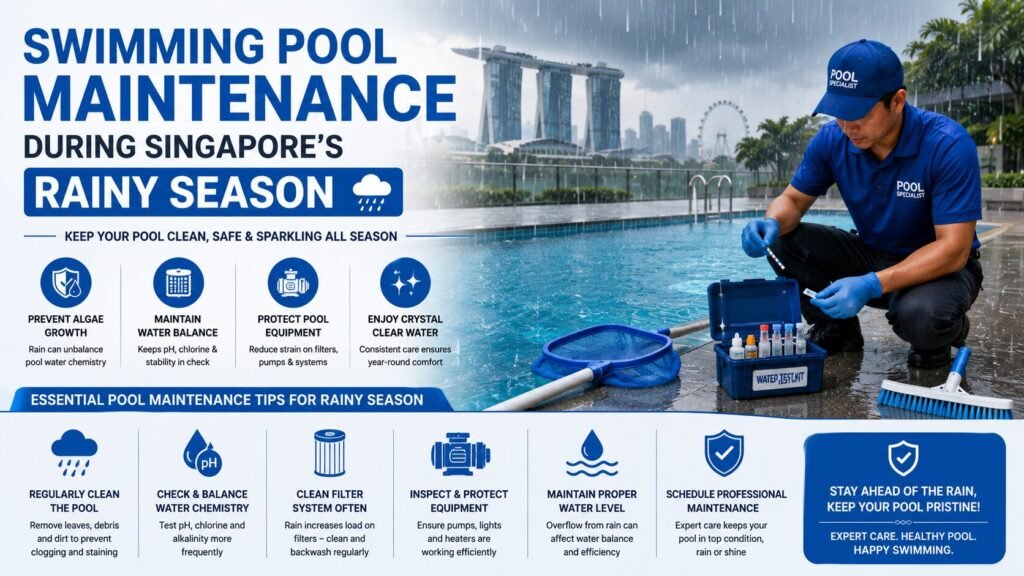
During Singapore’s rainy season, pool water chemistry needs more frequent monitoring because heavy rain dilutes chlorine, drops pH, and introduces algae spores. After every significant storm, test free chlorine and pH immediately, shock dose if chlorine has dropped below 1.0 ppm, and run the pump continuously for 24 hours. Pools should also be inspected for structural issues as sustained heavy rainfall saturates the soil around the pool structure and accelerates waterproofing degradation and underground pipe stress. Singapore does not have a single rainy season. The wettest periods are typically November to January (northeast monsoon) and April to May (inter-monsoon), but meaningful rainfall occurs year-round. Some months average over 250 mm of rain. Individual storms regularly dump 50 to 100 mm in a few hours.
For pool owners, this is not a seasonal concern. It is a year-round reality that requires a consistent response every time it rains heavily. This guide covers what heavy rain does to your pool, what you need to do after every significant storm, and how to protect the pool structure during sustained wet periods.
What Heavy Rain Does to a Swimming Pool
Heavy rain affects a swimming pool in Singapore in four direct ways. First, it dilutes the pool water volume, reducing the concentration of all dissolved chemicals including free chlorine, total alkalinity, and calcium hardness. Second, rainwater is naturally acidic (typically pH 5.0 to 6.5), which pulls the pool pH downward, reducing chlorine effectiveness. Third, rainwater carries algae spores, organic debris, and airborne contaminants directly into the pool. Fourth, sustained heavy rainfall saturates the surrounding soil and increases hydrostatic pressure on the pool shell and underground plumbing. Understanding these four effects explains why rain creates pool problems so predictably.
Effect 1: Chemical dilution
A heavy storm can add 20 to 50 mm of water to the pool surface in a few hours. For a standard 50,000-litre pool with a surface area of 32 square metres, 50 mm of rainfall adds approximately 1,600 litres of fresh water to the pool volume. This represents roughly 3 percent dilution of all dissolved chemicals in a single storm.
Free chlorine is depleted both by this dilution and by the direct reaction with organic material that rain carries in. After a heavy storm, a pool that tested at 2.0 ppm chlorine may measure 0.5 ppm or less.
Effect 2: pH drop
Rainwater in Singapore’s urban environment is mildly acidic with a typical pH of 5.0 to 6.5. When this water mixes into a pool with a target pH of 7.2 to 7.6, the pool pH drops. At lower pH, chlorine becomes more chemically aggressive but is depleted faster. More importantly, most pool owners do not realise that low pH alone reduces the stability of grout, accelerates corrosion of metal fittings, and at extended low levels etches pool surfaces.
Effect 3: Algae spore introduction
Rain carries airborne algae spores and organic particles from the surrounding environment directly into the pool. In Singapore’s tropical environment, the air and rainwater carry significantly more biological material than in temperate climates. Algae spores landing in pool water that has low chlorine and low pH find ideal conditions to establish within 24 to 72 hours.
Effect 4: Soil saturation and structural stress
This is the effect that most pool owners overlook. When Singapore receives sustained heavy rainfall over days or weeks, the soil around the pool becomes saturated. Saturated soil exerts greater lateral pressure on the pool shell than dry soil. Underground plumbing joints experience increased soil movement stress. This is one reason why pool leaks and structural cracks are more commonly reported during and after extended wet periods.
Pools with existing waterproofing weakness, failing grout joints, or deteriorated fitting seals are particularly vulnerable during prolonged wet weather. Water that was slowly infiltrating from the inside accelerates when external soil pressure increases from the outside.
The Immediate Post-Rain Checklist
After any heavy rainstorm in Singapore, check free chlorine (target 1.0 to 3.0 ppm), pH (target 7.2 to 7.6), and water level. If free chlorine has dropped below 1.0 ppm, shock dose immediately. If the pool has overflowed from the rain, drain to normal water level before chemically adjusting. Run the pump continuously for at least 12 hours after a shock treatment. Test again 24 hours later to confirm chemistry has stabilised. Here is the step-by-step post-rain routine:
Step 1: Check the water level
Rain may have raised the pool above its normal operating level. An overfilled pool has reduced skimmer effectiveness because the skimmer throat is partially submerged. Drain down to the normal operating level, which is typically the mid-point of the skimmer opening, before doing anything else.
Step 2: Test free chlorine immediately
Use a reliable test kit or digital tester. If free chlorine reads below 1.5 ppm, shock the pool immediately. Do not wait until the next scheduled service visit.
Step 3: Test pH
Rainfall pulls pH down. If pH reads below 7.2, the low pH is compounding the chlorine effectiveness loss. Add pH plus (sodium carbonate) to bring it back into range before or alongside shock dosing. Correct pH first if it is below 7.0, then shock.
Step 4: Shock the pool
A shock dose raises free chlorine to 5.0 to 10.0 ppm temporarily. This kills any algae spores that entered with the rain before they can establish. Use calcium hypochlorite shock granules dissolved in a bucket of water before adding to the pool. Never add undissolved granules directly to pool tiles.
For salt chlorination pools, boost the controller to maximum output for 12 to 24 hours instead of adding separate shock granules.
Step 5: Run the pump continuously
After shock dosing, run the pump continuously for at least 12 to 24 hours to distribute the treatment evenly through the full pool volume and to maximise filtration of suspended particles and dead algae.
Step 6: Check and clean the filter
Heavy rain carries debris and organic material into the pool, placing additional load on the filter. Check the filter pressure after every significant storm and backwash if pressure has risen above normal.
Step 7: Test again after 24 hours
Confirm free chlorine has returned to the 1.5 to 2.5 ppm range and pH is between 7.2 and 7.6 before the pool is used again.
The Extended Rainy Period Routine
When Singapore experiences an extended wet period over several days or weeks, a single post-storm response is not enough. A consistent monitoring routine is needed throughout the wet period.
How do you manage a pool during a prolonged rainy period in Singapore?
During extended rainy periods, test pool chemistry every 2 to 3 days rather than weekly. Shock the pool within 24 hours of every significant storm rather than waiting for the next scheduled service. Keep the pump running for longer daily cycles (8 to 10 hours rather than 6) to maintain filtration capacity and chemical distribution. Inspect and clean the filter every 5 to 7 days during sustained wet weather. Check the pool surrounds for signs of soil movement or soft ground near the pool edge. The frequency increase during wet periods is the most common thing Singapore pool owners do not adjust. They continue a dry-season routine of once or twice weekly testing during a monsoon period when chemistry is shifting every day.
Chemistry targets during the rainy season:
| Parameter | Normal Target | During Extended Wet Period |
| Free chlorine | 1.5 to 2.5 ppm | Check every 2 to 3 days, shock after every storm |
| pH | 7.2 to 7.6 | Check every 2 to 3 days, correct if below 7.2 |
| Total alkalinity | 80 to 120 ppm | Check weekly, top up with sodium bicarbonate if below 80 |
| Cyanuric acid | 30 to 50 ppm | Check monthly, top up if diluted below 25 ppm |
| Calcium hardness | 200 to 400 ppm | Check monthly |
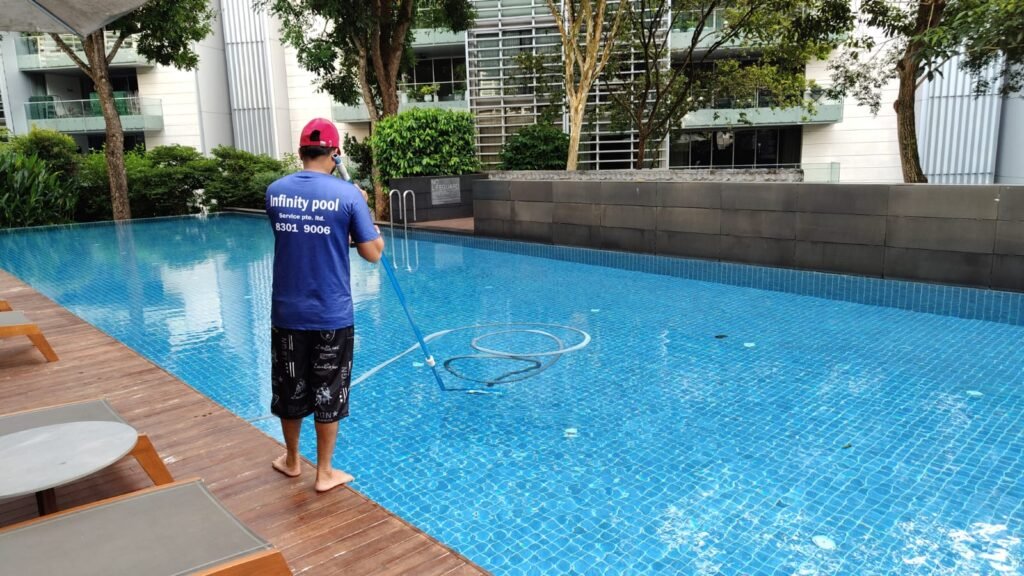
Structural Concerns During Singapore’s Rainy Season
Sustained heavy rainfall does not directly cause immediate structural damage to a sound pool. But it accelerates existing weaknesses. Grout joints that have small cracks allow more water infiltration when soil moisture is high and external pressure on the pool shell increases. Fitting seals that are beginning to fail can allow water ingress to accelerate significantly during wet periods. Underground plumbing joints under soil movement stress are more likely to fail during sustained saturation cycles. A pool that is structurally sound weathers the rainy season without issue. A pool with existing damage shows accelerated symptoms.
Signs of rainy season structural stress to watch for:
After each extended wet period, check for the following before assuming everything is fine. New soft patches in the garden or lawn near the pool that were not present before the wet period. This can indicate new soil movement from underground pipe leakage that is being exacerbated by soil saturation.
Water level dropping faster than normal after the storm rain has been drained to normal level. If the pool chemistry is correct but water is still consistently lower each morning, the pool may have a structural leak that the rainy season conditions have opened or worsened. New tiles that sound hollow on a tap test when tested during or after an extended wet period. Sustained external moisture pressure combined with internal water can accelerate adhesive bond failure in pools with early-stage waterproofing weakness.
Visible new cracking in the pool coping or surrounds. Ground movement from soil saturation can produce movement in surface structures above the pool shell. If any of these signs appear, a professional inspection before the next dry period is worthwhile. Wet period structural stress often reveals problems that remain hidden during drier conditions. For a full guide on detecting hidden pool damage, see our blog: How to Detect Hidden Damage in Swimming Pools.
Protecting Pool Surfaces During the Rainy Season
Pool grout is the most vulnerable surface element during Singapore’s rainy season. Acidic rainwater that enters the pool pulls pH down, and consistently low pH is corrosive to cement-based grout over time. Maintaining pH within the 7.2 to 7.6 range during wet periods is the single most effective way to protect grout from acid erosion. Epoxy grout, which is chemically resistant and non-porous, is significantly more durable than cement grout in these conditions and is the recommended choice when regrouting a Singapore pool.
Beyond chemistry management, the rainy season is a good time for the following surface care steps:
Brush pool surfaces more frequently
Algae and biofilm establish on pool surfaces before they become visible in the water. During the rainy season when algae spore introduction is higher and chlorine management is more demanding, brushing all pool walls, floor, steps, and the waterline area twice per week rather than once per week removes biofilm before it anchors.
Check grout joint condition after every extended wet period
Run your fingers along grout joints in different areas of the pool. Grout that is beginning to fail feels soft or crumbles under light finger pressure. Catching grout deterioration during or after the rainy season, before it progresses to tile adhesive failure, is the most cost-effective intervention. Regrouting a pool costs SGD 1,500 to SGD 6,000. Waiting until tiles start detaching moves the scope to retiling with waterproofing at SGD 12,000 to SGD 22,000. For the full explanation of why regrouting at the right time matters, see our blog: What Is Swimming Pool Regrouting and Why Is It Important?
Equipment Care During the Rainy Season
Yes. Sustained high humidity and frequent heavy rain accelerate corrosion on pool equipment that is not housed in a protected plant room. Open plant rooms expose pump housings, filter bodies, valve bodies, and electrical connections to constant moisture. Rust formation on pump housing seams and electrical component housings is more active during the wetter months. Lightning during storms also creates surge risk for pool controllers and salt cell electronics if surge protection is not in place. Practical equipment care steps during the rainy season:
Check electrical connections after every storm
Water ingress into controller enclosures or junction boxes can cause electrical faults. Inspect all electrical connections, controller enclosures, and cable entries after every significant storm. Any sign of water inside an electrical enclosure means the equipment needs to be dried and the entry point resealed before the next use.
Inspect the pump housing for new rust formation
Run your hand along the base and sides of the pump housing after the wet period. Active rust indicates water is reaching the housing body. This is the early warning before a pinhole leak develops in the housing itself.
Check filter pressure more frequently
With more debris entering the pool during wet weather, the filter loads faster. A filter that is checked every two weeks in dry weather should be checked weekly during the rainy season. For full filter and equipment servicing, see our Filter Servicing and Replacement service page.
When to Call a Professional During Rainy Season
Some rainy season pool issues are manageable with consistent owner attention. Others warrant professional involvement. Call a professional pool contractor when:
- The pool turns green within 48 hours of shock treatment and cannot be cleared with further chemical intervention. A failing filter, a salt cell approaching end of life, or an equipment fault is likely.
- The water level consistently drops faster than during the previous dry season, suggesting a new or worsening structural leak that the wet conditions have exposed.
- New soft ground or wet patches appear near the pool perimeter after an extended wet period.
- Tiles begin sounding hollow on a tap test in areas that were solid at the last inspection.
- The pool chemistry cannot be stabilised despite regular testing and dosing during a wet period.
At Infinity Pool Services, we carry out inspections and emergency service calls across Singapore for residential and condo pool owners. If your pool is showing any of these signs, contact us for an assessment. We serve Bukit Timah, Sentosa Cove, Tanglin, Novena, Serangoon Gardens, Katong East Coast. Visit Our homepage for the full range of services we provide. Book a Pool Assessment: infinitypool.com.sg/contact or call: +65 8301 9006
Frequently Asked Questions
Why does my pool go green after heavy rain in Singapore?
Heavy rain dilutes free chlorine, drops pool pH (reducing chlorine effectiveness), and introduces algae spores directly into the water. A pool with already-borderline chlorine levels can drop to near zero after a significant storm. Algae establish within 24 to 72 hours in warm, under-chlorinated water. The fix is to test and shock within 24 hours of every heavy storm, not wait for the next scheduled service.
How long should I run the pump after heavy rain in Singapore?
Run the pump continuously for at least 12 to 24 hours after a shock treatment following heavy rain. This ensures the shock chemical is distributed evenly through the full pool volume and that the filter is running at maximum capacity to remove suspended particles and dead algae. After this initial period, return to the normal daily run schedule.
Does heavy rain raise or lower pool pH?
Heavy rain lowers pool pH. Rainwater in Singapore’s urban environment is mildly acidic with a typical pH of 5.0 to 6.5. When this enters the pool, it pulls the pool pH downward from the target range of 7.2 to 7.6. Low pH makes chlorine less stable, accelerates grout erosion, and can cause corrosion of metal fittings. After heavy rain, always test pH and correct it before or alongside shock treatment.
Should I cover my pool during Singapore’s rainy season?
A pool cover significantly reduces chemical dilution from rain, minimises algae spore introduction, and cuts down on debris load in the pool. If the pool will not be used for an extended period during the wet season, covering it reduces the chemical work needed to maintain water quality substantially. For pools in regular use, a cover between swims is practical and extends chemical stability between dosing events.
How often should I test pool water during Singapore’s rainy season?
During extended wet periods, test free chlorine and pH every 2 to 3 days rather than weekly. After every significant rainstorm, test immediately. The rainy season creates faster and more unpredictable chemistry shifts than dry periods, and a once-weekly testing schedule is insufficient to maintain consistent water quality when rainfall is frequent and heavy.
Can heavy rain cause structural damage to my pool in Singapore?
Heavy rain does not typically cause immediate structural damage to a sound pool. But it accelerates existing weaknesses. Deteriorating grout lets in more water when soil moisture pressure increases. Failing fitting seals worsen under prolonged wet conditions. Underground plumbing joints under soil movement stress are more likely to fail during extended saturation cycles. After each major wet period, tap-test tiles and check for new soft ground near the pool edge.
What is the best way to prevent chemical loss during Singapore’s rainy season?
Three practices work together: maintain cyanuric acid (stabilizer) at 30 to 50 ppm to protect chlorine from UV degradation between storms, shock dose within 24 hours of every significant storm rather than waiting for the next scheduled service, and keep pH within 7.2 to 7.6 to maintain chlorine stability. A salt chlorination system also helps by producing chlorine continuously rather than relying on manual dosing that can fall behind during frequent storm events.
How do I stop algae from growing in my pool during Singapore’s monsoon period?
Shock the pool within 24 hours of every storm. Brush all pool surfaces twice per week to remove biofilm before it anchors. Run the pump for at least 8 hours daily. Maintain free chlorine above 1.5 ppm consistently. Never let pH rise above 7.6 during wet periods. Keeping cyanuric acid at 30 to 50 ppm protects the chlorine between dosing events. For pools that repeatedly go green during wet periods, consider converting to salt chlorination for more consistent automatic chlorine generation.
Should I drain and refill the pool after the rainy season?
A full drain and refill is not necessary just because of the rainy season. What the rainy season does is dilute chemicals and introduce contaminants, both of which are managed by testing, dosing, and shock treatment. A partial water change (20 to 30 percent of the pool volume) may be useful if total dissolved solids have risen significantly from extended wet-period chemical dosing, but this is a chemistry decision based on testing, not a seasonal protocol.
When should I call a pool professional after a bad storm in Singapore?
Call a professional if the pool turns green despite shock treatment and cannot be cleared within 48 hours, if the water level drops consistently after you have already drained back to the normal level post-storm, if new soft patches appear near the pool edge after an extended wet period, or if tiles sound hollow in new areas after the wet period ends. These signs suggest the storm has exposed or worsened a structural issue that needs professional diagnosis.