
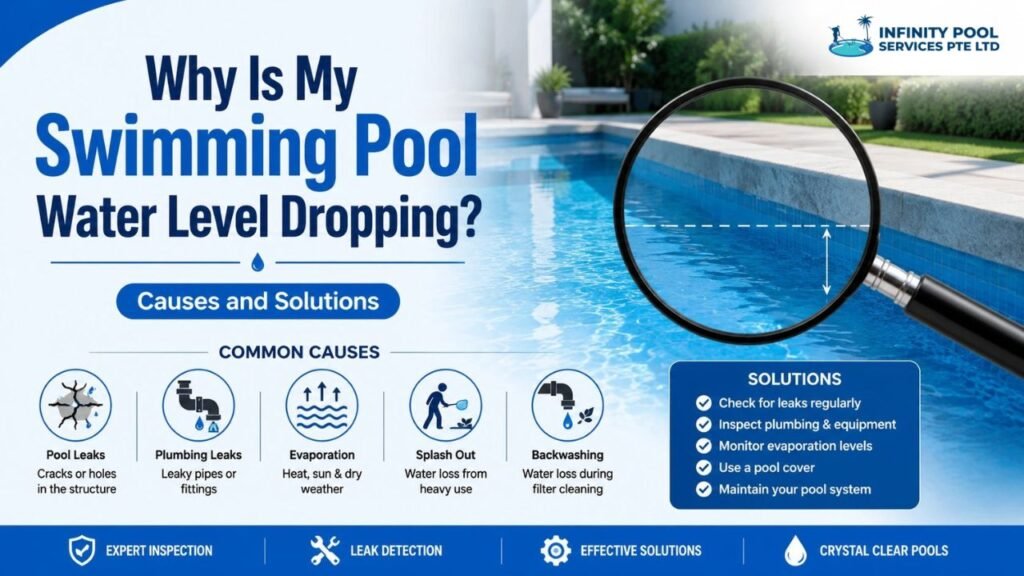
Every pool owner in Singapore eventually notices it: you top up the water on a Sunday, and by the following weekend, the level has dropped again. Sometimes it’s nothing. Sometimes it’s a genuine leak that’s been quietly working away at your pipework or tiling for weeks. The tricky part is telling the two apart, because both look exactly the same at first glance — the waterline is just lower than it used to be. This guide walks through the real causes behind a dropping pool level, how to tell whether it’s normal evaporation or an actual leak, and what to do about each one.
Start With the Obvious: Is It Just Evaporation?
Singapore’s heat and near-constant airflow mean pools lose water to evaporation faster than most people expect, especially pools that are exposed to direct sun for most of the day or sit near open, breezy stretches of a garden. A typical residential pool can lose anywhere from 5mm to 10mm a day purely from evaporation during hot, dry stretches, and more if there’s a pool heater running or the pool water is warmer than the surrounding air.
The simplest way to check is the bucket test:
- Fill a bucket with pool water and place it on a step in the pool so the water levels match.
- Mark the water level inside the bucket and the pool’s waterline.
- Wait 24 hours.
- Compare the two. If both dropped by roughly the same amount, you’re looking at evaporation. If the pool dropped noticeably more than the bucket, you likely have a leak.
This one test saves a lot of guesswork, and it’s the same starting point our technicians use before recommending anything more involved.
The Common Causes of a Genuine Leak
Singapore’s climate is particularly hard on pool structures. Heavy rainfall saturates the soil around a pool, and the repeated wet-and-dry cycle causes the ground to expand and contract, putting lateral pressure on the pool shell and buried plumbing over time. We covered this in detail in our piece on Common Pool Repair Problems in Singapore’s Humid Climate, which walks through exactly how waterproofing membranes fail beneath the tile line long before any visible damage shows up on the surface.
Cracked or Missing Grout
Grout is the first line of defence between your pool water and the structure underneath. Once it deteriorates, water works its way behind the tiles and can slowly undermine the waterproofing layer. If you’re seeing gaps in the grout lines or tiles that sound hollow when tapped, it’s worth reading our explainer on What Swimming Pool Regrouting is and Why it matters before deciding on a fix. Our Swimming Pool Regrouting Service addresses this directly, restoring the watertight seal between tiles.
Loose, Cracked, or Detaching Tiles
If the tiles themselves are the problem rather than just the grout, regrouting alone won’t solve it. This is a common point of confusion for homeowners, and it’s exactly why we wrote a full comparison on Regrouting Versus Retiling, since choosing the wrong fix can mean paying for the same repair twice. Our Tile Repair and Replacement Service covers everything from isolated tile fixes to full sections, and if you want to understand the process itself, our guide on How professionals repair damaged pool tiles breaks down each step.
Plumbing Leaks
Underground pipes carrying water to and from the pump, filter, and return jets can develop leaks from soil movement, age, or a poor original installation. These leaks are often invisible from the surface, showing up only as a steadily dropping water level or unusually damp patches in the surrounding deck or lawn. Our Swimming Pool Plumbing Repair Service is built specifically to trace and fix this kind of issue without unnecessary excavation.
Skimmer, Light Niche, and Fitting Leaks
Every fitting that penetrates the pool shell, skimmers, return jets, main drains, and light niches, has a seal that can fail over time. These are usually the easiest and cheapest leaks to fix once located, often costing a few hundred dollars rather than thousands, but they’re also easy to miss because the water loss can look identical to a much bigger structural problem.
Equipment and Pump Issues
A failing pump seal, a cracked filter housing, or a valve that isn’t seating properly can all leak water, sometimes only while the pump is actually running. If your water loss seems to track with how often the pump cycles, the issue is likely mechanical rather than structural. Our Pump Repair and Replacement Service and Equipment Repair and Replacement Service cover this kind of diagnosis and fix.
Why This Isn’t Something to Wait On
A dropping water level isn’t just a maintenance inconvenience, it’s a signal that something underneath the surface may be failing. Left unaddressed, a small leak can undermine tile adhesive, erode the soil supporting the pool structure, or lead to corrosion of buried electrical and plumbing components. What starts as a SGD 200 to SGD 500 fitting repair can, over months of continued water loss, turn into a full waterproofing and retiling job costing well into five figures. We’ve seen this pattern often enough that we treat any unexplained water loss as worth investigating properly rather than assuming it will resolve on its own.
There’s also a practical safety and hygiene angle. A pool that’s losing water is often also losing chemical balance faster than expected, since the water being lost has to be replaced with untreated tap water, diluting your chlorine and pH levels more frequently than normal. That makes consistent Swimming Pool Cleaning and monitoring even more important while a leak is being tracked down.
What to Do If You Suspect a Leak
- Run the bucket test described above to rule out simple evaporation.
- Check the obvious spots first — around skimmers, light fixtures, return jets, and any visible cracks in the tile or deck.
- Watch for damp patches in the lawn, garden beds, or paving near the pool equipment pad, which often point to an underground plumbing leak.
- Note when the water loss happens — only when the pump is running versus constantly — since this narrows down whether the issue is mechanical or structural.
- Call in a professional inspection if the loss continues past a few days or you can’t visually confirm the source. Tracing a leak without the right tools usually means either guessing or unnecessary digging, neither of which serves you well.
Getting a Proper Diagnosis
This is where a lot of DIY troubleshooting hits its limit. Structural leaks, plumbing leaks, and fitting failures can all present the exact same symptom on the surface, and treating the wrong one wastes money without solving the actual problem. A proper diagnosis typically involves pressure testing the plumbing lines, dye testing around fittings and the shell, and a tap test across tiled surfaces to check for hollow spots.
If you’d like a sense of what this kind of inspection and repair typically costs before booking anything, we’ve laid it out in our guide on Pool Leak Detection and Repair costs in Singapore. And if the leak has already been going on for a while, it’s worth also reading up on How to detect hidden damage in Swimming Pools, since water loss and hidden structural damage often go hand in hand.
A Note on Location
We service pools across Bukit Timah, Novena, Tanglin, Katong East Coast and Sentosa Cove the cause of a dropping water level does tend to vary by area. Coastal properties near Sentosa Cove and the East Coast see more corrosion-related fitting failures from salt air, while homes in older, established districts like Novena and Tanglin more often deal with aging plumbing runs. It’s one more reason a localised inspection, rather than a generic checklist, gives you a more accurate answer.
The Bottom Line
A dropping pool water level almost always has an explanation, and in Singapore’s climate, evaporation is a genuine possibility but far from the only one. The bucket test is a good first step, but if the numbers don’t add up, treating it as a leak worth investigating properly, rather than something to top up and ignore, will save you money and protect the structure of your pool in the long run. If your pool’s water level has been dropping and you’re not sure Why, Get in touch or Request a quote for an inspection, and we’ll help you find the actual source before it becomes a bigger repair.