
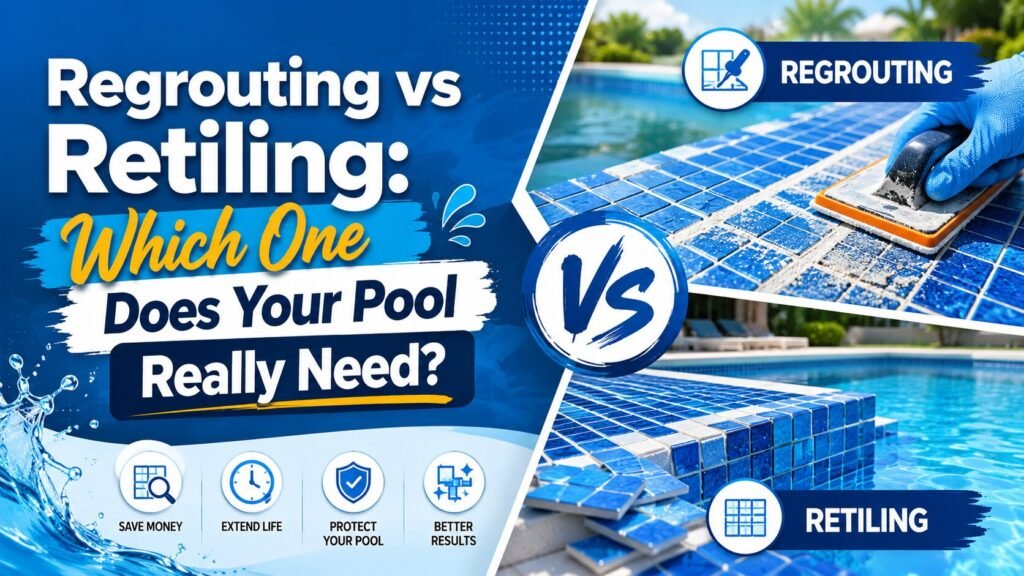
Pool regrouting removes and replaces deteriorated grout between tiles while keeping the existing tiles in place. Pool retiling removes all existing tiles and installs new ones, typically alongside waterproofing work. Regrouting is the right choice when tiles are solid and only the grout has failed. Retiling is needed when tiles are hollow, debonded, cracked, or when the waterproofing beneath has failed and the whole surface layer needs to be rebuilt. Choosing the wrong one is one of the most common and costly mistakes Singapore pool owners make.
Regrout a pool that needs retiling and you are spending SGD 2,000 to SGD 6,000 on a fix that lasts 18 months before the tiles start coming off again. Retile a pool that only needed regrouting and you are spending SGD 12,000 to SGD 22,000 when SGD 3,000 would have solved the problem for the next 6 to 8 years. This guide helps you make the right call.
What is Pool Regrouting?
What does pool regrouting involve?
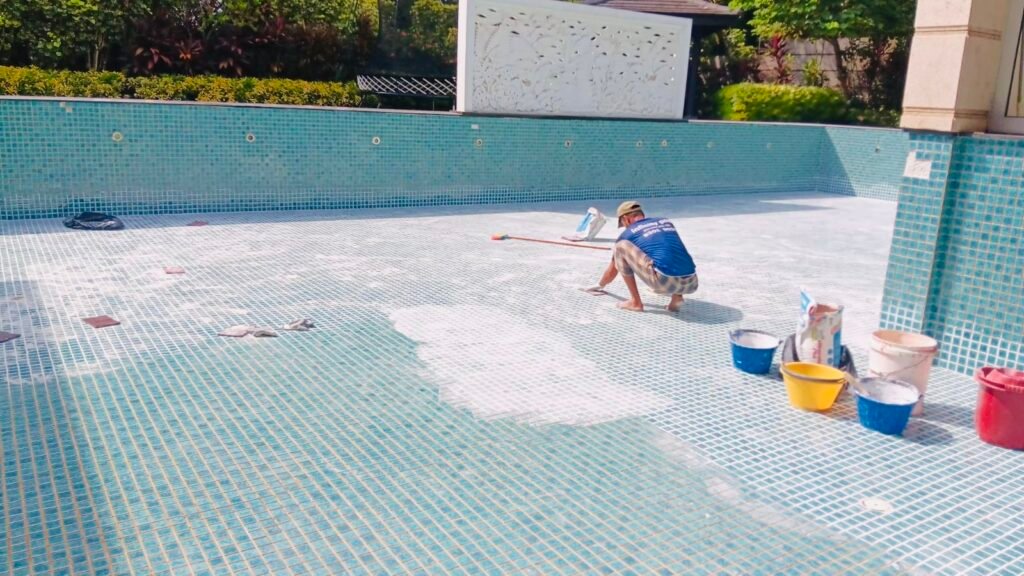
Pool regrouting is the process of removing all deteriorated grout from the joints between pool tiles and replacing it with fresh, waterproof grout. The tiles themselves are not touched. The pool shell and waterproofing layer beneath remain undisturbed. Regrouting is a surface-level operation that restores the watertight seal between tiles and stops water from infiltrating behind them through failing joints.
Grout in a pool wears down over time. Pool chemicals, particularly chlorine, break down the grout binder. UV exposure in Singapore’s sun accelerates surface degradation. Constant thermal cycling from daily temperature changes causes micro-cracking. The joints widen, the grout becomes porous, and water starts getting behind the tile surface. The regrouting process works like this:
- Pool is fully or partially drained
- All deteriorated grout is mechanically ground or raked out of every joint
- Joint faces are cleaned thoroughly to remove residue and algae
- Fresh pool-grade waterproof grout (epoxy or cement-based) is packed into all joints
- Excess grout is cleaned from tile faces
- Grout is allowed to cure for the required period
- Pool is refilled and water chemistry is rebalanced
The result is fresh, watertight joints between all tiles, with the existing tile surface preserved intact. For full details on the service, visit our Swimming Pool Regrouting page.
What is Pool Retiling?
What does pool retiling involve?
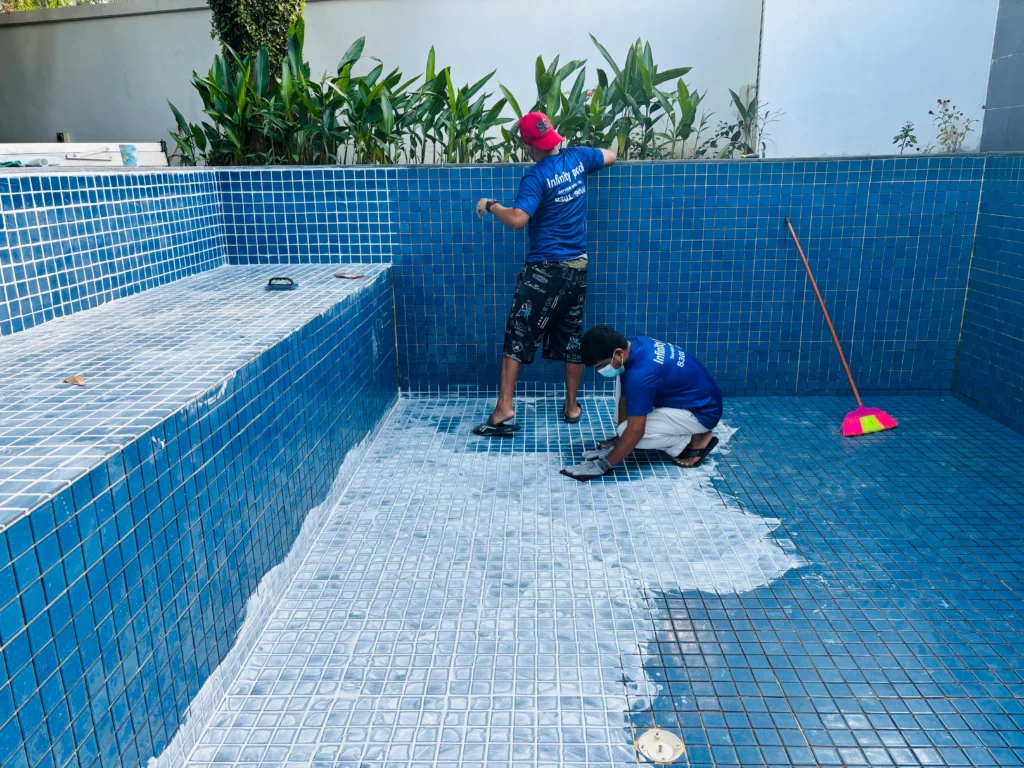
Pool retiling is the removal of all existing tiles across the pool surfaces and the installation of new tiles in their place. Because tiles must be removed to access the waterproofing membrane beneath, retiling almost always includes a waterproofing scope. The substrate is inspected, structural cracks are repaired, the waterproofing membrane is replaced, a flood test is conducted, and then new tiles are installed with fresh adhesive and grout. Retiling rebuilds the pool’s entire surface layer from the membrane up.
Retiling is not simply an aesthetic upgrade. It is a structural reset of the pool’s surface and waterproofing system.
The retiling process works like this:
- Pool is fully drained
- All existing tiles are removed by demolition or careful extraction
- Pool shell is inspected for structural cracks and substrate condition
- Structural repairs are carried out where needed
- New waterproofing membrane is applied to the prepared substrate
- Flood test: water is ponded on the waterproofed surface for 24 to 48 hours
- New tiles are selected and laid with pool-grade adhesive
- Fresh grout is applied to all joints
- Pool is refilled and water chemistry is rebalanced
The result is a pool that has been effectively rebuilt from the waterproofing layer outward. Done correctly, the results last 10 to 15 years under normal Singapore conditions. For context on what the full renovation scope costs, read our blog: How Much Does Pool Renovation Cost in Singapore?
Regrouting vs Retiling: Side-by-Side Comparison
| Factor | Regrouting | Retiling |
| Tiles removed | No | Yes (all tiles removed) |
| Waterproofing replaced | No | Yes (part of the scope) |
| Structural repairs included | No | Yes (assessed and repaired before tiling) |
| Pool drained | Yes (partial or full) | Yes (fully) |
| Typical duration | 2 to 5 days | 2 to 4 weeks |
| Cost range (SGD) | SGD 1,500 to SGD 6,000 | SGD 10,000 to SGD 30,000+ |
| Right when | Grout has failed, tiles are solid and bonded | Tiles are hollow, cracked, detaching, or waterproofing has failed |
| Fixes waterproofing failure | No | Yes |
| Lifespan of result | 5 to 8 years | 10 to 15 years |
| Pool appearance changes | Grout colour only | Full new tile surface |
The Key Question: What Has Actually Failed in Your Pool?
The right answer between regrouting and retiling depends entirely on what layer of the pool has failed. Grout is one layer. The tile adhesive is another. The waterproofing membrane is a third. Each failure requires a different response.
Grout failure only: The joints between tiles are deteriorating but the tiles themselves are still solidly bonded to the substrate. The waterproofing beneath is intact. Regrouting is the correct fix.
Tile adhesive failure: The tiles have separated from the adhesive bed and sound hollow when tapped. The adhesive failed because water reached it through deteriorated grout, or because the waterproofing beneath failed and water undermined the adhesive from below. This requires tile removal to investigate and address the cause. Regrouting will not solve it.
Waterproofing membrane failure: The membrane beneath the tiles has cracked, delaminated, or degraded. Water is moving through the substrate. Tiles are being pushed off from below by water pressure and adhesive weakening. Retiling with a new waterproofing scope is the only lasting fix.
The challenge is that you cannot see the tile adhesive layer or the waterproofing membrane without removing the tiles. This is why a thorough surface assessment before committing to any scope matters so much.
How to Assess Your Pool Before Deciding
The tap test: the fastest diagnostic tool available
Tap every tile firmly across all pool surfaces using a hard object, a coin or the handle of a screwdriver works well. Listen for the sound.
A properly bonded tile produces a solid, dense thud. The tile is fully in contact with its adhesive bed and there is no gap.
A debonded or hollow tile produces a higher-pitched, echoing sound. The tile has separated from the adhesive bed beneath it, meaning there is a void between the tile and the substrate.
What the results tell you:
- Hollow tiles in one small section: localised adhesive failure, possibly from a grout joint that failed in that area. Targeted repair plus regrouting may be sufficient.
- Hollow tiles scattered across multiple sections of the pool: the adhesive has failed broadly. This is almost always caused by waterproofing failure, and retiling is the appropriate scope.
- No hollow tiles anywhere: the tile bond is intact throughout. If grout joints are the only visible problem, regrouting is the right call.
Water loss check
Monitor your pool’s water level over 48 hours without using the pool. Mark the water level clearly on the pool wall. Check it at the same time two days later.
Normal evaporation in Singapore accounts for approximately 2 to 5 mm of water loss per day. In 48 hours, expect 4 to 10 mm of evaporation, roughly equivalent to 1 to 2 cm.
Loss greater than this that is not explained by a specific plumbing or fitting fault suggests the waterproofing membrane has failed. Water is escaping through the pool shell. Regrouting will not stop this. Retiling with new waterproofing is required.
Grout condition across the whole pool
Walk the perimeter of the pool and look closely at the grout joints. Are they crumbling uniformly across all surfaces? Or are they intact in most places with specific areas of deterioration?
Uniform deterioration across all joints points to normal age-related grout breakdown. Regrouting addresses this properly.
Specific areas of accelerated grout loss, particularly around fittings, at the waterline, or at step edges, can indicate localised water movement that is causing the grout to fail faster in those areas. This may point to a waterproofing issue in those specific locations rather than simple grout wear.
Tile condition and physical appearance
Look at the tile surfaces themselves. Standard wear, minor surface staining, and slightly faded colour are not reasons to retile. These are cosmetic issues that regrouting and cleaning can address.
Visible cracks across multiple tiles, chips along tile edges particularly on pool steps, widespread discolouration from mineral staining that cleaning cannot remove, or tiles that are visually uneven and lifting at their edges all point to retiling being the appropriate scope.
5 Situations Where Regrouting Is the Right Answer
1. All tiles pass the tap test
You have tapped the tiles across all surfaces and they all sound solid. No hollow tiles anywhere. The tile bond is intact. Only the grout joints have deteriorated. This is the textbook scenario for regrouting.
2. Pool is less than 10 years old with good waterproofing history
A relatively young pool where quality waterproofing was applied at the last renovation and the pool has been professionally maintained is a good candidate for regrouting. The membrane is likely still performing. The grout is the wear item that needs attention.
3. Grout is failing uniformly but the pool is not losing water
The 48-hour water level check shows normal evaporation only. The pool is holding water correctly. The grout joints are crumbling but the membrane beneath them is still intact. Regrouting seals the joints before water reaches the membrane and extends the life of the existing waterproofing.
4. You want to change the grout colour without changing the tiles
Regrouting with a different grout colour is a cost-effective way to change the look of the pool without the cost of full retiling. Many owners in Bukit Timah and Sentosa Cove have used this approach to refresh the appearance of their pools between major renovations.
5. Budget constraint and pool is structurally sound
If the pool genuinely does not need retiling but budget is a consideration, regrouting extends the service life of the existing tile surface by 5 to 8 years. This is a legitimate and cost-effective maintenance strategy when the structural assessment supports it.
5 Situations Where Retiling Is the Right Answer
1. Hollow tiles across multiple areas
Tap testing reveals hollow-sounding tiles in more than one section of the pool. The adhesive bond has failed broadly. The root cause is almost certainly waterproofing failure. Regrouting does not address this. Retiling with new waterproofing is required.
2. Pool is losing water beyond normal evaporation
The 48-hour check confirms water loss exceeding normal evaporation with no specific plumbing or fitting leak identified. The waterproofing membrane has failed. Water is escaping through the pool shell. No surface repair addresses this without tile removal and membrane replacement.
3. Tiles have been previously repaired or regrouted and the problem has returned
If the pool has had tile repairs or regrouting done and the same problem has returned within 2 to 3 years, the root cause was never fixed. The underlying waterproofing failure was masked temporarily. Retiling with waterproofing is now the necessary scope.
4. Pool is over 15 years old with no renovation history
A pool of this age with no documented renovation or waterproofing work is overdue for a full assessment. Even if visible tile damage is limited, the waterproofing membrane is likely past its reliable lifespan. Retiling with new waterproofing is a proactive and cost-effective decision at this stage.
5. Multiple tiles are cracked or physically damaged
Widespread cracked or chipped tiles cannot be fixed by regrouting. Damaged tiles need to be replaced. If the damage is widespread rather than isolated, a full retile is more cost-effective than sourcing and replacing individual tiles across many different locations.
The Hidden Cost of Choosing Regrouting When Retiling Is Needed
This is the scenario that costs Singapore pool owners the most money, and it happens regularly.
A pool owner notices tile issues and calls a contractor. The contractor recommends regrouting because it is cheaper and faster to sell. The regrouting is done. The pool looks good for 12 to 18 months. Then tiles start coming off again in the same areas, sometimes in new areas as well. Another contractor is called. This time the recommendation is retiling.
The pool owner has now paid:
- Round 1 regrouting: SGD 2,500 to SGD 4,000
- Round 2 retiling with waterproofing: SGD 12,000 to SGD 20,000
- Total: SGD 14,500 to SGD 24,000
If retiling with waterproofing had been done in the first instance: SGD 12,000 to SGD 20,000.
The regrouting did not save money. It delayed the inevitable and added cost on top.
The only protection against this is an honest, thorough assessment before any work is committed. A tap test across all surfaces, a water loss check, and a review of the pool’s maintenance and repair history together provide the information needed to make the right call.
Which Grout Type Is Best for Singapore Pools?
If regrouting is the right scope, the type of grout selected matters significantly for how long it lasts.
Cement-based waterproof grout The standard option and the most commonly used in Singapore pools. It performs adequately in pool conditions but is porous by nature and more susceptible to chemical staining and algae growth over time. Lifespan in Singapore pool conditions: 4 to 7 years.
Epoxy grout A two-component system that cures to a hard, chemically resistant, non-porous finish. Epoxy grout is significantly more durable than cement grout in pool environments. It resists chlorine and salt water, does not stain as readily, and does not support algae growth. Lifespan: 8 to 12 years in Singapore pool conditions. Cost is higher but the extended service life usually justifies it.
Which to choose: For pools where regrouting is appropriate, epoxy grout is the better long-term investment. The additional cost of epoxy over cement grout for a full residential pool regrouting is typically SGD 800 to SGD 1,500. Over an 8-year lifespan compared to 4 to 5 years for cement grout, this difference is recovered easily.
Cost Summary: Regrouting vs Retiling in Singapore
| Service | Typical Cost (SGD) | Lifespan |
| Full regrouting with cement grout | SGD 1,500 to SGD 4,000 | 4 to 7 years |
| Full regrouting with epoxy grout | SGD 2,500 to SGD 6,000 | 8 to 12 years |
| Partial retiling (one section) | SGD 3,000 to SGD 8,000 | 8 to 12 years |
| Full retiling with waterproofing (standard tiles) | SGD 12,000 to SGD 22,000 | 10 to 15 years |
| Full retiling with waterproofing (premium tiles) | SGD 18,000 to SGD 35,000 | 10 to 15 years |
For detailed waterproofing cost context, see our blog: How Much Does Pool Waterproofing Cost in Singapore?
Getting the Right Diagnosis Before Committing
The single most important step before deciding between regrouting and retiling is a professional inspection. Not a phone call. Not a quote based on photos. An on-site inspection that includes a tap test across all surfaces, a water loss assessment, and a review of the pool’s history.
At Infinity Pool Services, we carry out free site inspections for all residential and condo pool clients across Singapore. We give you an honest written assessment of what we find and what we recommend, before any costs are committed.
We are not going to recommend retiling when regrouting is sufficient. And we will be direct with you when regrouting is not going to hold.
We serve Bukit Timah, Sentosa Cove, Tanglin, Novena, Serangoon Gardens, Katong, and East Coast.
Book a Free Site Inspection: infinitypool.com.sg/contact or call +65 8301 9006
Related Reading and Services
- Swimming Pool Regrouting Singapore — Full regrouting service details and what to expect
- Swimming Pool Tile Repair & Replacement Singapore — Tile repair and retiling service details
- Pool Repair & Renovation Singapore — When retiling is part of a full renovation scope
- Pool Waterproofing Singapore — Why waterproofing is always part of a proper retiling job
- Pool Waterproofing vs Regrouting: What Is the Difference? — Understanding what layer of your pool has actually failed
- How Waterproofing Protects Your Pool from Leaks and Tile Damage — Why the waterproofing layer determines whether regrouting holds
- Pool Repair vs Pool Renovation: What’s the Difference? — Broader decision guide when multiple systems are failing
- Pool Re-Grouting vs Pool Renovation — A related comparison from the existing blog
- How Much Does Swimming Pool Re-Grouting Cost in Singapore? — Full regrouting cost breakdown
- How Much Does Pool Waterproofing Cost in Singapore? — Full waterproofing cost breakdown
- How to Know When Your Pool Needs Re-Grouting — Signs that regrouting is the right next step
- Swimming Pool Tile Repair & Replacement Expert Checklist — Pre-work checklist for tile repair and replacement
Frequently Asked Questions:
What is the difference between pool regrouting and pool retiling?
Regrouting replaces only the grout between existing tiles without removing the tiles themselves. Retiling removes all tiles and installs new ones, almost always alongside new waterproofing. Regrouting is a surface fix for joint deterioration. Retiling is a structural rebuild of the pool’s surface layer from the membrane upward.
How do I know if my pool needs regrouting or retiling?
Tap every tile across all pool surfaces. Solid-sounding tiles with only grout joint deterioration indicate regrouting is sufficient. Hollow-sounding tiles in multiple areas mean the adhesive bond has failed and retiling is needed. Also check your water level over 48 hours. Consistent loss beyond normal evaporation means the waterproofing has failed and retiling is required.
Can I regrout a pool that has hollow tiles?
Regrouting does not fix hollow tiles. Hollow tiles have separated from the adhesive beneath them. Regrouting seals the grout joints but does not rebond tiles to their substrate. Hollow tiles need to be removed and relaid, which requires investigation of why the bond failed in the first place.
How long does pool regrouting last in Singapore?
Cement-based grout in a Singapore pool lasts 4 to 7 years under normal conditions. Epoxy grout lasts 8 to 12 years. The lifespan depends on pool chemistry management, UV exposure, and whether the underlying waterproofing layer remains sound. Poor water chemistry accelerates grout degradation regardless of grout type.
Is retiling more expensive than regrouting?
Yes, significantly. Full regrouting with epoxy grout typically costs SGD 2,500 to SGD 6,000 for a residential pool. Full retiling with waterproofing and standard tiles typically costs SGD 12,000 to SGD 22,000. However, retiling when it is genuinely needed is cheaper over 5 years than repeated regrouting that does not solve the underlying problem.
Does retiling always include waterproofing?
In any properly executed retiling job, yes. The waterproofing membrane sits beneath the tiles. When tiles are removed for retiling, the membrane is exposed and must be inspected and replaced before new tiles go down. Any retiling quote that does not include waterproofing is either a very limited scope or it is skipping a critical step.
What type of grout is best for Singapore pool regrouting?
Epoxy grout is the better long-term choice for Singapore pool conditions. It is chemically resistant, non-porous, does not support algae growth, and lasts significantly longer than cement grout in a chlorinated or salt pool environment. The additional cost over cement grout is typically SGD 800 to SGD 1,500 for a full residential pool regrouting.
Can regrouting stop a pool from losing water?
Only if the water loss is specifically caused by failing grout joints. If the waterproofing membrane beneath the tiles has failed, regrouting will not stop water from escaping through the pool shell. A 48-hour water level test and professional inspection confirms which situation you are dealing with.
How long does pool retiling take in Singapore?
A full retiling project for a standard residential pool in Singapore typically takes 2 to 4 weeks from drainage to refill. This accounts for tile removal, structural repairs, waterproofing application and curing, flood testing, tile laying, and grouting. The waterproofing curing period alone takes 2 to 4 days before tiling can begin.
If my pool was regrouted recently and tiles are already failing again, what should I do?
Book a professional inspection that includes a full tap test and water loss assessment. If tiles are hollow across multiple areas or the pool is losing water beyond evaporation levels, the underlying waterproofing has failed. The regrouting masked the symptoms temporarily. Retiling with waterproofing is now the correct and only lasting solution.