
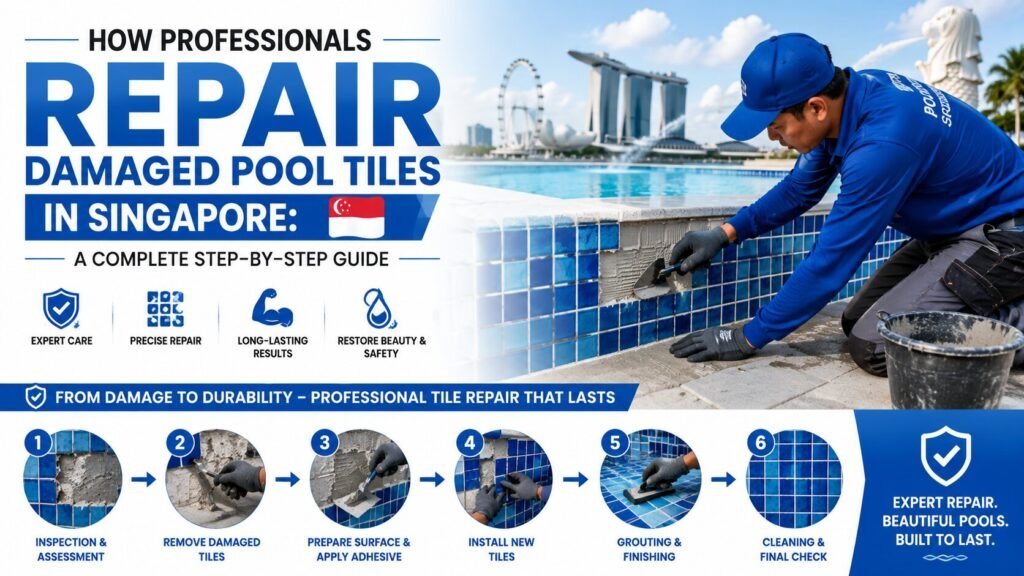
Professional pool tile repair in Singapore begins with draining the pool and identifying the root cause of the damage before any tile is touched. A proper repair assesses whether the failure is at the grout level, the adhesive level, or the waterproofing membrane beneath. The damaged tile is then removed, the substrate is prepared, any waterproofing issues are addressed, and the new tile is laid with the correct adhesive and grout. Skipping any of these steps produces a repair that fails within 12 to 24 months. Most pool owners assume tile repair is simple. Remove the bad tile, stick in a new one, fill the grout. Done.
That is not what a professional does. And that gap between what most people think happens and what actually needs to happen is exactly why so many pool tile repairs in Singapore fail and repeat. This guide walks through the professional process step by step, explains why each stage matters, and covers the common shortcuts that cause failures.
Why Professional Pool Tile Repair Is Not a DIY Job
Can I repair pool tiles myself in Singapore?
While replacing a single tile is technically possible as a DIY task, professional pool tile repair goes far beyond applying a new tile. Professionals assess the root cause of the failure, test the surrounding tile bond, inspect the waterproofing beneath, source matching tiles, and use pool-grade adhesives that bond correctly in wet-prone environments. Skipping these steps produces a repair that looks fine briefly but fails quickly.
The reason professional repair produces lasting results while DIY attempts often fail comes down to three things: diagnosis, materials, and substrate preparation. A non-professional typically addresses what is visible. A tile came off. Put a new one back. But the reason the tile came off in the first place is rarely visible at the surface. It is almost always happening beneath the tile, at the adhesive layer or at the waterproofing membrane below that. Without diagnosing and addressing the underlying cause, the new tile will fail on the same timeline as the old one.
Step 1: Initial Assessment and Root Cause Diagnosis
What does a professional check before repairing pool tiles?
Before removing a single tile, a professional inspects the entire pool surface to understand the extent of the damage and identify the root cause. This involves tapping all tiles to check the bond, assessing grout joint condition across all surfaces, reviewing the water loss history, and looking for signs of waterproofing failure including efflorescence, damp patches near the pool, and rust staining on pool walls.
This assessment step is what separates a professional repair from a cosmetic patch job. The key diagnostic tool is the tap test. A technician taps every tile systematically using a hard implement, typically a coin or the handle of a screwdriver. The sound each tile produces tells the story.
Solid, flat thud: The tile is fully bonded. Adhesive is intact. The tile is not the problem.
High-pitched hollow echo: The tile has separated from the adhesive bed. There is a void between the tile and the substrate. This tile has failed or is about to fail.
Mapping the distribution of hollow tiles across the pool surface is critical information:
- Isolated hollow tile in one location: localised failure, possibly from a grout joint that let water in at that specific point. Targeted repair may be sufficient.
- Hollow tiles clustered around a fitting, step edge, or waterline: water is infiltrating at that specific point, likely through a failed fitting seal or a waterproofing breach near that area.
- Hollow tiles spread across multiple walls and floor sections: the waterproofing membrane has failed broadly. No targeted repair will hold long. Retiling with waterproofing is the appropriate scope.
Only after this assessment is complete does the repair scope get defined.
Step 2: Pool Draining
Does the pool need to be drained for tile repair?
For most tile repair work, the pool needs to be at least partially drained to expose the affected area. Repairs on the pool floor require full drainage. Repairs limited to tiles above the waterline can sometimes be done with only a partial drain. The pool cannot be refilled until all adhesive and grout have fully cured, which typically takes 24 to 72 hours depending on the products used.
Full pool draining is required when:
- The damage is on the pool floor or lower walls
- Waterproofing work is part of the repair scope
- Multiple sections of the pool are being addressed in a single visit
The drain itself typically takes 4 to 8 hours for a standard residential pool. This time is used productively by the repair team for setup, tool preparation, and final assessment while the water level drops.
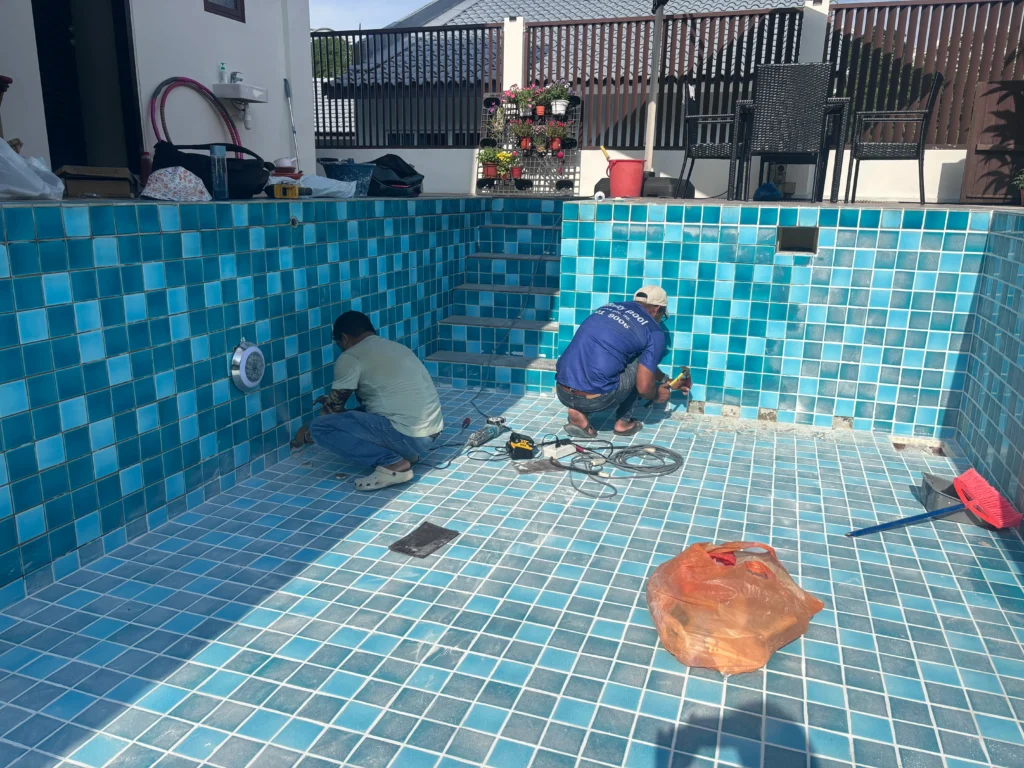
Step 3: Removing the Damaged Tiles
How do professionals remove pool tiles without damaging surrounding tiles?
Professionals use angle grinders or oscillating multi-tools to cut through the grout joints surrounding the damaged tile before removal. This isolates the tile mechanically from its neighbours. A chisel and hammer are then used to work under the tile and break the adhesive bond from the substrate, working from the centre of the tile outward to avoid cracking adjacent tiles. Patience at this stage protects surrounding tiles that are still intact. There are two approaches to tile removal depending on the scope:
Careful extraction (for targeted repairs) When only a small number of tiles need to be replaced and the surrounding tiles are in good condition, each tile is removed methodically to avoid damaging its neighbours. The grout joint is cut first. The tile is then lifted carefully. This takes more time but preserves surrounding tiles.
Demolition removal (for full retiling) When all tiles across the pool are being removed as part of a full renovation, speed matters more than preservation. Tiles are removed by demolition using electric chisels and demolition hammers. This is faster and the broken tiles go to waste, which is acceptable because new tiles are going in regardless.
What happens if a surrounding tile cracks during removal?
Even with careful technique, adjacent tiles sometimes crack during removal, particularly in older pools where the grout joints are rigid and the tiles have become fused to each other through years of calcium build-up in the joints. A professional brings spare matching tiles to every repair job to replace any collateral damage during removal. If matching tiles are not available because the original tile is discontinued, the contractor should discuss options before starting work, not after.
Step 4: Substrate Inspection and Preparation
What does the substrate preparation involve after tile removal?
After tiles are removed, the substrate (the surface beneath where the tiles were bonded) is inspected for structural cracks, moisture presence, adhesive residue, and condition of the waterproofing membrane. All old adhesive is ground off the substrate. Structural cracks are repaired with crack injection or patching compound. The surface is cleaned and allowed to dry completely before any new waterproofing or adhesive is applied. Proper substrate preparation is the most critical determinant of how long the repair lasts.
This step is where most failed tile repairs originate. When a tile is removed and the substrate is not properly prepared before a new tile is installed, the new adhesive is bonding to old adhesive residue, dust, or a compromised substrate. The bond is weak from day one.
Substrate preparation includes:
Grinding off old adhesive: All residue from the previous adhesive bed must be removed. An angle grinder with a diamond cup wheel is used to grind the substrate back to a clean, rough surface.
Crack identification: With tiles removed, any cracks in the pool shell become visible. Fine hairline cracks are treated with epoxy injection. Wider structural cracks are chased out, reinforced, and filled with repair mortar before any waterproofing is applied.
Moisture assessment: The substrate must be dry before adhesive is applied. In Singapore’s humidity, this sometimes requires additional drying time or the use of a damp-tolerant primer to ensure adhesion to slightly moist concrete.
Surface profile check: The substrate must be flat and even for the new tile to sit correctly. High spots are ground down. Low spots are built up with patching compound. An uneven substrate causes the new tile to sit proud or recessed relative to surrounding tiles.
Step 5: Waterproofing Assessment and Repair
Does waterproofing need to be checked during pool tile repair?
Yes, always. With tiles removed, the waterproofing membrane beneath is exposed and must be inspected. If the membrane is intact, the repair proceeds to tiling. If the membrane shows signs of failure including delamination, cracking, pinholes, or areas of separation, it must be repaired or replaced before the new tile is laid. Tiling over a failed waterproofing membrane guarantees the same tile failure will repeat on the same timeline.
In targeted tile repair, the waterproofing membrane is assessed in the area where tiles were removed. If it is intact, no waterproofing work is needed. If it shows localised failure at the repaired area, localised waterproofing repair is carried out before tiling. The process for localised waterproofing repair:
- The failing area of membrane is removed or ground back
- The substrate is prepared and primed
- New waterproofing membrane is applied to the affected area with adequate overlap onto the surrounding sound membrane
- The repair is allowed to cure fully
- A water test is conducted on the repaired area before tiling
If the membrane has failed broadly beyond the tile repair area, the conversation needs to shift from targeted repair to full retiling. A responsible contractor will identify this during the assessment and discuss it before proceeding with work that will not hold. For full details on waterproofing systems and the complete waterproofing process, see our Pool Waterproofing Singapore Service Page.
Step 6: Tile Matching and Sourcing
How do professionals match replacement tiles to existing pool tiles?
Matching replacement tiles to existing pool tiles requires knowing the tile brand, series, size, and colour code of the original tile. If the pool is relatively recent, the tile may still be available through suppliers. If the pool is older, the exact tile may be discontinued. In this case, the closest available match is sourced. For isolated repairs in visible locations, the tile match quality is critical. For repairs in less visible areas, a close match is usually acceptable.
This is a practical challenge that homeowners rarely anticipate. A pool tiled 10 or 12 years ago often uses tiles that are no longer manufactured. The batch colour of ceramic and porcelain tiles also varies between production runs, meaning even the “same” tile from the same manufacturer may show slight colour variation compared to the original.
What professionals do in this situation:
Check for leftover tiles first. Many pool builders leave a small stock of spare tiles when a pool is first built. Check in the pool equipment storage area or ask if any were stored at the property.
Source from tile suppliers. Singapore has multiple specialist pool tile suppliers who may carry the same tile or a discontinued tile in remaining stock. An experienced contractor knows where to look.
Discuss options with the owner before proceeding. If a match cannot be found, the owner needs to decide between using the closest available match, replacing a larger section so the new tile area reads as intentional rather than patched, or deferring the repair until a match is found. Applying a visually mismatched tile without discussing this with the owner first is not acceptable professional practice.
Step 7: Adhesive Selection and Tile Installation
What adhesive do professionals use for pool tile repair?
Pool tile repair requires a pool-grade, flexible tile adhesive rated for full water immersion. Standard construction tile adhesives are not suitable for below-waterline pool applications. Most professionals in Singapore use a C2TE or higher rated flexible adhesive conforming to EN 12004 standards, or an epoxy tile adhesive for repairs in high-stress areas such as pool steps and waterline tiles. The adhesive must bond correctly to the prepared substrate and to the back of the pool tile without voids.
The tile installation process for a professional repair:
- Back-buttering the tile Adhesive is applied to both the prepared substrate and the back of the tile. This double application, known as back-buttering, eliminates voids between the tile and the substrate that would otherwise trap water and weaken the bond over time.
- Notched trowel application to substrate A notched trowel is used to apply adhesive to the substrate in a uniform combed pattern. The notch depth is selected based on tile thickness to ensure full coverage when the tile is pressed into place.
- Tile placement and alignment The tile is pressed firmly into the adhesive with a slight twisting motion to collapse the adhesive ridges and achieve full contact coverage. Spacers are used to maintain consistent joint width matching the surrounding tiles.
- Checking alignment A straight edge is used to check that the new tile sits flush with surrounding tiles. Any high or low spots are corrected before the adhesive begins to set.
- Adhesive cure time The adhesive is allowed to cure for the time specified by the manufacturer before grouting begins. In Singapore’s humidity and temperature, most pool adhesives reach working strength within 24 hours. Full cure typically takes 48 to 72 hours.
Step 8: Grouting
What grout do professionals use for pool tile repair in Singapore?
Professional pool tile repair uses pool-grade waterproof grout rated for full water immersion. Epoxy grout is the preferred choice for Singapore pool conditions because it is chemically resistant, non-porous, and significantly more durable than cement grout in a chlorinated or salt pool environment. Cement grout is acceptable for above-waterline repairs or when budget is a constraint, but epoxy grout at the waterline and below produces a better long-term result.
The grouting process:
- Joint cleaning Before grouting, all tile joints are cleaned of adhesive residue using a grout saw or pointed tool. The joints must be clean and free of debris for the grout to bond properly.
- Grout mixing Epoxy grout is a two-component system mixed in specific ratios. Incorrect mixing ratios affect the cure chemistry and produce soft, weak grout. Professionals mix small batches to maintain consistency and work time.
- Grout application Grout is packed firmly into all joints using a grout float, working at a diagonal angle to the tile surface to ensure complete joint filling without air pockets.
- Excess grout removal Excess grout is removed from tile faces using a damp sponge before it begins to harden. Epoxy grout hardens quickly in Singapore’s heat, so this step requires attention to timing.
- Joint finishing Joint faces are tooled to a slightly concave finish, which sheds water more effectively than a flush or convex profile.
- Final clean Tile faces are cleaned thoroughly to remove grout haze before it sets permanently on the tile surface.
Step 9: Curing, Water Test, and Refill
How long after tile repair can the pool be refilled?
A pool should not be refilled until both the tile adhesive and grout have fully cured. With most pool-grade adhesives and epoxy grouts used in Singapore conditions, this typically takes 48 to 72 hours after grouting is complete. Refilling too early softens the uncured adhesive, weakens the tile bond, and can cause grout to wash out of the joints. Rushing the refill is one of the most common causes of premature repair failure.
After the curing period, a water level observation period is recommended. After refilling, the pool level is marked and checked at 24 and 48 hours to confirm the repaired area is holding water correctly. For repairs where waterproofing work was included in the scope, a flood test on the repaired waterproofing area is conducted before tiling. This is a non-negotiable step for any professional waterproofing repair.
Common Shortcuts That Cause Pool Tile Repairs to Fail
These are the steps that contractors skip when they want to reduce time and cost, and the direct consequences of each shortcut.
Skipping the tap test assessment Result: Hidden hollow tiles around the repair area are missed. Those tiles fail within months of the repair being done. The client calls back and the contractor has no explanation.
Not grinding out old adhesive from the substrate Result: New adhesive bonds to old adhesive residue rather than to the concrete. Bond strength is significantly reduced. The new tile detaches faster than the original.
Not checking or repairing the waterproofing membrane Result: The repair looks correct initially. Within 12 to 24 months, water has moved behind the new tile through the unaddressed waterproofing failure. The tile detaches again.
Using standard construction adhesive instead of pool-grade adhesive Result: The adhesive softens and loses strength in full water immersion conditions. The tile bond degrades progressively. The tile detaches within 1 to 3 years.
Grouting before adhesive has fully cured Result: Pressure from grouting moves the tile slightly in uncured adhesive. The tile sits in a slightly wrong position. The adhesive bond is disrupted and weakened.
Refilling the pool before adhesive and grout have cured Result: Uncured adhesive and grout are softened by water. Grout washes out of joints. Tile bond is compromised. The repair fails quickly.
When Tile Repair Is Not Enough: Knowing When to Recommend Retiling
A professional contractor will tell you when targeted repair is not the right answer. These situations call for a full retiling scope rather than targeted repair:
- Hollow tiles are widespread across multiple sections of the pool
- The pool is consistently losing water beyond normal evaporation
- The same tiles or nearby tiles have already been repaired and failed again
- The waterproofing membrane beneath the tiles has failed across broad areas
- The pool is over 15 years old with no documented renovation or waterproofing history
Recommending continued targeted repair on a pool that genuinely needs retiling is not honest practice. The client pays repeatedly for temporary fixes while the underlying problem gets worse. For a clear guide on when repair crosses over into renovation territory, Read our blog: Pool Repair vs Pool Renovation: What’s the Difference?
Getting a Professional Assessment
If your pool has tiles coming off, hollow-sounding sections, or persistent water loss, the right first step is a professional inspection rather than an immediate repair. At Infinity Pool Services, we carry out free site inspections across Singapore. We tap test all surfaces, assess the waterproofing condition, review the pool’s history, and give you an honest written recommendation before any work is committed. We serve landed homeowners, condo management teams, and penthouse clients across Bukit Timah, Sentosa Cove, Tanglin, Novena, Serangoon Gardens, and Katong East Coast.
Book a Free Site Inspection: infinitypool.com.sg/contact or call +65 8301 9006
Related Reading and Services
- Swimming Pool Tile Repair & Replacement Singapore — Full tile repair and replacement service details
- Pool Repair & Renovation Singapore — When tile damage requires a broader renovation scope
- Pool Waterproofing Singapore — Waterproofing repair that is often needed alongside tile work
- Pool Leak Detection & Repair Singapore — When tile damage is accompanied by consistent water loss
- Swimming Pool Regrouting Singapore — When the grout rather than the tiles is the primary issue
- Regrouting vs Retiling: Which One Does Your Pool Really Need? — Decision guide before committing to either scope
- Pool Waterproofing vs Regrouting: What Is the Difference? — Understanding which layer of the pool has actually failed
- How Waterproofing Protects Your Pool from Leaks and Tile Damage — The mechanism behind tile failure explained in detail
- Swimming Pool Tile Repair & Replacement Expert Checklist — Pre-work checklist for tile repair and replacement
- Pool Repair vs Pool Renovation: What’s the Difference? — Broader decision guide when multiple systems are failing
- How Much Does Pool Renovation Cost in Singapore? — Full renovation cost guide if repair is not sufficient
Frequently Asked Questions
How do professionals repair cracked or damaged pool tiles in Singapore?
Professionals begin by assessing the root cause through a tap test across all surfaces and inspection of the waterproofing beneath. The damaged tile is removed carefully, old adhesive is ground off the substrate, structural and waterproofing issues are addressed, and the new tile is laid with pool-grade flexible adhesive and grouted with waterproof epoxy grout after a full adhesive cure period.
How long does pool tile repair take in Singapore?
A small targeted repair of 5 to 10 tiles typically takes 1 to 2 days including pool drainage, tile removal, substrate preparation, tile installation, and grouting. The adhesive and grout then need 48 to 72 hours to cure before the pool can be refilled. Total pool downtime for a minor repair is typically 3 to 5 days.
How much does pool tile repair cost in Singapore?
Minor tile repair for a small number of isolated tiles costs SGD 300 to SGD 1,500 depending on the number of tiles, access requirements, and whether any waterproofing work is needed. Section repairs covering 10 to 30 tiles typically cost SGD 1,500 to SGD 4,000. Full retiling with waterproofing for a residential pool costs SGD 12,000 to SGD 22,000.
Why do pool tiles keep coming off after repair?
The most common reason is that the root cause was not addressed. If the waterproofing membrane beneath the tiles has failed, replacing the surface tile without addressing the membrane means water continues to undermine the new adhesive from below. The new tile detaches on the same timeline as the original. Proper assessment and waterproofing repair before tiling prevents this.
What adhesive is used for pool tile repair?
Pool tile repair requires a pool-grade flexible tile adhesive rated for full water immersion. Most professional contractors in Singapore use C2TE rated flexible adhesive or epoxy tile adhesive for high-stress areas such as pool steps and the waterline. Standard construction tile adhesives are not suitable for below-waterline pool applications as they soften with prolonged water exposure.
Can pool tiles be repaired without draining the pool?
Limited repairs on tiles above the waterline may be possible with a partial drain. Any repair involving tiles at or below the waterline requires full or partial drainage to expose the affected area properly. Waterproofing repairs always require a fully dry substrate, which means full drainage.
How do professionals match replacement tiles to existing pool tiles?
Professionals first check for any spare tiles stored at the property from the original installation. If none are available, the tile brand, series, size, and colour code are identified and sourced from Singapore pool tile suppliers. If the original tile is discontinued, the closest available match is found and the options are discussed with the owner before any tile is installed.
Is epoxy grout better than cement grout for pool tile repair?
Yes, in pool conditions. Epoxy grout is chemically resistant, non-porous, and significantly more durable than cement grout in chlorinated or salt water environments. It does not support algae growth and does not stain as readily as cement grout. The cost is higher but the extended lifespan of 8 to 12 years versus 4 to 7 years for cement grout justifies it in most pool repair situations.
What causes pool tiles to crack or detach in Singapore?
The main causes are waterproofing membrane failure allowing water to undermine the adhesive from below, grout joint failure allowing water ingress behind the tile, thermal cycling causing expansion and contraction stress in Singapore’s daily temperature range, ground movement in older properties, poor original installation using incorrect adhesive or inadequate surface preparation, and chemical imbalance in the pool water degrading the grout and adhesive over time.
When should I choose full retiling instead of tile repair?
Full retiling is the right choice when hollow tiles are widespread across multiple sections of the pool, when the pool is consistently losing water beyond normal evaporation, when the same repair area has failed previously, or when the pool is over 15 years old without a renovation history. A professional inspection with a tap test and water loss assessment confirms which scope is appropriate.