
Pool Waterproofing vs Regrouting: What Is the Difference and Which One Does Your Pool Need?
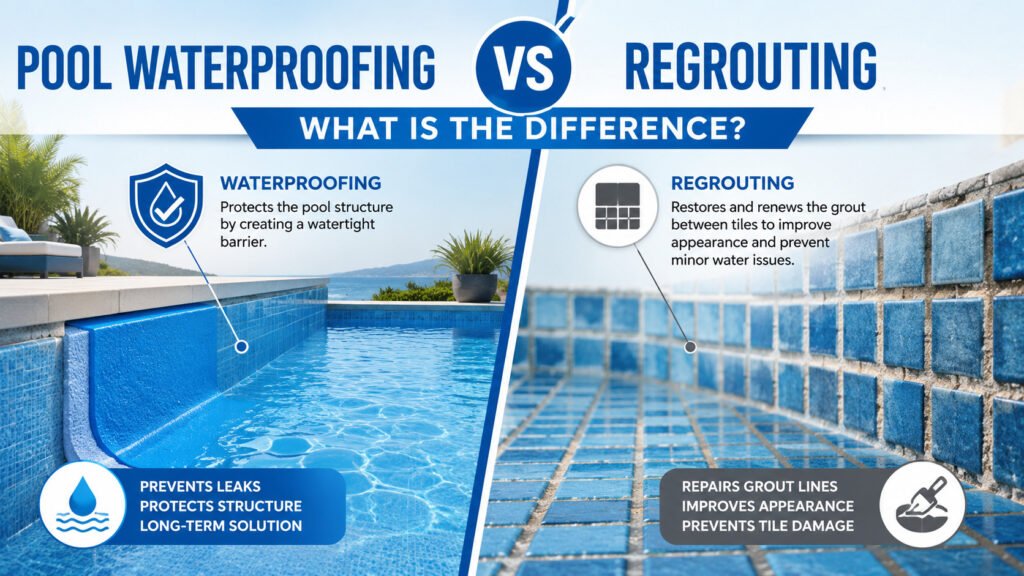
Pool regrouting replaces the grout between tiles to stop surface water from getting behind them. Pool waterproofing applies a protective membrane to the pool shell beneath the tiles to stop water from passing through the structure itself. Regrouting works at the surface level. Waterproofing works at the structural level. They address different problems, and confusing the two is an expensive mistake. Most pool owners in Singapore have heard both terms. Very few know exactly what separates them, or why choosing the wrong one means spending money on a fix that does not actually solve the problem. This guide clears that up completely.
What is Pool Regrouting?
What does pool regrouting involve?
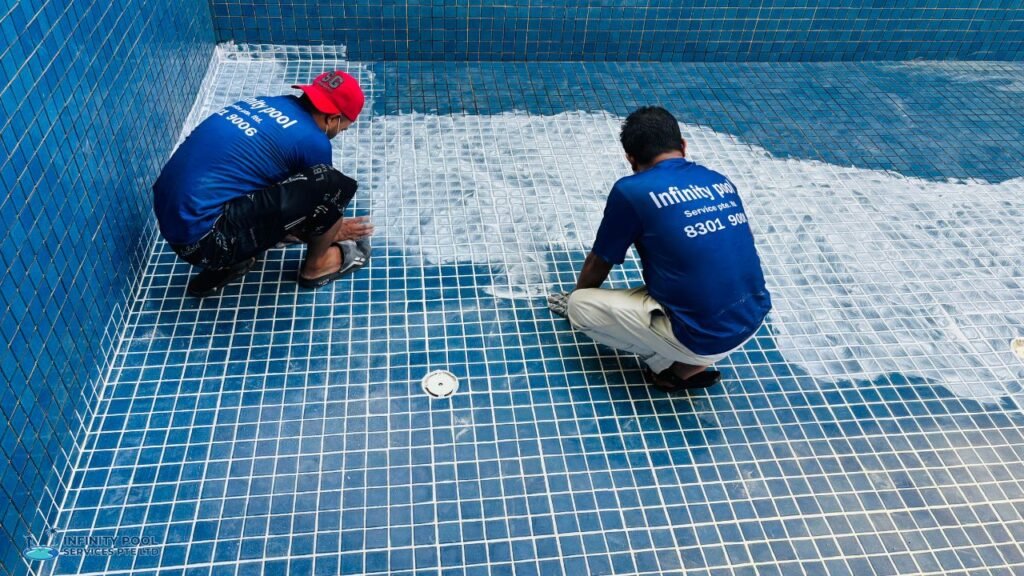
Pool regrouting is the process of removing deteriorated grout from the joints between pool tiles and replacing it with fresh, waterproof grout. The tiles stay in place. The pool shell and waterproofing layer beneath are not touched. It is a surface-level repair that restores the seal between tiles and stops water from getting behind them through the joints.
Grout in a swimming pool degrades over time. Pool chemicals, UV exposure, and constant water contact break it down. When grout cracks, erodes, or starts to fall out of the joints, water finds a path behind the tiles. This weakens the tile adhesive bond, allows moisture to reach the waterproofing layer beneath, and left long enough, causes tiles to detach. Regrouting stops this process at the grout level before the damage reaches the layer underneath. A full regrouting job on a residential pool covers all tile joints across the walls, floor, and steps. The process involves:
- Grinding or raking out all deteriorated grout from every joint
- Cleaning the joints thoroughly to remove residue and algae
- Applying fresh pool-grade epoxy or waterproof grout to all joints
- Allowing the new grout to cure before the pool is refilled
For full details on the service and what to expect, See Our Swimming Pool Regrouting page.
What is Pool Waterproofing?
What does pool waterproofing involve?
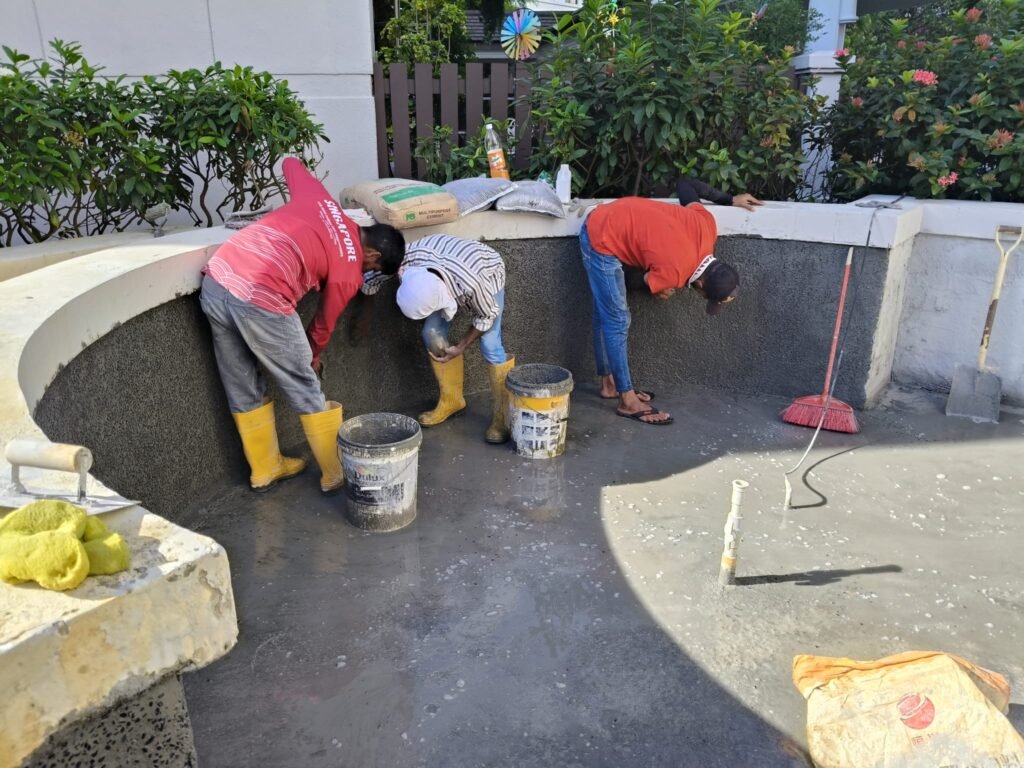
Pool waterproofing is the application of a protective membrane or coating directly to the pool shell, beneath the tiles. Its purpose is to prevent water from passing through the concrete or screed structure of the pool and escaping into the surrounding ground or building. It is structural-level protection, not surface-level. When waterproofing fails, no amount of regrouting will stop the pool from losing water.
A pool waterproofing job requires the pool to be fully drained and all tiles to be removed. The substrate is then cleaned, dried, and structurally repaired where needed. The waterproofing membrane is applied in the correct number of coats, allowed to cure fully, and flood-tested for 24 to 48 hours before any new tiles are laid.
Common waterproofing systems used in Singapore pool work include:
- Liquid applied membrane (LAM): Flexible, brush-applied system suited to pools of all shapes
- Sheet membrane: Pre-formed waterproof sheet bonded to the substrate, used particularly for rooftop and penthouse pools
- Cementitious waterproofing: Cement-based compound used where budgets are tighter and pool structures are relatively sound
- Epoxy coating: Hard, chemical-resistant system used in full refurbishment projects
For a full breakdown of each system and when each is appropriate, visit our Pool Waterproofing Singapore service page.
Pool Waterproofing vs Regrouting: Side-by-Side Comparison
| Factor | Pool Regrouting | Pool Waterproofing |
| What it addresses | Deteriorated grout joints between tiles | Failed waterproofing membrane beneath tiles |
| Where it works | Surface level (between tiles) | Structural level (beneath tiles) |
| Tiles removed | No | Yes (all tiles removed) |
| Pool drained | Yes (partial or full) | Yes (fully drained) |
| Waterproofing membrane replaced | No | Yes |
| Typical duration | 2 to 5 days | 7 to 14 days |
| Cost range (SGD) | SGD 1,500 to SGD 6,000 | SGD 3,000 to SGD 12,000 |
| Right when | Grout is failing but tiles are bonded solidly | Water loss ongoing, tiles detaching, membrane has failed |
| Solves water loss through structure | No | Yes |
| Lifespan of result | 5 to 8 years with proper maintenance | 8 to 15 years with proper maintenance |
The Critical Difference: Where the Water Problem Actually Is
This is what most pool owners miss, and it is the reason the wrong choice gets made so often.
Grout sits between the tiles at the surface of the pool. The waterproofing membrane sits beneath the tiles, bonded directly to the pool shell. They are different layers serving different functions.
When grout fails, water can get between the tiles and start weakening the adhesive. If caught early, regrouting removes that entry point before the water reaches the membrane.
When the waterproofing membrane fails, water is already moving through the pool shell. Regrouting the tile joints does nothing to stop this. The membrane is under the tiles. Grout is between the tiles. You cannot fix a membrane problem by working on the grout.
Think of it this way. The membrane is the dam wall. The grout is the seal on the surface of the dam. If the seal cracks, you reseal it. If the dam wall cracks, you repair the dam wall. Resealing the surface when the wall itself is broken does not hold the water back.
How to Tell Which Problem Your Pool Has
Signs your pool needs regrouting, not waterproofing:
- Grout lines are visibly cracked, discoloured, or crumbling in sections
- Tiles are still solidly bonded when tapped (producing a flat, dense sound)
- No ongoing water level drop beyond normal evaporation
- Pool is less than 8 to 10 years old with no history of waterproofing failure
- The pool had good-quality waterproofing applied at its last renovation
In this situation, regrouting restores the seal at the joint level and protects the waterproofing membrane beneath. It stops the problem from progressing further.
Signs your pool needs waterproofing, not just regrouting
- Tiles are hollow when tapped, meaning they have separated from the adhesive beneath
- Water level drops consistently beyond what evaporation explains
- Tiles are detaching without obvious impact or physical cause
- Visible efflorescence (white chalky deposits) on pool walls or floor, indicating moisture moving through the concrete
- Pool is more than 10 to 12 years old with no waterproofing history
- Regrouting was done previously but the problem returned within 2 to 3 years
- Damp soil or wet concrete around the pool edge with no visible surface leak
If the membrane has failed, regrouting is a temporary cosmetic fix. Water will continue passing through the structure regardless of how good the new grout is. The only lasting solution is waterproofing, which requires tile removal and membrane replacement.
The hollow tile test
Tap each tile firmly with a hard object across all pool surfaces. A properly bonded tile produces a solid, dense thud. A tile that has separated from its adhesive bed produces a higher-pitched, hollow echo.
If you find hollow tiles in isolated patches: the adhesive has failed locally, possibly due to grout failure letting water in over time. Targeted tile repair combined with regrouting may be sufficient.
If hollow tiles are widespread across the floor and walls: the adhesive bond has failed broadly, almost always because the waterproofing beneath has been failing and water has been undermining the adhesive from below. Waterproofing is required.
What Happens If You Regrout a Pool That Needs Waterproofing?
This is the expensive mistake, and it happens regularly in Singapore. The sequence goes like this:
- Pool owner notices grout deterioration and some tile movement
- Contractor recommends regrouting, which is cheaper and easier to sell
- Fresh grout is applied to all joints
- Pool looks good for 6 to 12 months
- Tiles start moving again, new grout starts cracking in the same areas
- Pool owner calls a contractor again
- Second regrouting, or this time the tiles come off entirely
- Full tile removal reveals the waterproofing membrane underneath has failed broadly
- Full waterproofing job required, plus full retiling on top of what was already spent on regrouting
The pool owner has now paid for two regrouting jobs and a full waterproofing and retiling project. The total is significantly more than if waterproofing had been identified as the actual problem in the first place.
A thorough inspection before any work is approved prevents this. If a contractor recommends regrouting without tapping the tiles across the whole pool and checking the water loss rate, push back and ask for that assessment to be done first.
Can Regrouting and Waterproofing Be Done Together?
Yes, and in some situations this is exactly the right approach. When a pool renovation is underway and all tiles are being removed for waterproofing, fresh grout is applied as a standard part of the retiling scope. The two are sequential, not competing. Waterproofing comes first, tiling second, grouting as part of tiling.
The question of “regrouting vs waterproofing” only arises when the pool is not being fully renovated. If you are doing targeted work rather than a full renovation, the distinction matters because the two scopes involve very different access requirements, timelines, and costs. If your pool needs a full renovation, both waterproofing and fresh grouting are included by default. For more on what full renovation involves and costs, read our blog: How Much Does Pool Renovation Cost in Singapore?
Cost Comparison: Regrouting vs Waterproofing in Singapore
How much does pool regrouting cost in Singapore?
Pool regrouting for a standard residential pool in Singapore typically costs between SGD 1,500 and SGD 6,000 depending on pool size, grout type selected, and the condition of the existing joints. Epoxy grout costs more than standard waterproof grout but lasts significantly longer in pool conditions.
For a detailed cost breakdown, see our blog: How Much Does Swimming Pool Re-Grouting Cost in Singapore?
How much does pool waterproofing cost in Singapore?
Pool waterproofing as a standalone scope (including tile removal, substrate preparation, membrane application, flood testing, and retiling) typically costs SGD 3,000 to SGD 12,000 for a residential pool. When waterproofing is part of a full renovation with new tiles, the total project cost ranges from SGD 12,000 to SGD 22,000 for a standard landed home pool.
For the full cost breakdown on waterproofing, see our Pool Waterproofing Singapore service page.
Why Getting the Diagnosis Right Saves You Money
The right diagnosis determines everything. A pool that genuinely needs regrouting and receives regrouting has the problem solved efficiently. A pool that needs waterproofing and receives regrouting has money spent with no lasting result.
A proper assessment takes 30 to 60 minutes on a residential pool and involves:
- Visual inspection of grout condition across all surfaces
- Tap test on all tiled surfaces to identify hollow or debonded areas
- Water level check and loss rate assessment
- Review of the pool’s maintenance and repair history
This assessment is the foundation of an accurate recommendation. Contractors who skip this and go straight to recommending regrouting are not necessarily cutting corners deliberately; some just do not ask the right questions first.
At Infinity Pool Services, we carry out this assessment as part of every free site inspection before recommending any scope of work. We do not recommend regrouting when waterproofing is needed, because that is your money and it should go toward solving the actual problem. Book your free inspection at infinitypool.com.sg/contact or call +65 8301 9006.
Related Services and Further Reading
- Swimming Pool Regrouting Singapore — Full details on the regrouting service and process
- Pool Waterproofing Singapore — Everything about waterproofing systems, process, and what to expect
- Pool Repair & Renovation Singapore — When the scope goes beyond regrouting or standalone waterproofing
- Pool Leak Detection & Repair Singapore — To confirm whether water loss is from the membrane or elsewhere
- Swimming Pool Tile Repair & Replacement — When hollow tiles need to be addressed alongside grout or waterproofing work
- Pool Repair vs Pool Renovation: What’s the Difference? — Broader decision guide on repair vs renovation scope
- Pool Re-Grouting vs Pool Renovation — When regrouting is enough vs when full renovation is required
- How Much Does Pool Renovation Cost in Singapore? — Full cost guide if renovation is the right answer
- How to Know When Your Pool Needs Re-Grouting — Identifying the right time to regrout
Frequently Asked Questions: Pool Waterproofing vs Regrouting
What is the difference between pool waterproofing and pool regrouting?
Regrouting replaces the grout between tiles at the surface level to stop water entering behind the tiles through the joints. Waterproofing replaces the protective membrane beneath the tiles at the structural level to stop water passing through the pool shell. Regrouting is a surface fix. Waterproofing is a structural fix.
Can regrouting stop a pool from losing water?
Only if the water loss is caused by grout joint failure specifically. If the waterproofing membrane beneath the tiles has failed, regrouting will not stop water from escaping through the pool shell. The two problems require different solutions at different layers of the pool structure.
How do I know if my pool needs regrouting or waterproofing?
The clearest indicators are the tile bond condition and water loss rate. Tap tiles across all surfaces. If tiles sound hollow in multiple areas, the adhesive has failed, almost always due to underlying waterproofing failure. If tiles are solid and only the grout joints are deteriorating, regrouting is the right scope.
Does regrouting fix waterproofing failure?
No. Regrouting works at the tile joint level. Waterproofing failure occurs beneath the tiles at the membrane level. Applying new grout over tile joints does not address or repair a failed membrane beneath. The two are separate layers requiring separate remediation.
Is pool regrouting cheaper than waterproofing?
Yes. Pool regrouting typically costs SGD 1,500 to SGD 6,000 for a residential pool. Waterproofing as a standalone or renovation scope costs SGD 3,000 to SGD 12,000 and above. However, spending SGD 3,000 on regrouting when waterproofing is actually needed costs more overall than addressing the right problem from the start.
Do tiles need to be removed for pool regrouting?
No. Regrouting removes and replaces grout in the joints between existing tiles. The tiles stay in place. Waterproofing, by contrast, requires all tiles to be removed to access and treat the pool shell beneath.
How long does pool regrouting last compared to waterproofing?
Quality pool regrouting using epoxy grout lasts 5 to 8 years under normal usage and maintenance conditions in Singapore. A properly applied waterproofing membrane lasts 8 to 15 years. Both lifespans depend on water chemistry management and regular professional maintenance.
Can I regrout and waterproof a pool at the same time?
Not simultaneously, because they are sequential steps. Waterproofing is applied to the pool shell first. Tiling comes second. Grouting is part of the tiling step. So in a full renovation, all three happen in the correct order. The “regrouting vs waterproofing” question only arises when choosing between targeted, non-renovation scopes of work.
If my pool was regrouted 2 years ago and tiles are already falling off, what does that mean?
It almost certainly means the pool needed waterproofing, not regrouting. When regrouting fails this quickly or tiles detach shortly after regrouting, the underlying waterproofing membrane had already failed before the regrouting was done. The grout was not the root cause of the tile failure. A proper inspection will confirm this, and waterproofing with full retiling will be the correct next step.
Who should I trust to tell me which one my pool needs?
A pool specialist who carries out a full tap test across all tiled surfaces, assesses the water loss rate, and reviews the pool’s repair history before making any recommendation. Any contractor who recommends regrouting or waterproofing without doing this assessment first is guessing. Ask for the assessment to be done and documented before agreeing to any scope of work.