
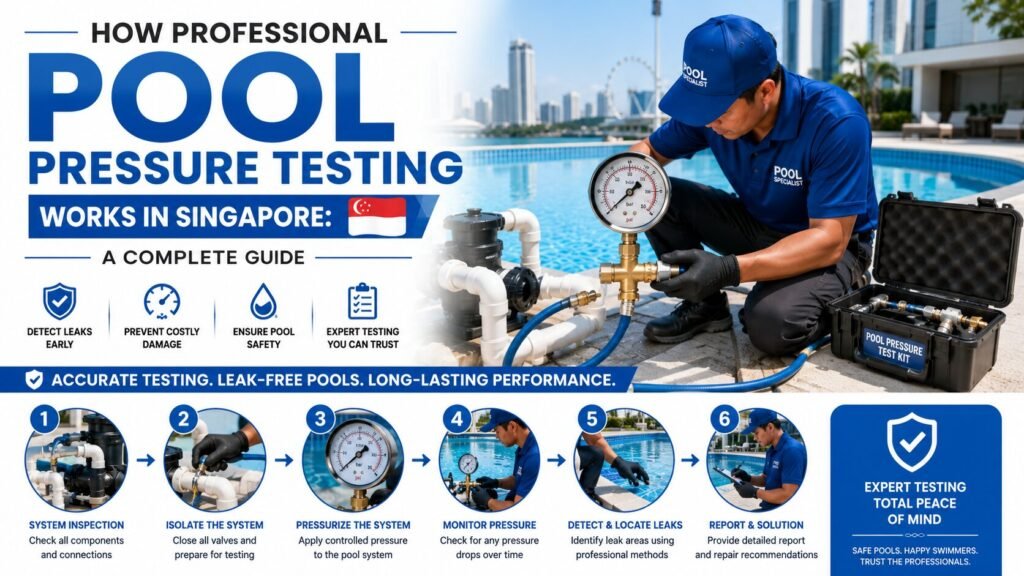
Pool pressure testing in Singapore involves isolating each plumbing line connected to the pool, sealing the pipe ends, and introducing pressurised air or water into the line. A gauge monitors the pressure over a set period. If pressure drops, the pipe or fitting in that line has a leak. This method identifies underground pipe faults without excavation, giving a precise diagnosis before any repair work begins. Most pool leaks are not visible at the surface. The water is not pouring from a crack you can see. It is escaping through a pipe buried beneath the pool deck, a fitting behind the pool wall, or a joint underground that has fractured from ground movement or age.
You cannot find these leaks by looking. You find them by testing the plumbing system under pressure and watching what the pressure does. This guide explains exactly how professionals do this, what the results reveal, and what happens after a leak is confirmed.
What is Pool Pressure Testing?
A pool pressure test is a diagnostic procedure that pressurises each plumbing line in a pool system to check for leaks. Each pipe is isolated, sealed at both ends, and filled with either pressurised air or water. A pressure gauge attached to the line shows the pressure level. If the gauge holds steady, the pipe is intact. If the pressure drops, there is a leak somewhere in that line. The rate of drop indicates the severity of the leak.
Pool plumbing systems include multiple separate lines. In a typical Singapore residential pool, these include:
- Suction lines: Drawing water from the skimmer and main drain to the pump
- Return lines: Pushing filtered water back into the pool through the return jets
- Backwash line: Carrying waste water out of the filter during backwashing
- Feature lines: Supplying water features, jets, or spa equipment where present
Each line runs underground from the pool shell to the equipment pad, and each can develop a leak independently. Pressure testing allows each line to be assessed separately so the fault can be isolated to a specific pipe run before any physical investigation begins.
When Does a Pool Need Pressure Testing?
Pressure testing is indicated when a pool is losing water beyond normal evaporation levels and no visible surface leak has been identified. If the pool has been checked for structural leaks at fittings and through the shell and none were found, the leak is most likely in the underground plumbing. Pressure testing confirms which pipe line is failing before any repair work is planned.
Specific situations that call for pressure testing in Singapore pools:
Consistent water loss with no identified cause The bucket test shows the pool is losing more water than evaporation explains. Visual inspection of skimmers, return jets, and visible fittings reveals no obvious fault. The pool shell shows no visible cracks. Pressure testing is the next step.
Air bubbles coming from return jets Bubbles appearing in the return jets when the pump is running indicate air is entering the suction side of the plumbing system. This typically means a crack or joint failure on the suction line between the skimmer or main drain and the pump. Pressure testing confirms which section of suction plumbing is at fault. Soft or wet ground around the pool area Damp soil or soft patches in the garden or deck near the pool, with no surface water source to explain it, suggests water is escaping underground. Pressure testing identifies which pipe run is the source.
Pump running louder than usual or losing prime frequently When the pump loses prime repeatedly or sounds like it is cavitating, air is entering the suction side. This is often a plumbing fault rather than a pump fault. Pressure testing rules out or confirms the plumbing before the pump is blamed.
Before any major renovation or waterproofing work Testing the plumbing integrity before a renovation confirms whether any pipe repairs need to be included in the project scope. It is more cost-effective to discover and repair an underground plumbing fault during a planned drain than to find it after new tiles and waterproofing have been applied. For context on how pressure testing fits into the broader leak detection process, see our Pool Leak Detection & Repair Singapore service page.
The Tools Used in Professional Pool Pressure Testing
Professional pool pressure testing uses a pressure testing kit consisting of threaded plugs or inflatable test plugs to seal pipe ends, a hand pump or compressor to introduce pressure into the sealed line, and a calibrated pressure gauge to monitor the pressure level over time. Digital gauges are preferred over analogue for accuracy, particularly when monitoring slow leaks where pressure drop is gradual.
The key components and what each does:
Test plugs (mechanical or inflatable) These seal the pipe at each accessible end. Mechanical plugs use threaded fittings to seal standard pipe diameters. Inflatable plugs are inserted into the pipe opening and inflated to create a seal, useful for irregularly sized or older pipes where threads may be worn or non-standard.
Pressure source A hand pump is used for low-volume lines where the pipe capacity is small. A compressor is used for longer runs where a larger volume of air is needed to pressurise the line fully. Water is used instead of air when a water pressure test is preferred, particularly where air compressibility could mask slow leak results.
Calibrated pressure gauge The gauge monitors the pressure in the sealed pipe continuously. Professional gauges are calibrated to a known standard and are accurate to within 0.1 to 0.2 PSI, allowing even slow leaks to be detected over an observation period.
Digital leak detection equipment (for precise location) Once pressure testing confirms a specific pipe run is leaking, acoustic listening equipment can be deployed to locate the fault point along that run. The microphone sensor is moved along the path of the underground pipe, listening for the sound signature of escaping water or air. This narrows the fault location to within approximately 0.5 to 1 metre without excavation.
Step-by-Step: How Pool Pressure Testing Works
Pool pressure testing begins with identifying all pipe runs, isolating each line by plugging both ends, pressurising each line to a standard test pressure (typically 10 to 20 PSI for residential pool plumbing), and monitoring the pressure gauge for a set period of 10 to 30 minutes. A stable reading means the pipe is intact. A pressure drop indicates a leak in that line. The rate of drop and the test pressure reached together indicate the severity and approximate location of the fault. Here is the full process in sequence:
Step 1: System mapping and initial assessment
Before testing begins, the technician maps the pool’s plumbing system. This involves identifying each pipe run, locating the access points at the equipment pad and at the pool fittings, and confirming which lines are present.
In Singapore, many residential pools were built without full plumbing documentation. The technician may need to trace the pipe runs by following the general routing from fittings to equipment. This understanding of the system layout informs the testing sequence.
Step 2: Isolating each pipe run
Each line is isolated from the rest of the system by closing isolation valves where present or by plugging the line at both accessible ends. This ensures that pressure introduced into one line does not travel into adjacent lines and that any pressure drop observed can be attributed specifically to the line being tested.
Isolation is critical for accurate results. Testing all lines together at once, which some contractors do to save time, produces a result that tells you there is a leak somewhere in the system but cannot tell you which line has the fault.
Step 3: Pressurising the line
Air or water is introduced into the sealed pipe run through a Schrader valve or test fitting at the equipment pad. The line is pressurised to the test pressure appropriate for the pipe material and diameter. Standard test pressures for residential pool plumbing in Singapore:
- UPVC pipes (the most common type in Singapore pools): 10 to 15 PSI
- Rigid PVC or older pipe materials: 10 to 15 PSI
- Flexible hose sections: 8 to 12 PSI
Over-pressurising is avoided because it can stress joints and fittings that are sound but aged. The goal is to find existing leaks, not to create new ones.
Step 4: Monitoring the pressure gauge
Once the line is pressurised to the test level, the gauge is monitored for 10 to 30 minutes. Temperature affects air pressure: air in a pipe warms up slightly after pressurisation and gauge readings may rise briefly before stabilising. Professional technicians allow for this stabilisation period before beginning the observation window.
Interpreting the results:
| Result | Interpretation |
| Pressure holds steady throughout | Pipe line is intact, no leak in this run |
| Slow, gradual pressure drop over 15 to 30 minutes | Small leak present, likely a hairline crack or minor joint failure |
| Rapid pressure drop within 5 minutes | Significant leak, likely a fractured pipe or major joint failure |
| Cannot pressurise line at all | Major breach, possibly a completely separated joint or significant fracture |
Step 5: Identifying which line is at fault
If multiple lines are tested and one shows pressure loss, that line is confirmed as the leak source. Testing continues on the remaining lines to confirm whether the fault is isolated to one run or present in multiple runs.
A pool with one leaking plumbing line is a straightforward repair. A pool with multiple failing lines may indicate that the pipe material has reached end of life broadly, which changes the scope and cost conversation.
Step 6: Fault location using acoustic detection
Pressure testing tells you which pipe run is leaking. It does not tell you exactly where along that run the fault is located. For underground pipes, the fault location is found using acoustic listening equipment.
With the pipe pressurised, a sensitive microphone sensor is moved along the surface above the pipe route. The sound of air or water escaping through a crack or joint gap creates a distinct noise signature detectable through the ground. The signal is strongest directly above the fault. This narrows the fault location to within approximately 0.5 to 1 metre without any excavation or surface breaking.
Step 7: Written leak report
Before any repair work is proposed, a written report is produced documenting:
- Which pipe lines were tested
- The test pressure applied and observation period
- Which lines passed and which lines showed pressure loss
- The rate of pressure loss for failing lines
- The suspected fault location on failing lines based on acoustic detection
- Recommended repair approach and scope
This report is the basis for the repair quotation. A professional operation separates the detection and the repair scope, so you know exactly what was found before committing to repair costs.
What Pressure Testing Cannot Find
Understanding the limitations of pressure testing is as important as understanding what it does find. Pressure testing identifies faults in the plumbing lines only. It does not detect leaks through the pool shell (structural leaks), waterproofing membrane failures, or leaks at surface fittings that are only apparent when the pool is filled with water. These sources require separate detection methods including dye testing at fittings, structural inspection, and waterproofing assessment. This is why a complete pool leak detection visit typically uses multiple methods together, not just pressure testing alone.
The full toolkit for comprehensive pool leak detection includes:
Bucket test: Establishes whether the pool is losing water beyond normal evaporation before any diagnostic work begins. Without this baseline, you cannot quantify the severity of the leak.
Visual inspection: Checks visible fittings, skimmer boxes, return jets, light niches, and the pool shell for obvious surface defects.
Dye testing: A dye syringe is used to inject coloured dye near suspected leak points at fittings and cracks. If the dye is drawn into the gap, water is escaping at that point. This is effective for surface and fitting leaks that pressure testing does not cover.
Pressure testing: Covers the underground plumbing lines as described above.
Acoustic detection: Narrows the location of underground faults identified by pressure testing.
Thermal imaging: Detects temperature anomalies in pool walls or floors caused by water movement behind the surface. Useful for identifying structural leaks where water has been moving through the concrete for some time.
For a full explanation of how all these methods combine in a professional leak detection visit, read our Pool Leak Detection & Repair Singapore page.
What Happens After a Pressure Test Confirms a Leak?
After pressure testing confirms which pipe line is failing and acoustic detection narrows the fault location, the repair approach depends on the depth and access situation of the pipe. Most underground pool pipe repairs in Singapore involve limited excavation at the confirmed fault location, cutting out the failed section of pipe, installing a new section with proper solvent welded joints, and pressure testing the repaired line before backfilling and restoring the surface.
The repair sequence:
- Confirming the fault location The fault location identified by acoustic detection is marked on the surface. The depth of the pipe at that point is confirmed using the known pipe routing and installation records where available.
- Targeted excavation The surface above the confirmed fault location is opened. For pools with tiled surrounds, pool coping, or a concrete deck above the pipe, the minimum necessary area is broken out to access the pipe. The goal is minimal surface disruption.
- Pipe section inspection and removal The pipe at the fault location is exposed. The type of failure is confirmed visually. Common failures include:
- Joint separation: The solvent-welded joint between two pipe sections has let go, typically from ground movement or thermal cycling
- Pipe fracture: A crack in the pipe body, often from external ground pressure, tree root intrusion, or point loading from above
- Fitting failure: A cracked tee, elbow, or union fitting, often caused by stress at a change in pipe direction
The failed section or fitting is cut out and removed.
- Pipe repair or replacement A new pipe section is cut to fit and connected to the existing pipe using solvent weld joints on each side. Flexible unions are used at connection points where there is any risk of future movement to allow removal without cutting.
- Post-repair pressure test Before the excavation is filled and the surface is restored, the repaired line is pressure tested again to confirm the repair holds. This non-negotiable step confirms the fault has been resolved before the pipe is buried again.
- Backfill and surface restoration The excavation is filled with appropriate backfill material, compacted properly to avoid future settlement, and the surface is restored. For tiled areas, tile matching and relaying follows.
How Much Does Pool Pressure Testing Cost in Singapore?
Pool pressure testing as part of a professional leak detection visit in Singapore typically costs between SGD 150 and SGD 400 depending on the number of pipe lines tested, the complexity of the pool plumbing system, and whether acoustic detection for fault location is included. This is charged as part of the detection visit, separate from any repair costs. Most reputable contractors provide a written report from the detection before quoting for repairs. Plumbing repair costs after a confirmed underground fault vary significantly based on:
- Depth of the pipe at the fault location
- Type of surface above the fault (grass, concrete, tiling)
- Length of pipe section requiring replacement
- Number of fittings involved
Typical underground pool pipe repair costs in Singapore:
| Repair Scope | Estimated Cost (SGD) |
| Minor joint repair (accessible, shallow pipe) | SGD 400 to SGD 900 |
| Section pipe replacement (moderate depth, concrete surface) | SGD 800 to SGD 2,000 |
| Major pipe run repair (deep, under tiled surface) | SGD 2,000 to SGD 5,000 |
For broader context on Pool Leak Detection and repair costs, See Our Pool Leak Detection & Repair Singapore page.
Pressure Testing vs Other Leak Detection Methods: How They Compare
| Method | What It Finds | What It Misses |
| Pressure testing | Underground pipe and fitting leaks | Structural, waterproofing, and surface fitting leaks |
| Dye testing | Surface fitting leaks, visible crack leaks | Underground plumbing faults |
| Acoustic detection | Precise location of underground faults | Structural and surface leaks |
| Thermal imaging | Water movement behind pool surfaces | Underground plumbing faults |
| Bucket test | Whether water loss exceeds evaporation | Specific source of the leak |
| Visual inspection | Obvious surface cracks and fitting gaps | Anything subsurface |
A comprehensive leak detection visit uses all applicable methods together. No single method covers all leak types, and professionals select the combination appropriate to the pool’s symptoms.
Book a Leak Detection Visit
If your pool is losing water and you cannot identify the source, professional pressure testing combined with the full leak detection process is the right next step. At Infinity Pool Services, we carry out full leak detection visits across Singapore using pressure testing, dye testing, acoustic detection, and thermal imaging where appropriate. You receive a written report of findings before any repair costs are committed. We serve Bukit Timah, Sentosa Cove, Tanglin, Novena, Serangoon Gardens, Katong East Coast.
Book a Leak Detection Visit: infinitypool.com.sg/contact or call +65 8301 9006.
Related Reading and Services
- Pool Leak Detection & Repair Singapore — Full service details and what a professional detection visit involves
- Swimming Pool Leak Detection — Our existing leak detection service page
- Pool Waterproofing Singapore — When waterproofing membrane failure is confirmed as the leak source
- Pool Repair & Renovation Singapore — When leaks lead to broader structural repair needs
- Swimming Pool Plumbing Repair — The repair service after pressure testing confirms a plumbing fault
- How to Spot and Fix Leaks in Your Pool in Singapore — Broader guide to identifying and addressing pool leaks
- Pool Waterproofing vs Regrouting: What Is the Difference? — When leak source is membrane rather than plumbing
- How Waterproofing Protects Your Pool from Leaks and Tile Damage — Understanding structural vs plumbing leak sources
- Common Swimming Pool Problems in Singapore Homes — Broader context on pool problems and their causes
- Swimming Pool Maintenance & Equipment Cost Guide — Cost reference for pool services in Singapore
Frequently Asked Questions
What is pool pressure testing and how does it work?
Pool pressure testing isolates each plumbing line in the pool system, seals both ends, and pressurises the pipe with air or water to a standard test pressure. A calibrated gauge monitors the pressure over an observation period. If pressure holds, the line is intact. If pressure drops, the line has a leak. The rate of drop indicates the severity.
How long does a pool pressure test take?
Testing a standard residential pool plumbing system with 3 to 4 pipe lines typically takes 2 to 3 hours including line isolation, pressurisation, observation periods, and initial acoustic detection on any line that fails. The written report is usually produced the same day.
Can pressure testing find all pool leaks?
No. Pressure testing finds leaks in the underground plumbing lines only. It does not detect structural leaks through the pool shell, waterproofing membrane failures, or surface fitting leaks visible only when the pool is water-filled. A comprehensive leak detection visit uses pressure testing alongside dye testing, visual inspection, and thermal imaging to cover all leak sources.
Does pressure testing damage pool pipes?
No, when conducted correctly. Professional pressure testing uses appropriate test pressures for the pipe material and diameter. Singapore residential pool plumbing is typically UPVC, tested at 10 to 15 PSI. This is well within the operating range of sound pipe and will not damage intact plumbing. The test finds faults that already exist rather than creating new ones.
What happens if the pressure test finds a leak?
The failing pipe line is confirmed and documented. Acoustic detection equipment is then used to narrow the fault location along that run to within approximately 0.5 to 1 metre without excavation. A written report is produced documenting the findings and a repair quotation is provided. No repair work begins without written authorisation from the pool owner.
How much does pool pressure testing cost in Singapore?
Pool pressure testing as part of a professional leak detection visit costs between SGD 150 and SGD 400 in Singapore depending on the number of lines tested and whether acoustic fault location is included. This is the detection cost. Plumbing repair costs after a confirmed fault are quoted separately based on the scope of repair needed.
What causes underground pool pipes to leak in Singapore?
The main causes in Singapore are ground movement from soil settlement or heavy rainfall saturation, thermal cycling causing stress at pipe joints, tree root intrusion forcing joints apart or fracturing pipe bodies, age-related degradation of solvent-welded joints, and external point loading from heavy objects or vehicles on surfaces above buried pipes.
Can I pressure test my pool pipes myself?
The basic concept of sealing and pressurising a pipe is simple, but professional pool pressure testing requires calibrated gauges, correctly sized test plugs for pool fittings, knowledge of appropriate test pressures for different pipe materials, and the ability to interpret results correctly. Without acoustic detection equipment, DIY pressure testing tells you that a line is leaking but not where. Professional equipment and interpretation produces actionable results.
What is the difference between air pressure testing and water pressure testing for pool pipes?
Air pressure testing is faster to set up, easier to observe on a gauge, and leaves no water in the pipe after testing. Water pressure testing is more accurate for detecting very slow leaks because water is incompressible and any pressure drop is directly attributable to water escaping the system rather than air temperature changes affecting the reading. Professionals choose between them based on the pipe type and the suspected severity of the leak.
After pool pressure testing finds a leak, can the repair be done the same day?
For minor leaks at accessible locations, same-day repair may be possible. For underground pipe faults requiring excavation, the repair is scheduled after the detection report and repair quotation have been accepted. Most underground pool pipe repairs in Singapore are completed within 1 to 3 days of the detection visit.