
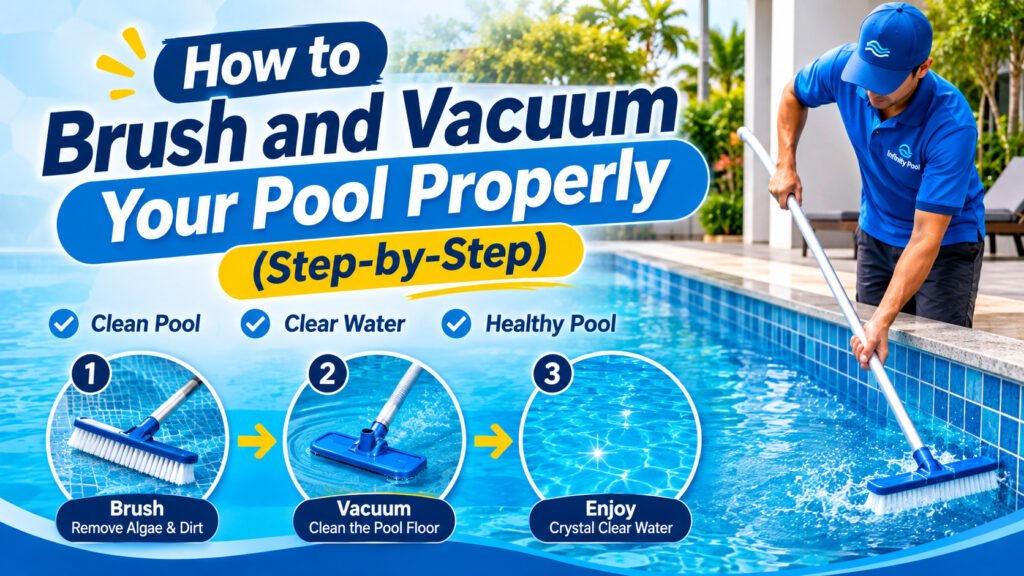
In Singapore’s heat, a pool that goes two weeks without a brush can start growing algae on the walls even when the chlorine reading looks fine. Skimming takes care of what floats. Chlorine handles what’s dissolved. The dirt, pollen and thin slimy film that settle on tiles and the floor only come off with a brush and a vacuum. This guide shows the order we follow when we clean a pool, the mistakes we see homeowners make, and the safety points that are easy to miss.
Why Skimming Alone Isn’t Enough
Your filter only catches what moves through the circulation system. Anything that sinks stays on the floor and keeps using up chlorine as it breaks down. Left alone, that layer of leaf matter, dust and body oils becomes a food source for algae. Brushing loosens the film before it hardens and lets chlorine reach the tile surface. Vacuuming then removes what the brush loosened. If you skip either one, you end up treating a green pool instead of preventing one. Our guide on How to prevent green pool water in Singapore covers the rest of that routine.
What You Need Before You Start
- A telescopic pole that reaches the middle of the pool
- A nylon wall brush (a curved one helps in corners and around steps)
- A manual vacuum head and a hose long enough to reach the far end of the pool
- A leaf skimmer net
- A water test kit
- Non-slip footwear
A note on brushes: Use nylon on tiled pools. Stainless steel brushes can scratch tiles and wear down grout lines, so keep them for stubborn spots on bare concrete or plaster only.
Safety First
A few minutes of preparation prevents most of the accidents we hear about.
- Switch the pump off at the isolator before you open any basket or lid. Switch it back on only once everything is closed and the water level is right.
- Look up before you swing the pole. Telescopic poles are long. Keep them clear of overhead cables, lights and tree branches that carry wires.
- Keep swimmers out of the pool while you vacuum. A vacuum hose creates suction and can tangle around legs. Children and pets should stay out of the pool area while you work, and a child should never be left alone near water.
- Wear non-slip shoes. Pool decks are slippery when wet.
- Do your chemical dosing after cleaning, not before, and never mix two chemicals together. Follow the product label every time.
Step 1: Skim The Surface
Use the leaf skimmer to lift leaves, insects and floating debris off the surface. Do this first. If leaves sink while you brush, they are much harder to remove.
Step 2: Empty The Skimmer and Pump Baskets
With the pump switched off, lift out the skimmer basket and the pump basket and rinse them clean. A full basket restricts water flow, which weakens suction and puts extra strain on the pump motor. Before you close the pump lid, check that the O-ring is clean and sitting properly. A dry or twisted seal lets air into the system, and air is the most common reason a pump loses prime. If your pump is already noisy or struggling, read about pump repair and replacement before it gets worse.
Step 3: Brush The Pool
Turn the pump back on and leave it running while you brush. That way the filter catches fine particles as you stir them up. Brush in this order:
- Waterline tiles first. This is where oil and scum build up.
- Walls, working from the top down to the floor. Use short, overlapping strokes.
- Steps, ladders and corners. Algae likes the spots where water moves less. Brush behind ladders and around fittings too.
- The floor, pushing debris toward the main drain or the area you will vacuum first.
While you brush, pay attention to the surface under the bristles. Crumbling grout, gritty tile edges, or tiles that sound hollow when tapped are early signs of trouble. If you spot them, our article on How to know when your pool needs regrouting explains what to look for.
Step 4: Set Up the Manual Vacuum and Prime the Hose
Priming means filling the hose completely with water so no air enters the pump. Skipping it is the number one reason beginners say “my vacuum doesn’t work.”
- Clip the vacuum head to the telescopic pole and attach the hose to the head.
- Lower the head into the pool and feed the hose in, section by section, so it fills with water.
- When the end of the hose is the last part out of the water, hold it against a return jet until the bubbles stop.
- Connect the hose end to your vacuum port, or to the skimmer suction, keeping the end underwater while you connect it so air doesn’t get in.
If your skimmer has a basket, many pools use a vacuum plate that sits on top of it. Follow your equipment manual if you aren’t sure which setup you have.
Step 5: Vacuum Slowly and Overlap Each Pass
Start at the shallow end and work toward the deep end. Move the head across the floor like you’re mowing a lawn, overlapping each pass by a few centimetres. Slow movement matters. If you rush, you stir up a cloud and push fine dirt back into the water. Vacuum the steps, benches and the lower part of the walls too, not just the floor. If the head loses suction or starts to bounce, stop and check for air in the hose, a full basket, or a water level that has dropped below the skimmer opening.
Step 6: Clean Up and Check the Filter
When you finish, switch the pump off, remove the hose, and empty both baskets again. Then look at the pressure gauge on your filter. A pressure reading about 8 to 10 psi above its clean starting level usually means the filter needs backwashing or cleaning. Our complete guide to swimming pool filter servicing explains how filters differ and when a professional should step in. If your pool has a sand filter, check your equipment manual before you backwash, since the correct valve positions vary between models.
Step 7: Top Up The Water and Test
Vacuuming and backwashing both remove water, so check the level and top it up to the middle of the skimmer opening. Then test your water. A pH between 7.2 and 7.6 is the standard target, and free chlorine is commonly kept between 1 and 3 ppm. If your technician has set different targets for your pool, follow those. For a full explanation, Read why pool pH and chlorine levels matter.
How Often Should You Brush and Vacuum?
For a private pool in Singapore, once a week is a reasonable baseline. Add an extra session:
- After heavy rain or a storm
- After a party or a day of heavy use
- During leaf-fall periods, especially if trees overhang the pool
- Any time you see a hazy film or dull patches on the floor
Rain dilutes chlorine and washes dirt and spores into the water, so the days after a downpour are when algae tends to start. We cover this in more detail in Swimming pool maintenance during Singapore’s rainy season. If you’re working out a full schedule, See How often you should service a private pool in Singapore.
Vacuum to Waste: When You Need It
A normal vacuum sends water through the filter. After a storm or when there’s dead algae on the floor, the fine particles are small enough to pass straight through a sand filter and come back out of the return jets. In that situation, a technician will usually use the “waste” setting on the valve, which sends the dirty water out of the system instead of back into the pool. Two cautions. Not every pool has a waste line, so check your setup first. And vacuuming to waste drops the water level fast, so watch the skimmer and refill as you go. Never let the pump run dry, because that can damage it within minutes. If the pool is already green, vacuuming alone won’t fix it. That’s a chemical and filtration job and Our Green Pool recovery service is built for it.
Robotic Cleaners vs Manual Vacuuming
A robotic cleaner is a useful help between visits, especially on the floor. It doesn’t replace brushing, though. Most robots can’t scrub the waterline, steps, corners or the area behind ladders. You still need to brush those by hand, and you need to empty the robot’s filter after each run so it keeps working properly.
Common Problems and What to Do
| Problem | Likely cause | What to do |
|---|---|---|
| Suction is weak or the pump loses prime | Air in the hose, full basket, low water level | Re-prime the hose, empty baskets, top up water |
| Dirt blows back into the pool | Dirty or damaged filter, wrong valve setting | Check the valve, clean the filter, call for filter servicing if it continues |
| Water turns cloudy after vacuuming | Fine particles passing the filter, or water chemistry is off | Run the pump longer, clean the filter, test the water. See how to fix cloudy pool water |
| Green patches come back after brushing | Algae in grout lines, low chlorine | Test the water and treat early before it spreads |
| Water level keeps dropping | More than normal vacuuming and backwashing loss | Check for a leak. See why your pool water level is dropping |
When to Call A Professional
DIY cleaning works well for routine upkeep. Call a technician if:
- The pool is green, or you see black or dark spots on the walls
- The pump keeps losing prime, makes grinding noises, or trips the power
- Filter pressure climbs again within days of cleaning
- You find hollow tiles, crumbling grout or loose fittings while brushing
- You don’t have time for a weekly routine
A regular swimming pool cleaning service handles brushing, vacuuming, chemical balancing and equipment checks together and it catches small faults before they become expensive repairs. If you’re comparing providers, Read How to choose the right pool contractor in Singapore first. We look after landed homes across Bukit Timah, Novena, Serangoon Gardens, Katong, Sentosa Cove and Tanglin. If you’d like a technician to look at your pool, you can request a quote or contact us directly.
Frequently Asked Questions
Should I brush or vacuum first?
Brush first. Brushing loosens dirt and algae from the surface, and the vacuum then picks it up. If you vacuum first, you leave the loosened material in the water.
How long does it take to brush and vacuum a pool?
Allow about 45 minutes to an hour for a typical private pool while you are still learning the routine. It gets faster once the hose priming and the brushing order become habit.
Can anyone swim while I vacuum?
No. The suction and the hose are a hazard, particularly for children. Keep everyone out of the water until you’re done and the hose is removed.
Do saltwater pools need to be cleaned differently?
No. A salt chlorinator produces chlorine, but it doesn’t remove debris. Saltwater pools still need brushing, vacuuming and regular basket cleaning. Read our comparison of saltwater vs chlorine pools for Singapore homes if you’re deciding between them.
Should I add chemicals before or after vacuuming?
After. Clean the pool first, then test the water and dose it based on the reading. Adding chemicals to a dirty pool wastes product, because the debris uses it up.
Are there common mistakes to avoid?
Yes: skipping the hose priming, vacuuming too fast, using a steel brush on tiles, and forgetting to empty the baskets afterwards. Our list of top pool maintenance mistakes in Singapore covers more.