
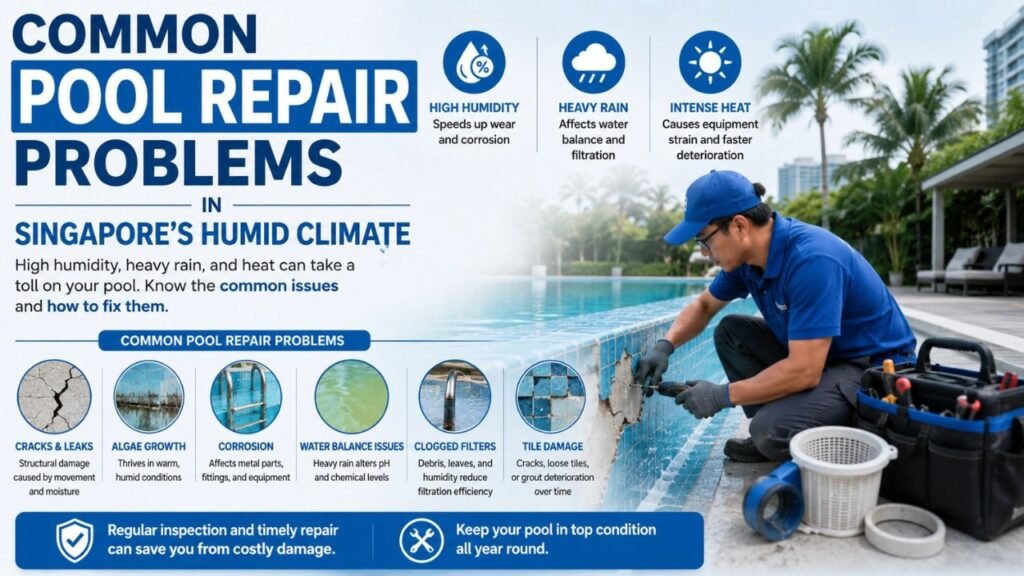
The most common pool repair problems in Singapore are waterproofing membrane failure, tile and grout deterioration from thermal cycling, underground pipe leaks from soil movement during heavy rainfall, structural cracking from ground settlement, and premature equipment corrosion from constant humidity and chemical exposure. Singapore’s combination of intense heat, UV radiation, over 2,300 mm of annual rainfall, and year-round high humidity accelerates every form of pool deterioration faster than in cooler, drier climates. Pools in Singapore work harder than pools almost anywhere else. They face peak UV radiation, daily thermal cycling, tropical storms that saturate the ground beneath them and constant humidity that never lets surfaces dry out fully.
This is not the same environment as a pool in a temperate European or North American climate. The failure modes are faster, more specific, and need to be understood correctly to be fixed properly. This guide covers the most common structural and repair problems seen in Singapore pools, why Singapore’s climate specifically causes each one, and what the correct fix looks like.
Problem 1: Waterproofing Membrane Failure
Why does waterproofing fail faster in Singapore than in other countries?
Waterproofing membranes in Singapore pools degrade faster because of three simultaneous stressors that rarely occur together in other climates: intense daily UV exposure that breaks down polymer-based membranes at the waterline and above, daily thermal cycling between roughly 23 and 34 degrees Celsius that causes the pool structure to expand and contract and stresses the membrane at joints and penetrations, and high ambient humidity that prevents complete drying of any micro-breaches, allowing water to infiltrate and accelerate degradation from the substrate side. Most pool-grade membranes are rated for 10 to 15 years. In Singapore, pools without documented maintenance history frequently show significant membrane degradation at 7 to 10 years.
How it shows up
Waterproofing failure is usually not immediately obvious. The signs appear gradually:
- Tiles begin detaching in multiple sections without physical impact
- Efflorescence (white chalky mineral deposits) appears on pool walls or floor
- The pool shows consistent water loss beyond normal evaporation
- Damp soil or soft ground appears near the pool edge without surface water source
By the time tiles are falling off in multiple areas, the membrane has usually been failing for 12 to 24 months. The tile failure is a downstream consequence, not the root cause.
The correct fix
Full waterproofing repair requires tile removal, substrate preparation, crack injection where structural cracks are found, new membrane application to specified thickness, mandatory flood testing before any new tiles are laid, and full retiling. There is no surface-level shortcut that produces a lasting result. For full details on the waterproofing process and costs, See Our Pool Waterproofing Singapore service page.
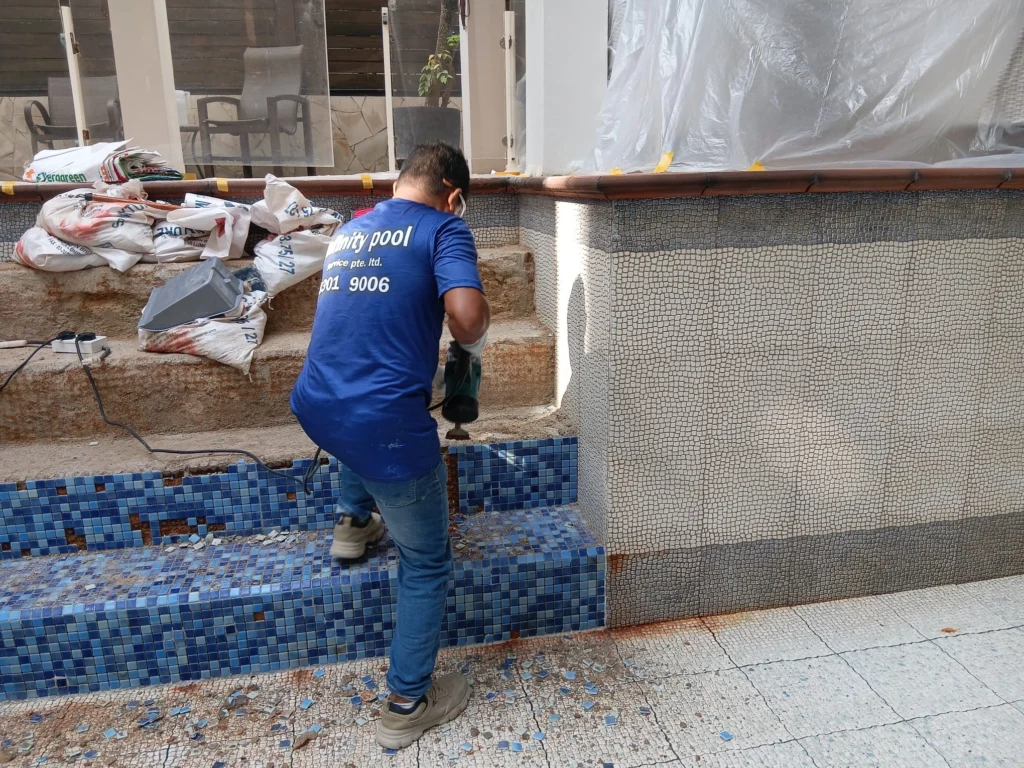
Problem 2: Tile and Grout Deterioration from Thermal Cycling
Why do pool tiles and grout deteriorate faster in Singapore?
Pool tiles and grout in Singapore deteriorate faster because the daily temperature swing from 23 degrees at night to 34 degrees in direct sun creates continuous thermal cycling. Tiles, adhesive, grout, and the concrete shell all expand and contract at slightly different rates because they have different thermal expansion coefficients. Over thousands of daily cycles, this differential movement creates micro-cracks in grout joints, progressively widens them, and stresses the tile adhesive bond until it fails. This mechanism is unavoidable. It is a physical consequence of daily temperature change working on dissimilar materials. What varies is how fast it progresses, which depends on the materials used, the quality of original installation, and whether grout maintenance happens proactively.
How It Shows up
- Grout joints crack along their length, particularly at the waterline where the transition between wet and dry surface is most pronounced
- Grout begins to crumble under finger pressure
- Small sections of grout fall out of joints entirely, leaving visible gaps
- Tiles near the waterline show earlier deterioration than tiles deep underwater, because this zone experiences the greatest daily temperature variation
The correct fix
If tiles are still solid when tap-tested, regrouting addresses the problem. Fresh pool-grade grout, ideally epoxy for its superior chemical and thermal resistance, restores the watertight seal between tiles and protects the waterproofing membrane beneath from water infiltration. If deterioration has been left long enough that water has reached the adhesive and tiles are now hollow, tile replacement and potentially waterproofing repair are required. For the full explanation of when regrouting is sufficient versus when retiling is needed, See Our Blog: Regrouting vs Retiling: Which One Does Your Pool Really Need?
Problem 3: Underground Pipe Leaks from Soil Movement
Why are underground pool pipe leaks more common in Singapore than in drier climates?
Singapore receives over 2,300 mm of annual rainfall, frequently in intense tropical downpours that saturate the soil around pool structures rapidly. This repeated saturation and drainage cycle causes the soil to expand when wet and contract when dry, creating lateral movement forces on buried pool plumbing. Over years, these forces stress the solvent-welded joints in UPVC pool pipes, causing them to separate or fracture at connection points. Tree root intrusion is an additional factor on landed properties with mature garden vegetation. Underground pipe leaks are particularly difficult to diagnose because there is no visible surface indicator until water loss is significant or soft ground develops near the pool.
How it shows up
- Pool loses water consistently beyond normal evaporation but no fitting or surface crack explains it
- Ground near the pool edge becomes soft or damp without surface water
- Air bubbles appear in the return jets when the pump is running, indicating air entry on the suction side
- Pool loses water faster when the pump is running than when it is off
The correct fix
Pressure testing each plumbing line in isolation identifies which pipe run is failing. Acoustic detection narrows the fault location along the underground run to within approximately 0.5 to 1 metre without excavation. Targeted excavation at the confirmed fault location, removal of the failed pipe section, and replacement with new UPVC pipe on solvent-welded joints resolves the leak. A post-repair pressure test confirms the fix before the excavation is filled. For a detailed explanation of pressure testing methodology, See Our Blog: How Professional Pool Pressure Testing Works in Singapore. For the full leak detection and repair service, See Our Pool Leak Detection and Repair Singapore service page.
Problem 4: Structural Cracking from Ground Settlement
Why do Singapore pools develop structural cracks?
Pool shells in Singapore are vulnerable to structural cracking from ground settlement because the repeated cycle of soil saturation from heavy rainfall followed by partial drying creates ongoing ground movement beneath and around the pool structure. Older pools built on fill material or near slopes are more susceptible. Pool shells are reinforced concrete structures but are not designed to accommodate large differential settlement. When the ground shifts unevenly beneath one section of the pool, the concrete shell cracks at the weakest point. Structural cracks are more serious than surface cracks. They pass through the full depth of the concrete shell and provide a direct path for water to escape from the pool into the surrounding ground.
How it shows up:
- Visible cracks in the pool floor or lower walls, often running along the longest dimension of the pool
- Cracks that grow or widen over time (typically a sign of ongoing settlement rather than historic movement)
- Water loss that cannot be attributed to fittings or plumbing
- Efflorescence staining running from a crack line outward onto the pool surface
Hairline vs structural cracks
Not all cracks are equally serious. A hairline crack less than 0.2 mm wide in the tile or grout surface is typically a surface phenomenon rather than a structural one. A crack that passes through the tile and into the concrete substrate, or that is visible in the bare concrete after tiles are removed, is a structural crack requiring proper repair.
The correct fix
Active structural cracks (those still moving) require polyurethane injection, which expands to fill the crack and remains flexible to accommodate future minor movement. Dormant structural cracks (those resulting from historic movement that has stabilised) are repaired with epoxy injection, which fills the crack rigidly and restores structural continuity. The choice of injection material depends on whether the crack is still active. Both types of repair must be completed before any waterproofing work proceeds. Applying a waterproofing membrane over an unrepaired structural crack produces a membrane that fails at the crack line within months.
Problem 5: Skimmer and Fitting Seal Degradation
Why do pool skimmer seals and fitting seals fail more quickly in Singapore?
The sealants used around pool skimmer boxes, return jets, main drains, and light fittings degrade faster in Singapore because of sustained UV exposure at and above the waterline, constant chemical exposure from chlorine and salt, and daily thermal cycling that causes the joint between the fitting and the pool shell to expand and contract repeatedly. Most pool-grade sealants have a realistic service life of 5 to 8 years in Singapore conditions before they become porous or lose adhesion. Fitting seal failures are one of the most common and most under-diagnosed causes of pool water loss in Singapore. They are affordable to repair but frequently overlooked because the leak is not visible without dye testing.
How it shows up
- Pool loses water consistently but no structural crack is visible
- Dye testing during a leak detection visit shows dye being pulled into the gap around a skimmer, return jet, drain, or light fitting
- Staining or calcium deposits appear around specific fittings, indicating long-term moisture movement at that point
- The pool loses water more noticeably at the waterline level, which drops to the height of the lowest leaking fitting then stabilises
The correct fix
Skimmer and fitting seal repairs typically do not require full pool drainage. The pool level is lowered to expose the fitting, the old sealant is removed, the joint is cleaned, and fresh pool-grade sealant is applied and allowed to cure before the pool is refilled. For fittings where the body itself has cracked rather than just the sealant, the entire fitting may need replacement. Cost is relatively low for this repair, typically SGD 150 to SGD 500 per fitting, which makes early detection and repair highly cost-effective compared to allowing the leak to continue.
Problem 6: Calcium Scale Build-Up on Surfaces and Equipment
Why does calcium scale build up more in Singapore pools?
Singapore’s tap water has moderate calcium hardness, typically in the range of 50 to 100 ppm from PUB. When pool water evaporates in Singapore’s heat, the calcium and other minerals left behind concentrate on pool surfaces, tile faces, grout joints, and equipment including salt cell plates and heat exchangers. The combination of high evaporation rates from Singapore’s sun and heat with water containing dissolved calcium produces scale deposits faster than in cooler climates where evaporation is slower. Scale is not just cosmetic. Heavy calcium scale on salt cell plates reduces chlorine production efficiency significantly. Scale on tile surfaces and grout joints makes cleaning harder and accelerates grout deterioration.
How it shows up
- White or grey crusty deposits forming at the waterline on tiles, coping, and any surface that regularly transitions between wet and dry
- Scale deposits accumulating on salt cell plates visible when the cell is removed for inspection
- Reduced chlorine output from a salt system despite correct salt levels and controller settings
- Rough texture developing on pool floor or wall tiles
The correct fix
Surface scale on tiles is removed by acid washing the affected area with diluted muriatic acid. This must be done carefully to avoid tile and grout damage from over-concentration or over-exposure time. The pool chemistry, particularly calcium hardness and pH, must be corrected after cleaning to prevent rapid re-scaling. Salt cell scale is removed by soaking the cell in a diluted acid solution, which dissolves the calcium deposits from the plate surfaces without damaging the reactive coating. Cell cleaning should be scheduled every 3 to 6 months in Singapore conditions, not as a reactive measure when output drops but as a preventive maintenance interval. For filter and equipment servicing that includes scale prevention, See Our Filter Servicing and Replacement service page.
Problem 7: Pump and Equipment Corrosion
Why does pool equipment corrode faster in Singapore?
Pool equipment in Singapore is exposed to constant high humidity, salt air in coastal areas, pool chemical vapours, and significant UV radiation. Pump housings, valve bodies, filter casings, and metal fittings all experience accelerated corrosion under these combined conditions. Salt chlorination systems introduce a mildly saline environment that is not corrosive at pool concentrations but does accelerate corrosion on any metal components that are already compromised or not rated for saltwater exposure.
How it shows up
- Pump housing developing surface rust and corrosion
- Metal ladders, handrails, or light fittings showing pitting and staining
- Valve bodies developing cracks or pinholes at weak points
- PVC equipment components becoming brittle and cracking, particularly those with direct UV exposure in open plant rooms
The correct fix
Equipment showing significant corrosion should be assessed for replacement rather than repair. A corroded pump housing that develops a pinhole leak will continue to develop leaks elsewhere as the corrosion progresses. Replacement during a planned renovation or alongside other equipment servicing is more cost-effective than emergency replacement after failure. For Pump Replacement Guidance, See Our Swimming Pool Pump Repair and Replacement service page. Equipment in covered plant rooms lasts noticeably longer than equipment in open, UV-exposed locations. If your pool equipment is in an open space with direct sun exposure, a simple shade cover extends equipment life significantly.
Problem 8: Coping and Pool Surround Deterioration
Why does pool coping deteriorate quickly in Singapore?
Pool coping in Singapore is exposed to the full range of environmental stressors: UV radiation, daily thermal cycling, constant moisture from pool splash and rainfall, and algae and lichen growth in the humid tropical climate. Concrete coping absorbs moisture and the repeated wetting and drying cycle combined with thermal expansion causes surface spalling and cracking over time. Natural stone coping is more durable but still requires periodic resealing to prevent staining and biological growth.
How it shows up
- Concrete coping developing surface flaking (spalling) and cracks
- Grout joints between coping pieces failing and allowing water to penetrate beneath
- Natural stone coping showing staining, biological growth, and pitting
- Coping tiles becoming hollow-sounding when tapped, indicating they have separated from the bond beam beneath
The correct fix
Minor coping repair involves repointing failed grout joints and resealing the coping surface. Hollow or debonded coping sections must be removed, the bond beam inspected, and new coping installed with proper adhesive and grout. Coping that is broadly deteriorated is most cost-effectively replaced during a pool renovation when the team and equipment are already on-site.
The Interaction Between Problems
One important reality of Singapore pool maintenance is that these problems rarely occur in isolation. They compound each other. Grout failure lets water reach the waterproofing membrane. Waterproofing failure lets water reach the tile adhesive and the pool shell. A cracked pool shell that is not repaired before waterproofing allows the new membrane to fail at the crack line quickly. Fitting seal failure contributes water loss that is misattributed to the waterproofing membrane, leading to an unnecessary full waterproofing scope when a fitting reseal would have resolved it. This interaction is why a thorough professional assessment before any repair work is committed is so important. A good assessment identifies all the problems present and the sequence in which they need to be addressed.
At Infinity Pool Services, every inspection covers tile bond condition, grout integrity, water loss assessment, fitting seal condition, equipment inspection, and structural crack review. You receive a written report of all findings before any repair scope is proposed. For the full range of repair and renovation services we provide, See Our Pool Repair and Renovation Singapore service page.
Book a Free Pool Condition Assessment
If your pool is showing any of the signs described in this guide, an inspection will tell you exactly what is happening, what needs to be addressed first, and what the cost of repair looks like. We carry out free site inspections for residential and condo pool owners across Singapore including Bukit Timah, Sentosa Cove, Tanglin, Novena, Serangoon Gardens and Katong East Coast. Book a Free Assessment: infinitypool.com.sg/contact or call +65 8301 9006
Frequently Asked Questions: Common Pool Repair Problems in Singapore
What are the most common pool repair problems in Singapore?
The most common are waterproofing membrane failure causing tile detachment and water loss, grout deterioration from daily thermal cycling, underground pipe leaks from soil movement during heavy rainfall, structural cracks from ground settlement, skimmer and fitting seal degradation, calcium scale build-up on surfaces and equipment, and accelerated equipment corrosion from constant humidity and chemical exposure.
Why do pools in Singapore need more frequent repair than in other countries?
Singapore’s combination of intense UV radiation, daily thermal cycling between 23 and 34 degrees, over 2,300 mm of annual rainfall causing repeated soil saturation and movement, constant high humidity preventing full surface drying, and year-round heat accelerating chemical degradation means every pool repair failure mode progresses faster than in cooler, drier climates. Pools built to the same standard need attention sooner in Singapore.
How long do pool tiles last in Singapore before needing repair?
Pool tiles themselves are durable and can last the life of the pool if the adhesive beneath them holds. The adhesive and waterproofing beneath the tiles are what fail. Most Singapore residential pools show significant tile adhesive failure between 8 and 15 years if waterproofing has not been maintained. Grout between tiles typically needs attention every 5 to 8 years depending on the grout type used.
What causes structural cracks in Singapore pools?
Structural cracks in Singapore pools are most commonly caused by ground settlement from the repeated cycle of soil saturation during heavy rainfall and partial drying between storms. Pools built on fill material, near slopes, or on land with clay-heavy soil are most susceptible. Tree root intrusion on landed properties and construction activity near the pool can also cause sudden settlement and cracking.
How do I know if my pool has an underground pipe leak?
Signs include consistent water loss beyond evaporation with no identifiable surface leak, air bubbles in the return jets during pump operation, soft or wet ground near the pool with no surface water source, and pool water loss that is greater when the pump is running than when it is off. Professional pressure testing of each plumbing line confirms which pipe run is failing.
Why does my pool’s grout keep cracking in Singapore?
Pool grout cracks primarily from thermal cycling. The daily temperature change between Singapore’s cooler nights and hot afternoons causes pool surfaces to expand and contract continuously. Tile, adhesive, grout, and concrete have different expansion coefficients and move at slightly different rates. Over thousands of cycles, this differential movement creates micro-cracks in the grout. Epoxy grout is significantly more resistant to this mechanism than cement grout.
How often should pool equipment be serviced in Singapore?
In Singapore’s conditions, pool filters should be backwashed or cleaned monthly and inspected annually. Pump seals should be inspected every 12 to 18 months. Salt cells should be acid-washed every 3 to 6 months and inspected for plate depletion annually. Full equipment reviews every 2 to 3 years catch components approaching end of life before they fail unexpectedly.
What is the most expensive pool repair problem in Singapore?
Waterproofing membrane failure combined with widespread tile detachment is the most expensive repair scenario. When this is left unaddressed until significant structural damage has occurred, the total cost including full waterproofing renovation, structural repairs, and retiling can reach SGD 20,000 to SGD 35,000 for a standard residential pool. Early intervention during grout deterioration, before water reaches the membrane, costs a fraction of this.
Can Singapore’s humidity cause pool problems even without rainfall?
Yes. Singapore’s ambient humidity averages 70 to 90 percent year-round. This sustained humidity keeps surfaces constantly exposed to atmospheric moisture, which accelerates corrosion of metal equipment, biological growth in grout joints, and chemical degradation of sealants and polymer-based components. Even during drier periods, the humidity never drops low enough for surfaces to fully dry out, removing the recovery period that equipment and materials in drier climates benefit from.
How do I prevent the most common pool repair problems in Singapore?
The most effective prevention measures are: professional regrouting every 5 to 7 years before water reaches the waterproofing membrane, waterproofing inspection every 5 to 8 years and full re-waterproofing by 10 to 12 years, prompt fitting seal repair when the first signs of leakage appear, salt cell cleaning every 3 to 6 months, filter servicing monthly, and a professional pool inspection every 1 to 2 years that specifically checks tile bond condition and water loss rates.