
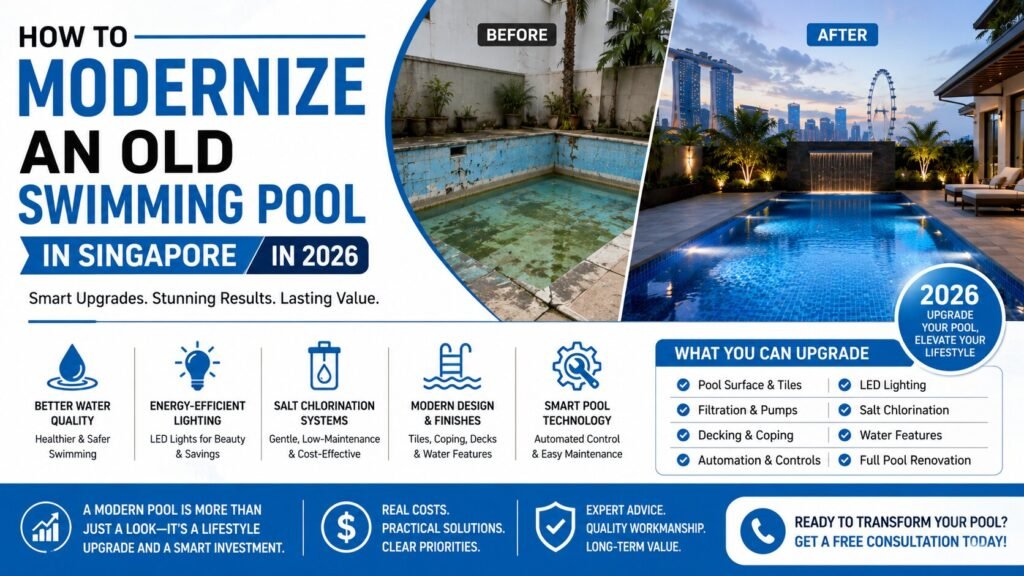
Modernizing an old pool in Singapore typically involves a combination of structural restoration, equipment upgrades, and aesthetic improvements. The most impactful upgrades are waterproofing and retiling to restore structural integrity, converting to salt chlorination for softer water and lower maintenance, and adding LED underwater lighting. Not all upgrades require a full renovation. Some can be done independently while the pool remains in service.
An old pool in Singapore does not always need to be completely rebuilt to feel new again. Some pools need full renovation. Others need targeted upgrades that transform the experience without the cost and downtime of a complete strip-back. The key is knowing which category your pool falls into, and then prioritizing the upgrades that make the biggest difference for your budget. This guide covers both paths clearly.
Step 1: Assess the Current Condition Before Deciding Anything
Assess an old pool by running a tap test across all tiled surfaces, checking for water loss beyond normal evaporation, inspecting grout joint condition throughout, reviewing equipment age and performance, and looking for signs of waterproofing failure including efflorescence, hollow tiles, and damp soil around the pool. If structural issues are present, they must be addressed before cosmetic or equipment upgrades. Modernizing a pool with a failing waterproofing membrane without addressing the membrane first produces short-lived results. There are two distinct types of old pool in Singapore.
Type 1: Structurally sound but dated
The pool holds water correctly. Tiles are solid when tapped. Equipment works adequately. The pool just looks tired, uses old technology, or is inefficient to run. This pool is a strong candidate for targeted upgrades without full renovation.
Type 2: Structurally compromised and dated
Tiles are hollow across multiple sections. Water loss is ongoing. Grout is broadly deteriorating. Equipment is aging and failing. This pool needs renovation first, then upgrades as part of that renovation scope.
Trying to modernize a Type 2 pool with equipment and aesthetic upgrades while the structural issues are unresolved wastes money. The pool surface will continue to fail regardless of how good the new lighting or chlorinator is. If you are unsure which type your pool is, a professional inspection will confirm it. We carry out free site inspections across Singapore. See Our Pool Repair and Renovation Singapore service page for what an inspection involves.
Modernization Path 1: Structural Restoration (For Type 2 Pools)
If the pool has structural issues, these must come first. Modernization built on a compromised structure will not last.
What structural work does an old pool typically need before modernization?
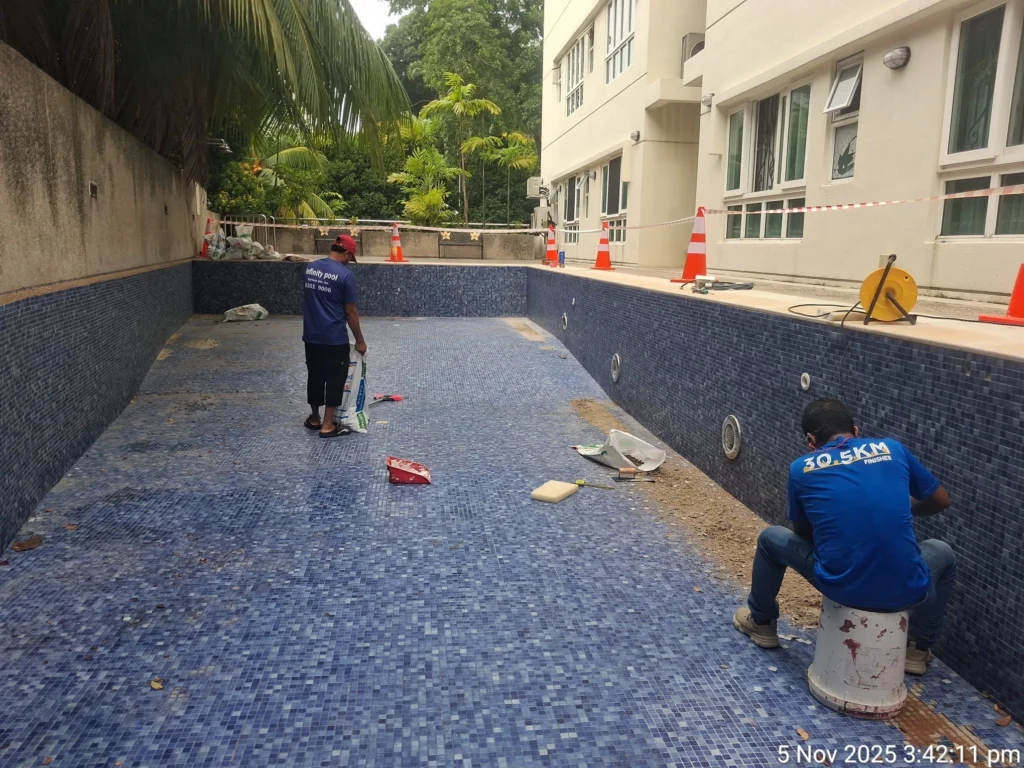
An old pool with widespread tile failure, ongoing water loss, or a history of repeated repairs typically needs full waterproofing and retiling before any other modernization is worthwhile. This involves draining the pool, removing all tiles, repairing structural cracks in the shell, applying a new waterproofing membrane, flood testing, and retiling with new tiles. This scope resets the pool structurally and opens the opportunity to upgrade equipment simultaneously. This is not just a cost. It is the foundation that makes every other upgrade investment worthwhile.
A new salt chlorinator on a pool that is leaking through the shell still leaks. New underwater LED lights in a pool with failing tiles still has failing tiles. Structural restoration done properly means the next round of maintenance or upgrade work starts from a clean base. For the full waterproofing process and costs, See Our Pool Waterproofing Singapore service page. For the full renovation scope and what to expect, See Our Complete Pool Renovation Guide for Singapore Homes.
The renovation also unlocks the best tile upgrade opportunity
When tiles are removed for waterproofing, you choose what goes back. This is the moment to upgrade from a dated 1990s tile design to something that reflects current aesthetics. The incremental cost of choosing premium tiles over standard tiles at this stage is significantly lower than changing tiles again later.
Modernization Path 2: Targeted Upgrades (For Type 1 Pools)
If the pool structure is sound, targeted upgrades can transform the pool experience without the cost and downtime of full renovation.
What are the best upgrades for a structurally sound but dated pool?
The most impactful upgrades for a structurally sound old pool in Singapore are: converting from traditional chlorine to salt chlorination for better water quality and lower maintenance, replacing old halogen underwater lights with LED lighting for energy savings and improved aesthetics, upgrading the pump to a variable speed model for significant electricity savings, and regrouting if grout joints are deteriorating but tiles are still solid. Each of these can be done independently without draining the pool or disrupting the tile surface. Here is a priority order for common upgrades:
Upgrade 1: Switch to Salt Chlorination
This is the upgrade that changes the daily experience of the pool most noticeably.
Converting from traditional chlorine dosing to a salt chlorination system means the pool generates its own chlorine automatically from dissolved salt. The water feels noticeably softer. Eye and skin irritation from chloramines is significantly reduced. Manual chemical dosing is largely eliminated.
For a family that swims regularly, this upgrade is felt every time the pool is used.
The salt cell is installed inline with the return plumbing. No pool draining is required. No tiles are touched. Installation takes half a day to a full day.
Cost: SGD 800 to SGD 2,500 for a standard residential pool including equipment, installation, and initial salt loading.
For full details on what the system involves and how it is installed, See Our Pool Salt Chlorination Installation and Replacement service page.
If you are uncertain whether salt chlorination suits your pool, our earlier guide covers this in detail: What Is a Salt Chlorination System for Swimming Pools?
Upgrade 2: Replace Halogen Lights with LED Underwater Lighting
Older Singapore pools often have halogen underwater lights that are energy-hungry, run hot, and produce a flat, yellowish light.
LED underwater lights use 60 to 80 percent less electricity than halogen equivalents. They produce brighter, more even illumination with better colour rendering. Many LED systems offer colour-changing options that transform the pool’s evening appearance.
LED pool lights also last significantly longer than halogen lamps. Halogen bulbs typically need replacing every 1 to 2 years. Quality LED pool lights last 5 to 10 years under normal use. The replacement process involves removing the old light fitting from the niche, disconnecting the electrical supply, fitting the new LED unit, and resealing the niche. The pool can often be partially drained for light replacement rather than fully drained.
Cost: SGD 300 to SGD 1,200 per light depending on the LED system selected.
For this service, See Our Underwater Swimming Pool Lighting Replacement service page.
Upgrade 3: Replace the Pump with a Variable Speed Model
Old single-speed pool pumps run at full capacity continuously. They are loud, inefficient, and expensive to run in Singapore’s electricity pricing environment. Variable speed pumps (VSPs) adjust their speed to match the actual demand at any given time. Circulation at low speed uses dramatically less electricity than continuous full-speed operation. Most pool owners who switch to a variable speed pump see their pool electricity costs drop by 40 to 60 percent. VSPs are also quieter than single-speed pumps, which matters for homes where the equipment area is near the living space or garden.
The replacement is straightforward: the old pump is disconnected and removed, the new variable speed pump is installed on the same plumbing connections, and the timer and controller are set for the appropriate run cycle.
Cost: SGD 500 to SGD 1,500 for the pump plus installation, depending on the model selected.
For pump repair and replacement options, See Our Swimming Pool Pump Repair and Replacement service page.
Upgrade 4: Regrout the Pool
If the pool tiles are solid but the grout joints between them are cracking, staining, or crumbling, regrouting refreshes the appearance of the pool without any tile replacement. Fresh grout immediately makes an old pool look cleaner and newer. Choosing a new grout colour can change the overall visual impression of the pool significantly. A white or light grey grout makes tiles look cleaner. A contrasting dark grout creates a more defined, contemporary look.
Regrouting also protects the waterproofing membrane beneath the tiles. Deteriorated grout lets water behind the tiles, which undermines the adhesive and eventually reaches the waterproofing layer. Timely regrouting maintains the structural protection that keeps the pool holding together between full renovations. Cost: SGD 1,500 to SGD 6,000 for a standard residential pool depending on pool size and grout type. For the full guide on regrouting, See Our Blog: What Is Swimming Pool Regrouting and Why Is It Important?
Upgrade 5: Replace the Filter System
Sand filters over 8 to 10 years old lose efficiency as the filter media becomes compacted and fouled. A pool with an old filter often shows reduced water clarity and increased chemical consumption because the filter is no longer trapping fine particles effectively. Replacing the filter media (for sand filters) or the entire filter body is a straightforward upgrade that immediately improves water clarity and reduces the chemical load needed to maintain it.
Cost: Filter media replacement SGD 200 to SGD 500. Full filter body replacement SGD 500 to SGD 1,500. For filter servicing and replacement, See Our Filter Servicing and Replacement service page.
Modernization Path 3: Aesthetic Upgrades During Renovation
If the pool is undergoing renovation for structural reasons, the renovation scope creates the opportunity for aesthetic modernization at the lowest incremental cost.
What aesthetic upgrades can be made during pool renovation?
During a pool renovation while tiles are removed and the pool is drained, the most cost-effective aesthetic upgrades are premium tile selection, updated coping material and design, pool surround resurfacing, addition of water features, and shape or depth modification if desired. These options carry incremental costs relative to a standard renovation but are significantly cheaper to add during renovation than as standalone projects later.
Tile design upgrade
Choosing glass mosaic or premium porcelain tiles instead of standard ceramic mosaic changes the look of the pool entirely. The tile cost per sqm increases but the labour cost is identical. The incremental cost for premium tiles over standard tiles on a standard residential pool is typically SGD 3,000 to SGD 10,000 depending on the premium tile chosen.
Updated coping
Pool coping frames the pool visually. Replacing dated concrete coping with natural stone, porcelain, or brushed concrete coping changes the aesthetic significantly. Coping is most cost-effective to replace during a tile renovation when the pool edge is already being worked on.
Cost: SGD 1,500 to SGD 5,000 depending on perimeter length and material.
Pool surround resurfacing
The deck or paving around the pool is the most visible part of the pool area from the house. Resurfacing or replacing dated paving transforms the overall visual impression of the pool zone. This work does not require the pool to be drained and can be scheduled independently.
Cost: SGD 3,000 to SGD 15,000 depending on area and material.
Water feature addition
A simple deck jet or cascade feature added during renovation changes the pool ambience significantly with modest cost. Most features are connected to the existing plumbing during the renovation while the plant room is open.
What Modernizing an Old Pool Costs in Singapore
Modernizing an old pool in Singapore costs between SGD 800 and SGD 45,000 depending on what the pool needs. Targeted equipment upgrades such as salt chlorination and LED lighting cost SGD 1,500 to SGD 4,000 combined. A full structural renovation with premium tiles and equipment upgrades costs SGD 25,000 to SGD 45,000. Most Singapore landed home pool modernizations fall between SGD 5,000 and SGD 20,000 depending on the starting condition and goals.
| Modernization Scope | Estimated Cost (SGD) |
| Salt chlorination conversion | SGD 800 to SGD 2,500 |
| LED lighting replacement (2 lights) | SGD 600 to SGD 2,400 |
| Variable speed pump replacement | SGD 500 to SGD 1,500 |
| Full regrouting with epoxy grout | SGD 2,500 to SGD 6,000 |
| Coping replacement | SGD 1,500 to SGD 5,000 |
| Full renovation (standard tiles) | SGD 12,000 to SGD 22,000 |
| Full renovation (premium tiles) | SGD 18,000 to SGD 35,000 |
| Full renovation plus equipment upgrades | SGD 20,000 to SGD 45,000 |
The most cost-effective modernization approach is to combine equipment upgrades with a renovation that is already needed for structural reasons. Doing everything while the pool is drained for waterproofing avoids multiple separate mobilisation costs and produces a pool that is reset at every level simultaneously.
Prioritizing Your Modernization Budget
If budget is a constraint, here is a practical priority order for modernization spend.
Priority 1: Fix structural issues first
If the pool has failing waterproofing, widespread hollow tiles, or ongoing water loss, no other upgrade makes sense until these are resolved. Structural integrity is the foundation of everything else.
Priority 2: Convert to salt chlorination
This upgrade has the biggest daily impact on the pool experience. The water quality improvement is immediate and noticeable. The running cost savings recover the installation cost over 2 to 3 years.
Priority 3: Replace old lighting with LED
Energy savings are real and the aesthetic improvement is significant. Evening use of the pool is transformed.
Priority 4: Regrout if tiles are solid but joints are failing
Protects the investment in the pool structure and improves appearance at moderate cost.
Priority 5: Replace the pump with a variable speed model
Meaningful electricity savings over the medium term. Most relevant on pools with older single-speed pumps that run continuously.
Priority 6: Aesthetic upgrades
Coping, surrounds, water features, and tile design upgrades are genuinely valuable but should follow structural and equipment priorities rather than precede them.
Getting a Free Modernization Assessment
Not sure where your pool sits on the structural versus cosmetic spectrum? A free site inspection will tell you clearly. At Infinity Pool Services, we assess the full condition of the pool and give you a prioritized recommendation for what to address first, what can wait, and what the different upgrade paths will cost. There is no obligation to proceed with any work after the inspection. We serve Bukit Timah, Sentosa Cove, Tanglin, Novena, Serangoon Gardens and Katong East Coast. Book a Free Pool Assessment: infinitypool.com.sg/contact or call: +65 8301 9006
Frequently Asked Questions
Can I modernize an old pool without Full Renovation?
Yes, if the pool structure is sound. Pools with solid tile bonds, no ongoing water loss, and functioning equipment can be meaningfully modernized through targeted upgrades including salt chlorination conversion, LED lighting, pump replacement, and regrouting. Full renovation is only necessary when structural issues such as waterproofing failure or widespread tile detachment are present.
What is the best upgrade for an old pool in Singapore?
Salt chlorination conversion produces the most immediate and noticeable improvement in the daily swimming experience. The water feels softer, chemical management is simpler, and ongoing chlorine costs are significantly lower. For pools with aging equipment and dated lighting, combining salt chlorination with LED light replacement and a variable speed pump covers the three most impactful upgrades at reasonable cost.
How do I know if my old pool needs renovation or just upgrades?
Tap all tiles across the pool surfaces. Hollow-sounding tiles in multiple areas indicate adhesive failure from waterproofing breakdown, meaning renovation is needed before upgrades. Also check water loss: mark the water level and check after 24 hours without using the pool. Loss significantly beyond the evaporation rate (2 to 5 mm per day) suggests the pool needs structural attention before modernization.
How much does it cost to upgrade a pool in Singapore?
Targeted equipment upgrades cost SGD 800 to SGD 6,000 depending on which upgrades are done. A full renovation with equipment upgrades costs SGD 20,000 to SGD 45,000 for a standard landed home pool. Most Singapore pool owners modernizing without full renovation spend SGD 3,000 to SGD 8,000 on a combination of salt chlorination, lighting, and regrouting.
Is it worth modernizing an old pool or better to replace it?
In almost all cases, modernizing through renovation and targeted upgrades is more cost-effective than demolishing and rebuilding a pool. A full pool demolition and rebuild in Singapore costs SGD 80,000 to SGD 200,000 or more depending on the pool design and site conditions. A thorough renovation with equipment upgrades costs SGD 20,000 to SGD 45,000 and produces a pool that performs like new for the next 10 to 15 years.
Can I convert my pool to salt chlorination without draining it?
Yes. Salt chlorination installation does not require draining the pool. The salt cell is installed inline on the return plumbing and the controller is mounted near the equipment. Salt is then added to the pool water and dissolved by normal circulation. No structural work is involved. The installation is completed in half a day to a full day.
How long does pool modernization take in Singapore?
Targeted upgrades such as salt chlorination, LED lighting, and pump replacement can be completed in 1 to 2 days without draining the pool. Regrouting takes 3 to 5 days including draining and grout curing. A full renovation with equipment upgrades takes 2 to 4 weeks. The timeline depends on which combination of work is being done and whether structural renovation is included.
What is the best tile choice when modernizing a pool in Singapore?
For modernization during renovation, glass mosaic tiles are the most popular premium choice among Singapore landed property owners currently. They produce excellent light refraction, particularly with LED underwater lighting, and give the pool a contemporary appearance. Standard ceramic mosaic is the most cost-effective choice and performs reliably in Singapore conditions. Porcelain pool tiles offer a contemporary alternative in larger formats.
Should I upgrade pool lighting at the same time as other pool work?
Yes, wherever possible. If the pool is being drained for renovation, upgrading lighting during the same project avoids a separate future visit that may require partial draining. LED pool light replacement can also be done independently of other work, but combining it with regrouting or equipment upgrades during a single contractor visit is more cost-efficient.
How long will a modernized pool last in Singapore before needing work again?
A pool that has been properly renovated with new waterproofing, retiled with quality tiles, and fitted with upgraded equipment should perform well for 10 to 15 years before another renovation is warranted. Grout maintenance through regrouting every 5 to 8 years and annual equipment servicing extend the interval. Consistent water chemistry management is the single most important factor in how long the renovation lasts.