
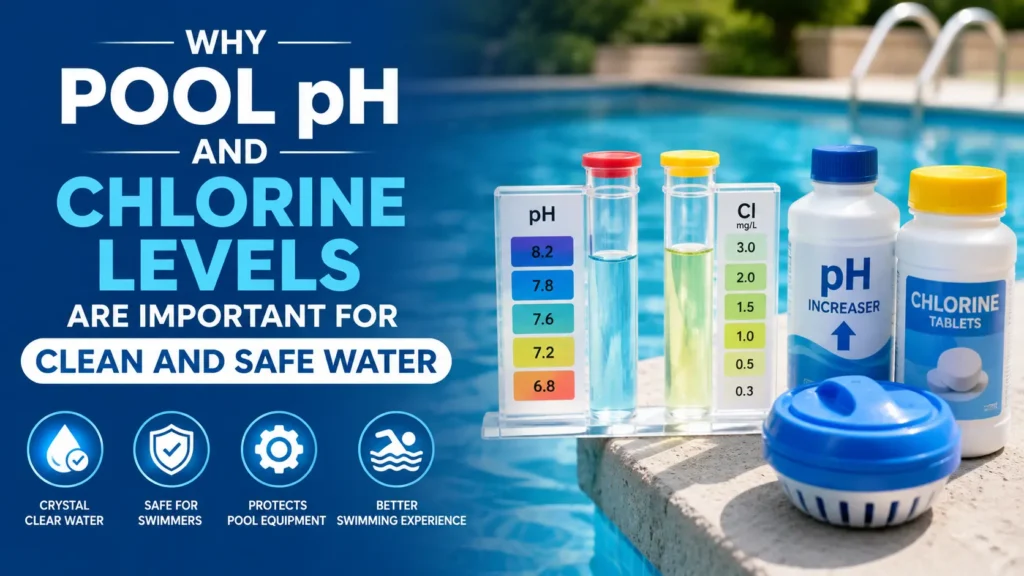
Most complaints we get about “bad water” aren’t really about dirt or algae. They’re about chemistry. A homeowner in Katong calls to say the water is stinging their kids’ eyes. Someone in Novena notices the pool smells strongly of chlorine even though they just topped it up. Someone else in Bukit Timah finds the water turning slightly cloudy despite skimming it every other day. Nine times out of ten, the root cause is the same thing: pH and chlorine levels have drifted out of range, and nobody caught it in time.
This isn’t a small technical detail best left to pool technicians. pH and chlorine are the two numbers that decide whether your pool is actually safe to swim in, not just clear-looking. Get them wrong, and you’re either swimming in water that can’t kill bacteria properly, or water that irritates skin, eyes, and swimwear. In Singapore’s heat and humidity, both numbers move faster than most homeowners expect, which is exactly why this deserves more attention than it usually gets.
What pH Actually Does in Your Pool
pH measures how acidic or alkaline your pool water is, on a scale of 0 to 14, with 7 sitting in the middle as neutral. For swimming pools, the target range is 7.2 to 7.6, which sits close to the natural pH of human eyes and skin. That’s not a coincidence — it’s the range where water feels comfortable rather than harsh. When pH drifts outside that window, two different problems show up, depending on which direction it moves:
Low pH (below 7.2) — water turns acidic. This eats away at metal fittings, ladder rails, and heater components through corrosion. It also breaks down grout and can etch plaster or tile surfaces over time. Swimmers usually notice red, stinging eyes and dry, itchy skin first.
High pH (above 7.6) — water turns alkaline. This causes cloudy water, scale buildup on tiles and equipment, and clogged filters. It also makes chlorine far less effective, which is where the real safety issue comes in.
That last point is worth sitting with for a moment, because it’s the one most homeowners miss entirely.
Why Chlorine Depends Entirely on pH
Chlorine doesn’t work as a single, fixed sanitiser. Once it’s added to water, it splits into two forms: hypochlorous acid (the active, germ-killing form) and hypochlorite ion (a much weaker form that barely does anything). Which form dominates depends almost entirely on pH.
At a pH of 7.5, roughly half of your chlorine is working at full strength. Push that pH up to 8.0, and the effective portion drops sharply — you could be dosing the pool with plenty of chlorine and still not be killing bacteria properly, because the water chemistry is working against it. This is why a pool can test “high” for chlorine and still develop cloudy water or an algae bloom. The chemical is present, but it isn’t doing its job.
This is also the answer to a question we get constantly: “Why does my pool smell so strongly of chlorine?” Counterintuitively, a strong chemical smell usually means chlorine levels are unbalanced, not high-performing. That smell comes from chloramines, a byproduct formed when chlorine reacts with sweat, urine, and body oils instead of being free to sanitise the water. Properly balanced pools with correct free chlorine levels barely smell of chlorine at all.
What the Numbers Should Actually Be
For a private residential pool in Singapore, the ranges generally recommended by pool professionals are:
| Parameter | Ideal Range |
|---|---|
| pH | 7.2 – 7.6 |
| Free Chlorine | 1.0 – 3.0 ppm |
| Total Alkalinity | 80 – 120 ppm |
| Calcium Hardness | 200 – 400 ppm |
| Cyanuric Acid (stabiliser) | 30 – 50 ppm |
Total alkalinity deserves a mention here because it acts as a buffer for pH — without it sitting in the right range, pH swings wildly every time it rains or the pool gets topped up, which is a near-daily occurrence in Singapore. If you’ve balanced pH once and it keeps drifting back out within a day or two, low or high alkalinity is usually the reason underneath.
Why Singapore’s Climate Makes This Harder Than It Looks
Water chemistry doesn’t sit still here the way it might in a cooler climate. A few local factors push pH and chlorine out of range faster than most homeowners plan for:
- Heat accelerates chlorine breakdown. Sunlight and warm water both degrade chlorine faster, meaning a pool can lose sanitising power within hours on a hot afternoon.
- Frequent rain dilutes chemicals and drops pH. Rainwater is mildly acidic, and Singapore’s near-daily showers mean pH needs checking more often than the “once a week” advice that works elsewhere.
- Heavy pool usage adds contaminants. Sunscreen, sweat, and body oils all consume chlorine and shift the water’s chemical balance, especially in family pools used daily.
- Humidity affects test kit accuracy. Test strips and reagents stored in humid outdoor sheds degrade faster than most people realise, which quietly leads to bad readings and bad dosing decisions.
We see this pattern most often in pools near the coast — Sentosa Cove and Katong East Coast properties in particular — where salt air combines with heat to throw both chlorine stability and equipment condition off faster than inland pools experience. It’s one of the reasons our saltwater pool system servicing includes a closer look at chlorinator output alongside standard chemical testing.
Signs Your Chemistry Is Off, Before You Even Test the Water
You don’t always need a test kit to know something’s wrong. Watch for:
- Cloudy or hazy water, even after cleaning
- A strong chlorine smell, especially indoors near covered pools
- Eyes or skin feeling irritated after a swim
- Green tint developing along tile lines or in corners
- Scale or white residue forming on tiles and fittings
- Metal ladders, rails, or fixtures showing rust faster than expected
If cloudy or green water is already showing, chemistry correction alone often isn’t enough — the pool usually needs a proper shock treatment and clean-out first. That’s the exact situation our Green Pool Recovery service is built to handle, since algae that’s taken hold in the water and along the pool walls needs more than a chlorine top-up to clear.
How to Keep Levels Balanced Between Visits
A few habits go a long way toward keeping pH and chlorine stable, even in Singapore’s fast-changing conditions:
- Test more often after rain. A heavy downpour is often enough to knock pH down a full point. If your area’s had a storm, test before you assume the pool is fine.
- Add chemicals in the evening, not midday. Direct sun burns off chlorine fast, so dosing after sunset gives it more time to work before the next hot afternoon.
- Don’t chase chlorine with more chlorine. If chlorine readings look low, check pH first. Correcting pH often brings the effective chlorine level back up without adding more product.
- Keep test kits fresh and stored properly. Reagents and strips degrade in heat and humidity. If your readings look inconsistent from week to week, the kit itself may be the problem.
- Have your filter checked if chemistry keeps drifting. A filter that isn’t circulating water properly makes chemical balancing far harder to maintain, which is where our filter servicing and replacement service usually comes in.
Why This Isn’t Something to Guess Your Way Through
Pool chemistry sits at the intersection of comfort, equipment lifespan, and genuine health and safety. Poorly balanced water isn’t just uncomfortable, it can allow bacteria like E. coli and Cryptosporidium to survive despite the pool “looking” clean, which is a real risk for children, older swimmers, and anyone with a compromised immune system. This is exactly why we treat water testing as a core part of every routine visit rather than an afterthought, and it’s the same standard behind our regular Swimming Pool Cleaning service.
If you’re noticing cloudy water, a strong chemical smell, or irritation after swimming, and you’re not confident the fix is as simple as adding more chlorine, it’s worth having a technician test and correct the full chemical profile rather than guessing with over-the-counter kits. We work with private pools across Bukit Timah, Novena, Tanglin, Serangoon Gardens, Katong / East Coast, and Sentosa Cove, and chemical balancing is one of the most common reasons homeowners in these areas first call us.
Frequently Asked Questions
What’s the ideal pH level for a swimming pool?
Between 7.2 and 7.6. This range keeps chlorine effective while staying gentle on skin, eyes, and pool equipment.
Can I swim in a pool with high chlorine?
Yes, within reason, but chlorine that reads high while the water still smells strong or looks cloudy usually points to a pH or chloramine problem rather than a genuinely over-chlorinated pool. It’s worth testing the full chemical profile rather than assuming the pool is over-treated.
Why does my pool water sting my eyes even though I add chlorine regularly?
This is almost always a pH problem, not a chlorine problem. Low pH makes water acidic and irritating, even when chlorine levels look normal on a basic test strip.
How often should I test pH and chlorine in Singapore?
At least twice a week for most residential pools, and immediately after heavy rain or a spell of heavy pool use. Singapore’s heat and frequent showers move these numbers faster than in most other climates.
Does rain really affect pool chemistry that much?
Yes. Rainwater is naturally acidic and dilutes chemical concentration, so a single storm can drop both pH and chlorine levels noticeably, particularly in uncovered pools. If your pool’s chemistry has been hard to pin down, or you’d rather have a technician handle testing and dosing properly, you can request a quote or get in touch and we’ll take it from there.