
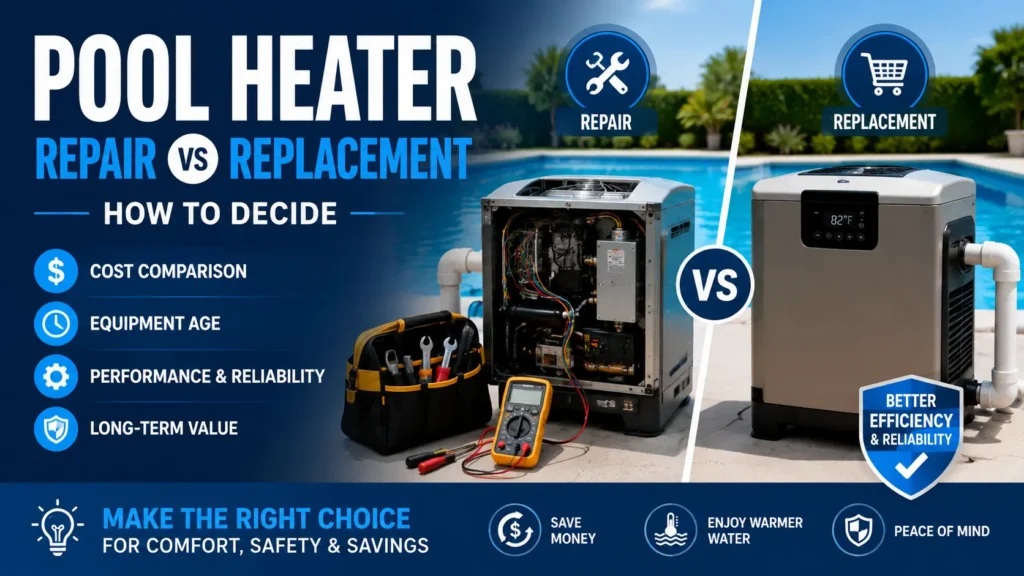
A pool heater rarely fails all at once. It usually starts small — the water takes a bit longer to warm up than it used to, or the heater cycles on and off more than it should, or there’s a faint burning smell when it first kicks in. Homeowners tend to live with these quirks for weeks, sometimes months, before calling anyone, mostly because it’s not obvious whether the fix is a quick repair or the start of a bigger, more expensive conversation.
That uncertainty is the real problem. Calling out a technician for every strange noise gets expensive fast, but ignoring the wrong warning sign can mean a heater that fails completely, sometimes taking other equipment down with it. This guide walks through how we actually make the repair-or-replace call when we’re standing in front of a pool heater in Singapore, so you have a framework before you’re the one making that decision.
Start With the Age of the Unit
Age is the single biggest factor, and it’s the first thing worth checking before anything else. Most pool heaters, whether gas, electric, or heat pump systems, are built to last somewhere between 8 and 12 years with proper maintenance. Singapore’s heat and humidity tend to sit at the shorter end of that range, since components corrode and wear faster in constant warm, moist air than they would in a drier climate.
If your heater is under 5 years old, repair is almost always the right call, provided the unit hasn’t been neglected. Between 5 and 8 years, it depends heavily on what’s actually broken. Past 8 years, we generally steer clients toward replacement once a real fault shows up, because the unit is close enough to the end of its expected life that further repairs tend to buy only a short reprieve before the next issue.
What the Repair Actually Costs vs What’s Left of the Unit’s Life
There’s a rule of thumb worth applying here: if the repair cost is more than 30 to 50% of what a new unit would cost, replacement is usually the smarter move financially. A heat exchanger replacement or a major control board failure, for instance, can run close to half the price of a new heater on an older unit, at which point you’re spending significant money to extend the life of equipment that’s already past its most reliable years.
Our general equipment repair and replacement work typically falls in the SGD 150 to 800 range for pool equipment, though heater-specific repairs can run higher depending on the part involved, especially heat exchangers or compressor components on heat pump units. A technician should always give you the actual repair quote alongside a rough figure for full replacement before you commit, so you’re comparing real numbers rather than guessing.
Common Heater Problems and What They Usually Mean
Heater won’t turn on at all. Sometimes this is as simple as a tripped breaker, a closed gas valve, or a flow switch that isn’t detecting water movement (which usually points back to the pump or a clogged filter, not the heater itself). If it’s an electrical or ignition component, repair is often possible unless the unit is already old.
Water isn’t reaching the set temperature. This can mean a struggling heat exchanger, a buildup of scale restricting flow, or simply an undersized heater for the pool’s volume. Scale buildup is repairable through descaling; a genuinely failing heat exchanger on an older unit usually isn’t worth fixing.
Heater cycles on and off repeatedly (short cycling). Often caused by poor water flow, a dirty filter, or a failing thermostat. This is frequently linked to filtration issues rather than the heater itself, which is why we usually check filter condition through our filter servicing and replacement service before assuming the heater needs major work.
Rust or visible corrosion on the housing. In Singapore, especially for homes near the coast in Sentosa Cove or Katong / East Coast, salt air speeds up corrosion on any metal housing or internal components. Surface rust alone doesn’t mean replacement, but rust that’s reached internal wiring or the heat exchanger usually does.
Burning smell or unusual noise on startup. This needs a technician’s eyes immediately rather than a wait-and-see approach. It can indicate anything from dust burn-off (harmless) to a failing motor or electrical fault (not harmless). We’d rather a homeowner call about a false alarm than skip this one.
Error codes on a digital display. Modern heat pump and electric units usually display a fault code rather than failing silently. These codes point technicians straight to the problem, which usually shortens the diagnosis and makes the repair-versus-replace decision more straightforward.
Heat Pumps, Gas Heaters, and Electric Heaters Age Differently
The type of heater you have changes this calculation slightly. Heat pumps, which are the most common choice for Singapore pools given the climate, tend to have a longer expected lifespan than gas heaters but rely on a compressor that’s expensive to replace individually — when that component fails on an older unit, replacement of the whole system is usually more sensible than a compressor swap. Gas heaters have simpler components that are often cheaper to repair individually, but their heat exchangers are more prone to corrosion in humid, salt-air conditions. Electric resistance heaters are the least common locally due to higher running costs, but their repairs tend to be more contained and less expensive when something does go wrong.
If you’re not sure which type you have or whether it’s still a good fit for your pool, that’s worth asking about directly during a service visit rather than assuming the current setup is optimal.
When Replacement Is Actually the Better Financial Decision
A few scenarios where we’d steer a homeowner toward replacement even if the current unit is technically repairable:
- The heater is over 8 years old and the fault involves a major component (heat exchanger, compressor, or control board)
- You’ve already had two or more repairs on the same unit within the past 18 months
- The unit is undersized for your pool and has been working harder than it should for years, accelerating wear
- Energy bills have crept up noticeably, suggesting the heater is losing efficiency even when it’s “working”
- Replacement parts for your specific model are becoming hard to source, which happens more often with older or discontinued units
Newer heat pump models are also considerably more energy-efficient than units built even five to seven years ago, so a replacement sometimes pays part of itself back through lower monthly running costs, particularly for pools that get heated regularly.
When Repair Is Still the Right Call
Repair generally makes sense when the unit is younger, the fault is isolated to a single, moderately priced component, and there’s no pattern of repeat failures. A first-time issue on a heater under 5 years old, for example, almost never justifies full replacement. The same goes for problems traced back to something else entirely, like a clogged filter or an aging pump restricting water flow to the heater — fixing the actual root cause through our pump repair and replacement service can resolve what looked like a heater problem without touching the heater at all.
Why This Isn’t a Decision to Make on Guesswork
A pool heater involves gas lines, high-voltage electrical connections, or refrigerant systems depending on the type, and getting a diagnosis wrong, or attempting a DIY fix, carries real safety risk beyond just wasted money. This is squarely a job for a trained technician who can test the actual fault rather than replace parts on a hunch. It’s also why we always give clients both numbers, the repair estimate and the replacement estimate, side by side, so the decision is based on real figures rather than a guess about which one is “probably cheaper.”
If your heater has been acting up and you’re not sure which way to go, an inspection through our equipment repair and replacement service will give you a clear answer, along with an honest recommendation, before you spend money on either option. We service pools across Bukit Timah, Novena, Tanglin, Serangoon Gardens, Katong / East Coast, and Sentosa Cove.
Frequently Asked Questions
How long do pool heaters typically last in Singapore?
Most heaters last 8 to 12 years elsewhere, but Singapore’s heat and humidity often push that toward the lower end, especially for units without regular servicing.
Is it cheaper to repair or replace a pool heater?
It depends on the age of the unit and what’s actually broken. As a rough guide, if the repair costs more than 30 to 50% of a new unit’s price, replacement is usually the better long-term value.
Why does my pool heater keep turning on and off?
This is called short cycling and is often linked to restricted water flow from a dirty filter or aging pump rather than the heater itself. It’s worth having flow checked before assuming the heater needs replacing.
Can I repair a pool heater myself?
We’d strongly advise against it. Pool heaters involve gas lines, high-voltage electrical components, or refrigerant systems, and incorrect handling is a genuine safety risk, not just a warranty issue.
What type of pool heater is best for Singapore’s climate?
Heat pumps are generally the most practical choice locally given the consistent ambient warmth, though the right option depends on pool size, usage patterns, and running cost preferences.
If your heater’s giving you trouble and you’d rather get a straight answer than guess, you can request a quote or get in touch and we’ll take a look.