
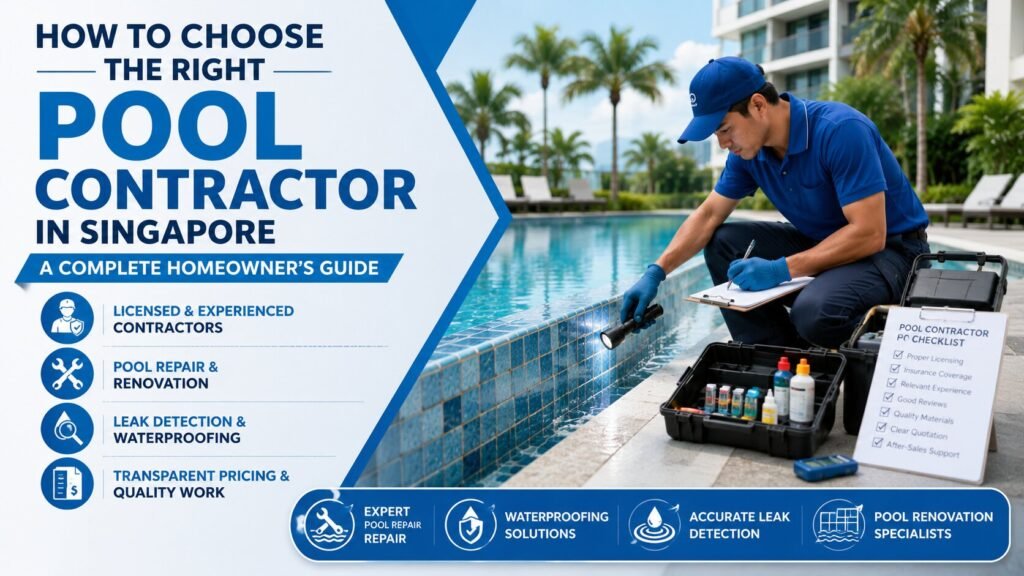
Choosing the right pool contractor in Singapore means verifying they conduct a site inspection before quoting, produce detailed written scopes of work, use their own team rather than subcontracting, provide a written workmanship warranty, have documented experience with the specific type of work you need, and give honest recommendations rather than overselling work you do not need. The contractor who quotes lowest is often the one who has omitted the most from the scope.
Hiring the wrong pool contractor in Singapore is one of the most common and most expensive mistakes pool owners make. The pool looks fine for a year. Then the tiles start coming off. The same leak appears. A second contractor comes to inspect and finds the root cause was never addressed. Getting the right contractor from the start is a better investment than paying twice. This guide covers how to evaluate contractors properly before committing to any scope of work.
Why Contractor Choice Matters More in Pool Work Than Most Trades
Pool work in Singapore involves materials and methods that are hidden once the job is complete. Waterproofing is buried under tiles. Pipe repairs are underground. Adhesive quality is concealed by the tile face. You cannot inspect these after completion without undoing the work. This means a contractor who cuts corners produces results that look identical to a contractor who does the job correctly, for 12 to 24 months. After that, the difference becomes very visible and very expensive to fix. This asymmetry between what is visible and what determines quality is what makes contractor selection so critical in pool work.
A residential building has multiple trades whose work can be independently inspected. Electrical work is tested. Plumbing is pressure tested. Concrete work can be core sampled. Pool waterproofing is buried under tiles and not visible. The only indicator of quality before the tiles go down is whether the contractor did a proper flood test and whether you witnessed it or have a written record of it. This is why the questions you ask before engaging a contractor matter more in pool work than in most other property trades.
Step 1: Identify What Type of Contractor You Actually Need
Singapore pool contractors broadly fall into three categories: maintenance contractors who handle regular cleaning and chemical management, repair and renovation contractors who handle structural work including waterproofing, retiling, and crack repair, and specialist contractors who focus on specific systems such as leak detection, salt chlorination, or equipment servicing. Some contractors cover all three categories. Others specialise. Matching your needs to the right type of contractor is the first step. Understanding which type you need prevents the common mistake of engaging a maintenance contractor for a structural repair that requires specialist knowledge, or vice versa.
If your pool is losing water or tiles are detaching: You need a repair contractor with leak detection and structural repair capability. A maintenance contractor who manages chemicals and cleans the pool weekly is not the right person to diagnose and fix a waterproofing failure.
If the pool needs full renovation: You need a renovation contractor with demonstrated waterproofing experience, not a general tile contractor who has done bathrooms and kitchens.
If equipment is failing: You need an equipment specialist or a full-service contractor with equipment servicing capability.
If you want ongoing pool care: You need a maintenance contractor with the right service frequency for your pool type and the chemical management knowledge appropriate for Singapore’s conditions.
Some contractors do all of this well. Many specialise. Be clear on what you need before evaluating anyone.
Step 2: Require a Site Inspection Before Any Quote
A pool quote produced without a site inspection is a guess. The contractor has not assessed the tile bond condition, structural crack extent, waterproofing status, plumbing condition, or equipment age. Any number they give you is an estimate based on assumptions. For minor maintenance work, this may be acceptable. For any repair, renovation, waterproofing, or leak detection scope, a quote without a site inspection is not a reliable basis for a decision. The site inspection tells you things about the contractor before they have done any work.
A contractor who visits in person, taps the tiles systematically, assesses the grout joints, runs a water loss check, and inspects the equipment before quoting is demonstrating the diagnostic process they will apply to the actual job. A contractor who gives you a renovation quote over the phone after you describe the pool is telling you they work without adequate information. For any significant scope of work, require the inspection first. At Infinity Pool Services, every quote for repair, renovation, waterproofing, or leak detection is based on a free site inspection.
Step 3: Evaluate the Quote Itself
A proper pool contractor quote should specify: exact pool surface area in square metres, tile brand, type, size, and colour for any tiling scope, waterproofing system named explicitly with flood test included, whether structural crack repair is in scope or billed separately if found, coping and equipment upgrade scope clearly listed, project timeline from start to completion, workmanship warranty terms and duration, and what happens if additional issues are discovered after work begins. A single total price with no breakdown is not a complete quote. Walk through any quote you receive against this checklist:
Tile scope: Does it name the tile? Standard ceramic mosaic and glass mosaic cost very different amounts. “Pool tiles” as a line item could mean anything.
Waterproofing: Is it listed explicitly? What system? Does the quote include a flood test or not? A renovation quote without waterproofing listed is either a retile-only scope or it is omitting waterproofing intentionally.
Structural work: How are cracks handled if found after tile removal? Is there an allowance in the quote, or will unexpected cracks be charged extra with no ceiling?
Timeline: Does the quoted timeline allow for proper waterproofing cure and flood testing? A full residential pool renovation completed in under 10 days has not had adequate cure or flood testing time.
Warranty: Is it written? What does it cover? What is excluded? A verbal assurance of a warranty is not a warranty.
If a quote is missing these elements, ask for a revised version that includes them before making any decision.
Step 4: Verify Experience for Your Specific Scope
Ask the contractor directly for examples of similar projects they have completed. For renovation work, ask how many full waterproofing and retiling projects they have done in the past 12 months. For leak detection, ask what detection methods they use and whether they produce a written report before quoting repairs. For condo pool work, ask which condo developments they have worked in and how they coordinate with MCST management. General experience in pool work does not guarantee specific competence in the scope you need. Specific questions to ask depending on the scope:
For waterproofing and renovation:
Do you flood test every waterproofing job before tiling? How long is your curing period for the membrane before testing? What membrane system do you use and why did you select it for our pool type? What happens if the flood test fails?
For leak detection:
What specific detection methods do you use? Do you produce a written report before quoting repairs? Is the detection fee separate from the repair cost? Have you done pressure testing on pool plumbing before?
For underground pipe repairs:
Do you use acoustic detection to locate the fault before excavating? What is your post-repair process for confirming the fix before backfilling?
Step 5: Check Whether They Use Their Own Team
A contractor who uses their own trained team on every job produces consistent results because the same people apply the same methods and standards each time. A contractor who subcontracts work to different third-party teams on each job has limited control over the quality of the actual workmanship. Pool work that involves waterproofing, tile adhesive application, or crack injection is particularly sensitive to the experience and discipline of the person doing the work, not just the contractor who quoted it.
Ask directly: is the team that quotes my job the same team that carries out the work? Subcontracting is not inherently wrong but the best pool contractors in Singapore typically use their own team. This also affects accountability. When something goes wrong after a job done by a subcontractor, the engagement between you and the main contractor can become unclear about responsibility.
At Infinity Pool Services, we use our own team on every job. The person who inspects your pool is the person responsible for the work being done correctly.
Step 6: Understand the Warranty
A pool contractor’s workmanship warranty should cover the repair or renovation work carried out against failures that result from poor workmanship within a defined period, typically 12 to 24 months. It should specify what is covered (the work scope), what is excluded (material manufacturing defects, damage from pool chemistry mismanagement, physical impact), how a warranty claim is made, and what remedy the contractor provides. A warranty that does not specify these elements is not a real warranty. Common warranty limitations to be aware of:
Material vs workmanship: Most contractors warranty their workmanship but not the tile or membrane manufacturer’s product performance. This is reasonable. Understand which is which.
Water chemistry exclusion: A contractor may exclude warranty claims where tile failure is caused by consistently unbalanced pool chemistry. This is also reasonable. Acid pool water attacks grout and adhesive regardless of installation quality.
Scope limitation: The warranty covers what was done. If a repair was carried out on one section and a different section fails, that is not a warranty claim on the first repair. Get the warranty in writing before work begins. A contractor who cannot or will not put warranty terms in writing is a risk.
Red Flags: When to Walk Away
These are the patterns that consistently precede bad pool work outcomes in Singapore.
Quote produced without a site visit
Any contractor who quotes renovation, waterproofing, or repair work without visiting the pool and inspecting it properly is working with insufficient information. The quote will be inaccurate, and the inaccuracy will resolve against you when the job is on-site.
No waterproofing in a renovation quote
A renovation that does not include waterproofing is a retile, not a renovation. It will produce the same tile failure within 2 to 3 years. If waterproofing is not a line item in the quote, ask directly whether it is included. If the answer is no, find a different contractor or ask for a revised scope that includes it.
No flood test in the scope
The flood test is the only confirmation that the waterproofing membrane is performing before it is covered by tiles. A contractor who does not include a flood test either does not know this step exists or plans to skip it. Both outcomes are bad.
Unusually short timeline for full renovation
A proper full renovation for a residential pool takes 14 to 28 days. If a contractor quotes 5 to 7 days for the same scope, critical steps are being compressed or skipped. Curing periods and flood testing cannot be shortened without consequence.
Significantly lower price with no scope explanation
A price that is 40 to 50 percent lower than other quotes without a clear explanation of what is different in the scope almost always reflects scope that is actually missing. Ask what has been removed.
Pressure to decide immediately
Legitimate pool contractors in Singapore do not pressure you to sign before you have reviewed the quote, compared it with others, or had time to ask questions. Pressure tactics are a flag about how the relationship will develop.
Choosing a Contractor for Repair vs Renovation vs Leak Detection
The right contractor for maintenance is not necessarily the right contractor for renovation. The right contractor for renovation is not necessarily the right contractor for leak detection. Here is how to match the scope to the contractor type.
For pool repair (tiles, grout, minor cracks):
Look for demonstrated experience in the specific repair type. A contractor who has done many tile repairs on similar pools will have the right adhesive, the right grout removal tools, and the knowledge to assess whether the repair will hold or whether a larger scope is needed. Visit Our Pool Repair and Renovation Singapore service page for what our repair work covers.
For full renovation including waterproofing:
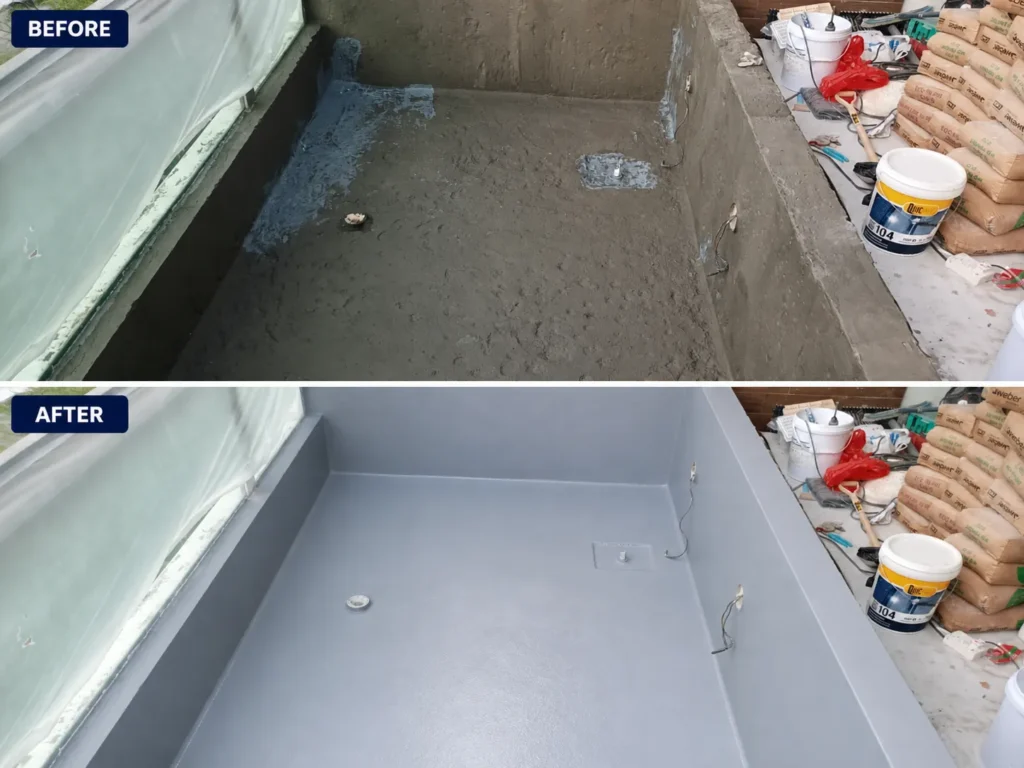
Look for a contractor who specifically mentions waterproofing and flood testing in their standard scope, not as an add-on you have to ask about. Experience with the pool type matters. Landed home pools and condo pools have different access, coordination, and standard requirements. Our Pool Waterproofing Singapore service page explains the correct waterproofing process in detail.
For leak detection:
Look for a contractor who separates detection from repair, uses calibrated pressure testing equipment, produces a written diagnostic report, and does not start repair work until you have approved a fixed repair quotation based on what the detection confirmed. Our Pool Leak Detection and Repair Singapore service page covers our detection methodology.
For salt chlorination installation:
Look for a contractor who visits the pool before quoting, sizes the cell correctly for your pool volume, specifies the brand and model they are installing, and provides a handover explanation of how to operate the system. Our Pool Salt Chlorination Installation and Replacement service page covers what a proper installation involves.
Book a Free Inspection
If you want to see how we work before committing to anything, book a free site inspection. We inspect the pool, tell you honestly what we find, and give you a written recommendation and fixed quote before any work begins. No pressure, no obligation. We serve Bukit Timah, Sentosa Cove, Tanglin, Novena, Serangoon Gardens and Katong East Coast. Book a Free Inspection: infinitypool.com.sg/contact or call +65 8301 9006
Frequently Asked Questions: Choosing a Pool Contractor in Singapore
How do I choose a good pool contractor in Singapore?
Look for a contractor who inspects the pool before quoting, produces a detailed written scope of work with all materials specified, includes waterproofing and flood testing in any renovation scope, uses their own team rather than subcontracting, provides a written workmanship warranty, and has verifiable experience in the type of work you need. The cheapest quote is rarely the most complete scope.
Should I get multiple quotes for pool work in Singapore?
Yes, particularly for renovation, waterproofing, and significant repair scopes. Getting two or three quotes allows you to compare scopes, not just prices. Quotes that are significantly lower than others usually reflect different scope, not greater efficiency. Compare what each quote includes rather than focusing only on the total number.
What questions should I ask a pool contractor before hiring them?
Ask: Do you conduct a site inspection before quoting? Is waterproofing included in the renovation scope? Do you flood test after waterproofing and before tiling? What membrane system do you use? Does the quote cover structural cracks discovered after tile removal? Do you use your own team? What does your workmanship warranty cover and for how long?
Is the cheapest pool contractor in Singapore usually a good choice?
Rarely for significant structural work. Pool waterproofing, renovation, and leak detection are quality-sensitive jobs where the cheapest option usually omits critical steps such as waterproofing, flood testing, or adequate curing time. The cost of a renovation that fails within 2 years and needs to be redone is significantly more than the price difference between a cheap and a correctly priced quote.
What is a pool contractor workmanship warranty?
A workmanship warranty is a written commitment from the contractor that if any work they completed fails within the warranty period due to poor workmanship, they will return and rectify it at no charge. It should specify the duration, what is covered, what is excluded, and how a claim is made. A verbal assurance is not a warranty. Get it in writing before work begins.
Should a pool renovation contractor conduct a flood test?
Yes. A flood test is the only way to confirm that a waterproofing membrane is performing before tiles cover it. Any contractor who tiles over waterproofing without a flood test has no way to know whether the waterproofing is working. When it fails two years later, the entire tile surface has to be removed to fix it. Require a flood test as a standard part of any waterproofing scope.
How do I know if a pool contractor uses their own team?
Ask directly: is the team that carries out the work the same team employed by your company? A contractor who uses subcontractors may answer indirectly. Follow up by asking: do you subcontract any part of the tile, waterproofing, or structural work? A direct answer, either way, is the information you need.
What should I do if a pool contractor finds unexpected problems after starting work?
A reputable contractor stops work, shows you what was found, explains the options and associated costs, and waits for your written approval before proceeding with additional scope. They do not continue without your approval and then present an inflated invoice at completion. Establish this process expectation before work begins.
How long should a Pool Renovation take in Singapore?
A standard full renovation for a residential pool takes 14 to 28 days. Any contractor quoting 5 to 7 days for a full renovation is compressing or skipping critical steps including waterproofing curing time and the 24 to 48 hour flood test. Rushing these steps produces a renovation that looks correct but fails within 2 to 3 years.
Can I hire one contractor for pool renovation and a different one for ongoing maintenance?
Yes. Many Singapore pool owners use a specialist renovation or repair contractor for structural work and a maintenance contractor for regular cleaning and chemical management. These are different skill sets and there is no obligation to use the same company for both. What matters is that each contractor is well suited to the specific scope they are engaged for.