
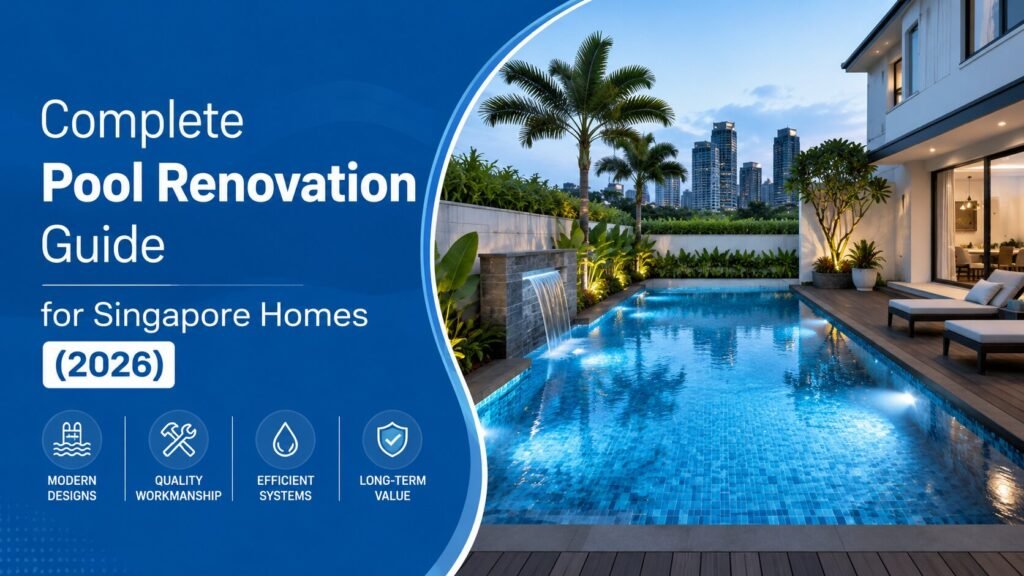
A complete pool renovation in Singapore involves draining the pool, removing all existing tiles, inspecting and repairing the pool shell, applying a new waterproofing membrane, flood testing the membrane, retiling with new tiles and grout, and refilling with rebalanced water. The process takes 2 to 4 weeks for a standard residential pool and costs SGD 12,000 to SGD 40,000 depending on pool size, tile selection, and equipment upgrades included.
Renovating a pool is a significant investment. Done properly, it resets the pool to full structural integrity and surface condition for the next 10 to 15 years. Done poorly, it produces the same problems within 2 to 3 years with a much larger bill. This guide covers the complete renovation process from deciding whether you need one through to handing the renovated pool back into use. Every stage is covered so you know exactly what should happen, what questions to ask, and what to watch for.
Part 1: Do You Actually Need a Renovation?
How do you know if a pool needs a full renovation?
A pool needs a full renovation when damage is widespread rather than isolated, when the waterproofing membrane has failed across large areas, when tiles are hollow or detaching in multiple sections, when the pool has not been renovated in 12 to 15 years, or when multiple systems are failing simultaneously. Targeted repair is appropriate for isolated, specific problems. When damage is broad and structural, renovation is the only lasting solution.
Before committing to a renovation, a professional inspection will confirm whether it is genuinely needed. The inspection involves:
- Tap testing all tiled surfaces to identify hollow or debonded tiles
- Assessing grout condition across all joints
- Checking for water loss beyond normal evaporation
- Reviewing equipment condition and age
- Assessing the overall structural condition of the pool shell
If the inspection shows that tile failure is widespread, the waterproofing membrane is broadly degraded, or multiple systems need replacement, renovation is the financially sound choice. Attempting to repair a pool that needs renovation leads to repeated short-term fixes that together cost more than a renovation done once properly. For a detailed guide on this decision, See Our Blog: Pool Repair vs Pool Renovation: What’s the Difference?
Part 2: What a Full Pool Renovation Includes
What is included in a complete pool renovation?
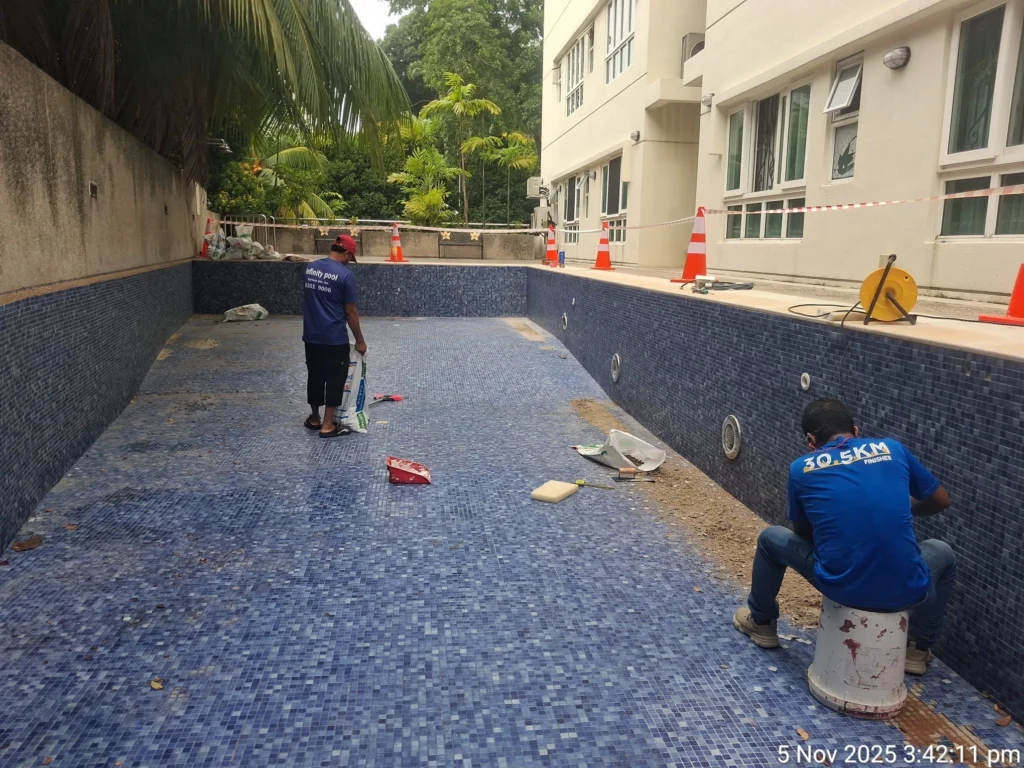
A complete pool renovation includes full tile removal across all surfaces, structural crack inspection and repair, application of a new waterproofing membrane, flood testing before tiling begins, full retiling with new tiles and fresh grout, coping and pool edge restoration where needed, equipment assessment and upgrades where required, pool refill, and water chemistry rebalancing. Any scope that skips the waterproofing step or the flood test is not a complete renovation. Here is a breakdown of each component:
- Full tile removal
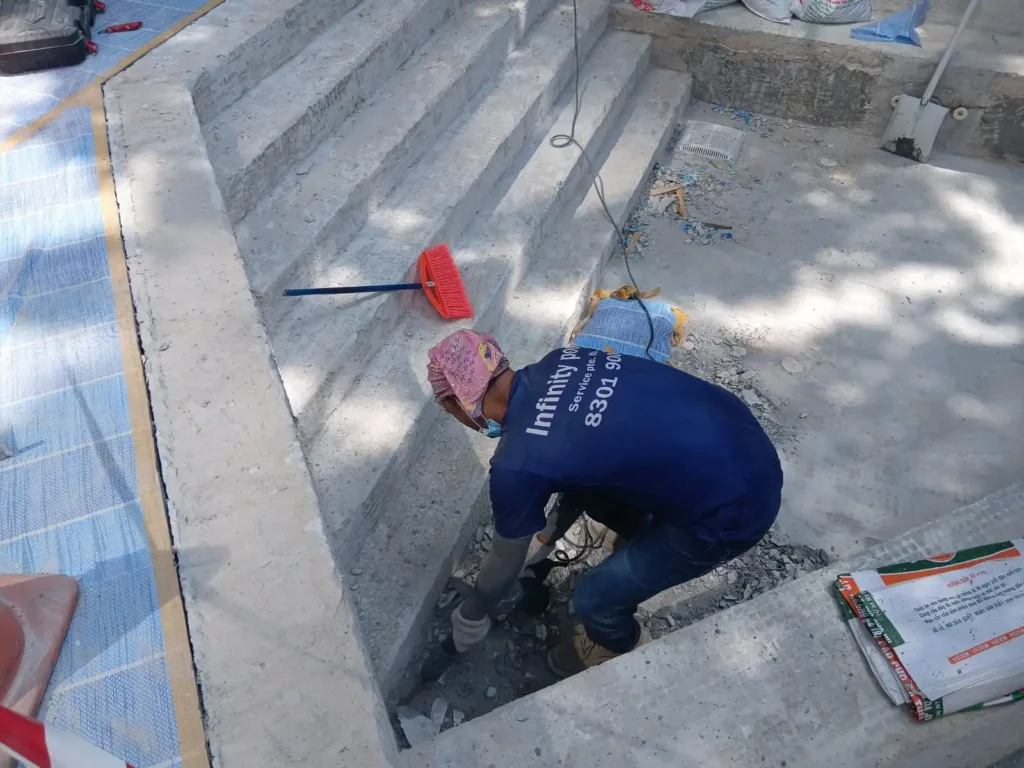
All existing tiles are removed from the pool walls, floor, and steps. This is done by demolition for a full renovation, which is faster than careful extraction. The tiles are discarded. All old adhesive is ground off the substrate. - Structural shell inspection and crack repair
With tiles removed, the pool shell is inspected fully for hairline cracks and structural damage. Cracks are repaired using epoxy injection or concrete patching before any waterproofing is applied. Applying waterproofing over an unrepaired crack produces a membrane that fails at that crack line quickly. - Waterproofing membrane application
A new waterproofing system is applied to the prepared substrate. The system is selected based on the pool type, age, and budget. Liquid applied membrane (LAM) is the most common for residential pools. Sheet membrane is used for rooftop and penthouse pools. Cementitious systems are used where the structure is very sound and the budget is tighter. The membrane is applied in the correct number of coats to the specified dry film thickness. - Flood testing
This is non-negotiable. Before any tile is laid over the new membrane, the waterproofed surface is ponded with water for 24 to 48 hours. If the test passes, tiling proceeds. If any area fails the test, it is addressed and retested before moving on. Contractors who skip this step are guessing at whether the waterproofing works. You find out when the tiles start falling off two years later. - Tiling
New tiles are selected and laid with pool-grade flexible adhesive using the back-buttering method to ensure full contact coverage. Spacers maintain consistent joint width. Tiles are checked for alignment and level across all surfaces. - Grouting
Fresh pool-grade grout is applied to all joints. Epoxy grout is recommended for below-waterline and waterline joints due to its chemical resistance and durability in Singapore’s pool environment. The grout is allowed to cure for the required period before the pool is refilled. - Coping and surrounds
Pool coping (the cap along the pool edge) is assessed during renovation. If it is in poor condition, it is replaced. Pool surrounds may be resurfaced separately if needed. - Equipment assessment and upgrades
Renovation is the best time to address aging equipment. The pool is drained, the plant room is accessible, and the installation team is on-site. Common upgrades include salt chlorinator installation, pump replacement, filter upgrade, and underwater lighting replacement.
Part 3: Renovation Options and Scope Levels
Not all renovations are at the same scale. Understanding the options helps you plan and budget correctly.
What are the different levels of pool renovation?
Pool renovation ranges from a partial renovation of one damaged section to a full structural renovation including equipment upgrades and design changes. The level appropriate for a given pool depends on the extent and location of the damage, the age of the pool, and the owner’s goals. Most Singapore residential pools fall into the mid-range: full waterproofing, standard tile retile, and basic equipment review.
Partial renovation
One section of the pool has widespread tile failure while the rest of the pool is sound. Only the damaged section is retiled, with waterproofing work focused on that area. This is a legitimate and cost-effective approach when the rest of the pool genuinely passes a tap test and is structurally sound.
Cost range: SGD 3,000 to SGD 8,000.
Full waterproofing and retile with standard tiles
All tiles are removed across the full pool. New waterproofing is applied. Standard ceramic mosaic tiles are used for the retile. This is the most common renovation scope for Singapore residential pools.
Cost range: SGD 12,000 to SGD 22,000.
Full renovation with premium tiles
Same scope as above but with glass mosaic, porcelain, or imported stone tiles. The tile cost increases significantly, which is often the biggest variable in premium renovation pricing.
Cost range: SGD 18,000 to SGD 35,000.
Full renovation with equipment upgrades
Full waterproofing and retile plus pump, filter, or salt chlorinator replacement or installation. The most comprehensive renovation scope that resets all aspects of the pool simultaneously.
Cost range: SGD 20,000 to SGD 45,000+.
For the detailed cost breakdown by component, See Our Blog: How Much Does Pool Renovation Cost in Singapore?
Part 4: Choosing Your Tiles
Tile selection is the most visible and most personal decision in any renovation. It is also one of the biggest cost variables.
What tiles are best for pool renovation in Singapore?
Standard ceramic mosaic tiles (2.5cm x 2.5cm) are the most cost-effective and most widely used option for Singapore residential pool renovation. They are pool-rated, durable in Singapore’s climate, and available in a wide range of colours. Glass mosaic tiles produce a different visual effect with better light refraction and are preferred in premium properties. Porcelain pool tiles offer a more contemporary look with larger format options. All tile selections must be pool-rated with a slip-resistant finish for floor and step applications. Common tile choices and their approximate supply costs:
| Tile Type | Approx. Supply Cost Per Sqm |
| Standard ceramic mosaic | SGD 30 to SGD 60 |
| Porcelain pool tile | SGD 50 to SGD 100 |
| Glass mosaic | SGD 60 to SGD 120 |
| Premium imported glass or stone | SGD 120 to SGD 300+ |
Practical considerations for tile selection in Singapore:
Heat absorption: Dark tiles absorb more heat from Singapore’s direct sun. A pool with dark navy or black tiles will be noticeably warmer than one with white or light blue tiles. This may be desirable in cooler months but less comfortable in peak heat.
Slip resistance: Floor tiles and step tiles must have a textured or matte surface finish. Glazed or polished tiles are not safe for pool floors regardless of how they look.
Grout joint size: Smaller mosaic tiles have more grout joints per square metre than larger format tiles. More joints mean more surface area of grout to maintain, but also more flexibility to follow curved surfaces cleanly.
Light effects: Glass mosaic tiles refract light differently from ceramic tiles, particularly in pools with underwater lighting. If the pool aesthetic matters, view samples in water before deciding.
Part 5: The Renovation Process Step by Step
What is the step-by-step process for pool renovation in Singapore?
A complete pool renovation in Singapore follows this sequence: site inspection and written quote, pool drainage, tile removal and debris clearance, structural crack inspection and repair, substrate surface preparation, waterproofing primer application, waterproofing membrane application in the correct coats, full curing period, 24 to 48 hour flood test, tile laying with pool-grade adhesive and spacers, grouting with pool-grade epoxy or waterproof grout, grout curing period, pool refill, and water chemistry rebalancing. Each step must be completed correctly before the next begins. Here is the timeline in realistic Singapore terms:
| Phase | Typical Duration |
| Pool drainage | 0.5 to 1 day |
| Tile removal and debris clearance | 1 to 3 days |
| Structural crack repairs | 1 to 3 days (if required) |
| Surface grinding and preparation | 1 day |
| Primer application | 1 day |
| Waterproofing membrane application | 1 to 2 days |
| Waterproofing curing | 2 to 4 days |
| Flood test | 1 to 2 days |
| Tile laying | 3 to 7 days depending on pool size and tile type |
| Grout application and curing | 2 to 3 days |
| Refill and water chemistry balancing | 1 to 2 days |
| Total typical timeline | 14 to 28 days |
The curing and flood testing phases are where impatient contractors cut corners. Rushing the waterproofing cure period or skipping the flood test produces a renovation that looks correct but fails within 2 to 3 years. Insist that both are included.
Part 6: Equipment Upgrades to Consider During Renovation
Renovation is the ideal time to upgrade equipment because the pool is already drained, the plant room is accessible, and no additional mobilisation cost is needed.
What equipment should be upgraded during a pool renovation?
Equipment worth reviewing for upgrade during a renovation includes the pump, filter system, salt chlorinator, underwater lighting, and automation systems. Equipment over 7 to 8 years old that is approaching end of life is worth replacing during the renovation to avoid a separate drainage and installation visit within 2 to 3 years. Combining equipment upgrades with renovation is almost always more cost-effective than doing them separately.
Salt chlorinator installation
If the pool currently uses traditional chlorine, renovation is the ideal time to convert to salt chlorination. The pool is drained, the plumbing is accessible, and the conversion can be completed as part of the same project. Cost: SGD 800 to SGD 2,500 additional. Our Pool Salt Chlorination Installation and Replacement service page covers this upgrade in detail, including sizing, brand selection, and what the installation involves.
Pump replacement
Variable speed pumps are significantly more energy efficient than older single-speed pumps. Replacing during renovation avoids a future drainage for plumbing access. Cost: SGD 500 to SGD 1,500 additional.
Filter upgrade
A sand filter approaching 8 to 10 years old is worth replacing. Media replacement or filter body replacement during renovation is far easier than retrofitting later. Cost: SGD 500 to SGD 1,500 additional.
Underwater lighting
LED lighting uses significantly less electricity than older halogen pool lights. Replacing during renovation avoids opening the pool surround for electrical access later. Cost: SGD 300 to SGD 1,200 per light.
Part 7: Choosing the Right Renovation Contractor in Singapore
This is where the renovation succeeds or fails. The materials and process are important. The people applying them are more important.
What should I look for when choosing a pool renovation contractor in Singapore?
Choose a pool renovation contractor in Singapore who conducts a site inspection before quoting, produces a detailed written scope with all work items specified, includes waterproofing and flood testing in the quote explicitly, has demonstrable experience with residential and condo pool renovation, provides a written workmanship warranty, and uses their own team rather than subcontracting the work. The cheapest quote rarely reflects the most complete scope.
Here is a checklist for evaluating any renovation quote:
The quote specifies:
- Pool surface area being renovated in square metres
- Tile brand, type, size, and colour
- Waterproofing system specified by name and whether flood test is included
- Whether structural crack repair is included or billed separately if found
- Coping and surrounds scope clearly stated
- Equipment upgrades listed individually
- Project timeline from drainage to handover
- Workmanship warranty terms and duration
Red flags to watch for:
- Quote produced without a site visit
- No mention of waterproofing in the scope
- No flood test included
- Single line item with a total price only
- Timeline of less than 10 days for a full renovation
- Significantly lower price than other quotes without a clear explanation of what is different
A renovation quote that looks cheaper because it omits waterproofing or skips the flood test is not a cheaper renovation. It is a partial renovation that will need to be redone sooner. At Infinity Pool Services, every renovation quote is based on a free site inspection, specifies all work items individually, and includes waterproofing and flood testing as standard. We use our own team on every job.
Part 8: After the Renovation Protecting Your Investment
A properly done renovation resets the pool for 10 to 15 years. Protecting that investment requires consistent maintenance after the renovation is complete.
How do you maintain a pool after renovation to protect the investment?
After renovation, maintain pool water chemistry within the recommended ranges for pH (7.2 to 7.6), total alkalinity (80 to 120 ppm), calcium hardness (200 to 400 ppm), and free chlorine (1.0 to 3.0 ppm). Have the pool professionally serviced monthly. Schedule a grout inspection every 3 to 4 years. Have the pool tap tested every 5 years to check tile bond condition. Address any grout deterioration promptly through regrouting before it reaches the waterproofing layer beneath.
Post-renovation maintenance that extends pool life:
Regular water chemistry management
Unbalanced water chemistry is the fastest way to damage a newly renovated pool. Low pH (acidic water) attacks grout and tiles. High pH reduces chlorine effectiveness and encourages scale. Have the water tested professionally at least monthly.
Timely regrouting when grout shows wear
The new grout from a renovation will last 5 to 12 years depending on the type and water chemistry management. When grout begins to deteriorate, regrout promptly. Allowing grout to fail and water to reach the new membrane shortens the waterproofing lifespan significantly. Our Swimming Pool Regrouting service page covers what regrouting involves and when to schedule it.
Protecting pool surfaces from chemical imbalance
Consistently low pH or high chlorine levels bleach tile colour, attack grout, and can stain pool surfaces permanently. Use a quality water test kit or have the water tested professionally rather than guessing at dosing.
Annual equipment servicing
Pump seals, filter media, and salt cells all have service intervals. Sticking to these prevents premature equipment failure that might require the pool to be drained again before the next renovation cycle.
Book Your Free Renovation Assessment
If your pool is showing signs that renovation is needed, or if you want an honest professional opinion on the current condition of your pool, our team is ready to help. At Infinity Pool Services, we carry out free site inspections for pool owners across Singapore. We assess the tile bond condition, grout integrity, waterproofing status, equipment age, and overall pool condition. You receive a written assessment and a detailed renovation quote before committing to anything. We serve Bukit Timah, Sentosa Cove, Tanglin, Novena, Serangoon Gardens and Katong East Coast. Book a Free Renovation Assessment: infinitypool.com.sg/contact or call: +6583019006
Frequently Asked Questions: Pool Renovation Singapore
How long does a full pool renovation take in Singapore?
A standard full renovation for a residential pool in Singapore takes 2 to 4 weeks from draining to refill. The waterproofing curing period takes 2 to 4 days before flood testing can begin. The 24 to 48 hour flood test follows before tiling starts. Larger pools or those requiring significant structural repairs take longer. Quotes promising full renovation in less than 10 days are skipping critical steps.
How much does pool renovation cost in Singapore?
Full renovation with waterproofing and standard tile retile typically costs SGD 12,000 to SGD 22,000 for a standard landed home pool. Premium tiles increase this to SGD 18,000 to SGD 35,000. Equipment upgrades add further costs depending on what is replaced. Partial renovations start from SGD 3,000. See our full cost guide at How Much Does Pool Renovation Cost in Singapore?
Does pool renovation always require waterproofing?
Yes. In any proper renovation, tiles are removed and a new waterproofing membrane is applied before new tiles are laid. A retile without waterproofing is not a renovation. It is a surface job that produces the same tile and water loss problems on the same timeline as before, usually within 2 to 3 years.
How do I know when my pool needs renovation?
Key indicators are: hollow-sounding tiles across multiple sections of the pool, consistent water loss beyond normal evaporation, tiles detaching without physical cause, visible efflorescence on pool surfaces, widespread grout deterioration, and the pool being over 12 to 15 years old without a renovation history. A professional inspection confirms whether renovation is warranted.
Can I use the same tiles as before in a renovation?
If the original tiles are still being manufactured and are available from suppliers in Singapore, yes. Many older tile designs are discontinued. If an exact match cannot be found, you can use the closest available match for a partial renovation, or choose a new tile design for a full renovation. Your contractor should raise this before removal begins, not after.
What is the best time of year to renovate a pool in Singapore?
Singapore’s weather is relatively consistent year round. There is no poor season for pool renovation from a weather perspective. The best time is when the pool is already showing signs requiring renovation. Waiting to reach a “better time” while the waterproofing continues to fail increases the eventual renovation scope and cost. Renovation during a planned property upgrade or coinciding with other major works is cost-effective because of shared access and mobilisation.
Can I stay in my home during pool renovation?
Yes. Pool renovation does not require you to vacate the property. Work is carried out at the pool area only. The main impacts are noise from tile removal (which is the loudest phase), reduced garden access around the pool, and the pool being out of service for the duration. Most homeowners find this manageable for a 2 to 4 week period.
Should I upgrade to a salt chlorinator during renovation?
If your pool currently uses traditional chlorine and the system is more than 7 years old, renovation is the ideal time to upgrade. The pool is already drained and the plumbing is accessible. Converting during renovation costs significantly less than a standalone conversion later because no additional drainage is required. The softer water and lower ongoing chemical costs make the upgrade worthwhile for pools used regularly.
How long should a properly done pool renovation last in Singapore?
A renovation done to the correct standard, including proper waterproofing, flood testing, quality tile adhesive and grout, and correct curing times, should last 10 to 15 years in Singapore conditions before another renovation is warranted. This assumes balanced water chemistry management and timely regrouting when grout begins to deteriorate.
What questions should I ask a pool renovation contractor before hiring them?
Ask whether the quote is based on a site inspection, whether waterproofing is included as a line item, whether a flood test is included, what waterproofing system they use and why, what tile brands and specifications they are quoting, how structural crack repairs are handled if found after tile removal, what the workmanship warranty covers and for how long, and whether they use their own team or subcontract the work. A contractor who cannot answer these clearly is not ready to manage your renovation.