
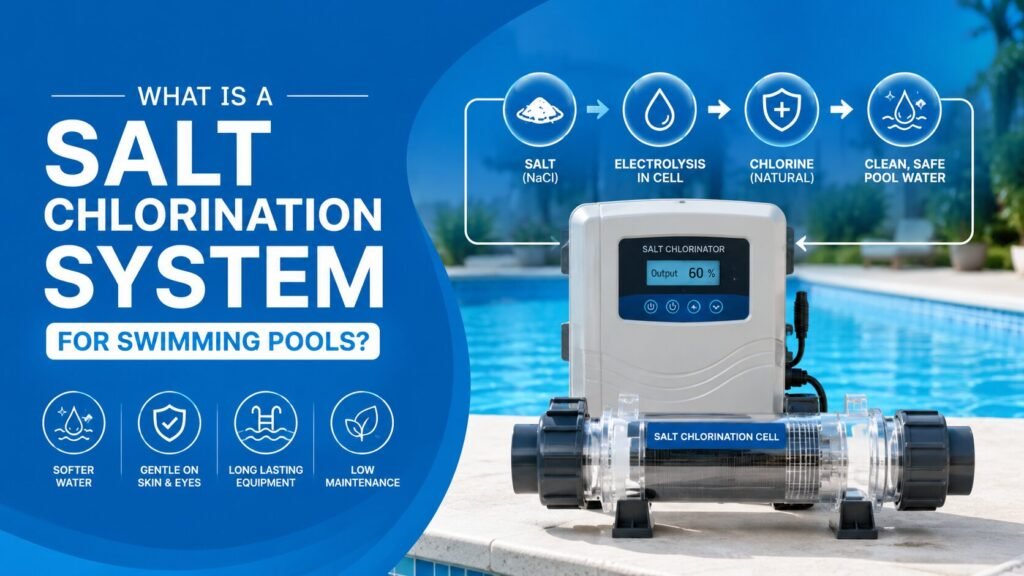
A salt chlorination system is a pool sanitation method that uses electrolysis to convert dissolved salt in the pool water into chlorine. The system consists of a salt cell installed inline with the pool’s return plumbing and a controller unit that regulates chlorine output. As water passes through the cell, an electrical current splits the salt molecules into chlorine, which sanitises the pool water, then reverts back to salt and repeats the cycle continuously.
More Singapore pool owners are switching to salt chlorination every year. And most of them wish they had done it sooner. But a lot of people do not fully understand how the system actually works before they decide whether to install one. The term “saltwater pool” creates some confusion too. People assume it means no chlorine, or that the water tastes like the sea, or that it is a completely different system from a chlorine pool. None of that is accurate. This guide explains exactly what a salt chlorination system is, how each component works, and what it means for day-to-day pool ownership in Singapore.
How a Salt Chlorination System Works
A salt chlorination system works through electrolysis. Pool water containing dissolved salt at around 3,000 to 4,000 parts per million passes through a salt cell that contains titanium plates coated with a reactive metal. A low-voltage electrical current from the controller passes through these plates. The electrical current splits the dissolved salt (sodium chloride) into its component elements: sodium and chlorine. The chlorine sanitises the pool water by killing bacteria and algae. After sanitising, the chlorine recombines with the sodium and reverts back to salt. The cycle continues as long as the pump runs.
The key thing to understand is that the pool is not chlorine-free. It uses chlorine for sanitation, the same as any other pool. The difference is that the chlorine is generated continuously and automatically on-site from salt rather than being purchased, stored, and dosed manually.
The pool water at the 3,000 to 4,000 ppm salt level used by most residential systems is not noticeably salty to swimmers. For comparison, seawater contains roughly 35,000 ppm of salt, approximately ten times higher. Most people cannot taste the salt at pool concentrations.
The Components of a Salt Chlorination System
Understanding what each part does helps you operate and maintain the system correctly.
The salt cell
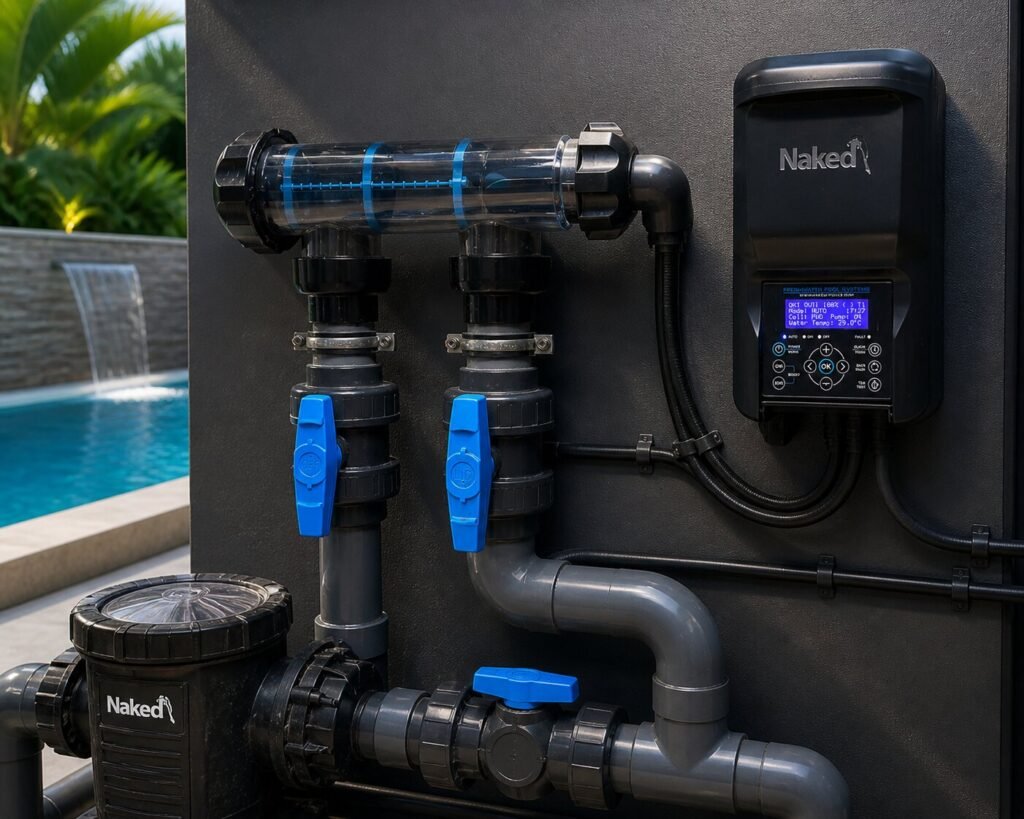
The salt cell is the core component. It is a cylindrical housing installed inline with the pool’s return plumbing line, between the filter and the pool inlets. Inside the housing are titanium plates coated with ruthenium or iridium oxide, which act as electrodes. When water flows through the cell and the controller supplies voltage, electrolysis occurs at the plate surfaces and chlorine is generated.
The cell has a finite lifespan, typically 3 to 5 years in Singapore conditions, because the reactive coating on the plates gradually depletes through use. A cell that has reached end of life produces little or no chlorine even though the controller shows it is running.
Calcium scale builds up on the cell plates over time, particularly in Singapore where tap water hardness is moderate. This scale reduces the cell’s efficiency and must be removed by acid washing every 3 to 6 months. Regular cleaning extends cell life significantly.
The controller unit
The controller is the brain of the system. It is typically mounted on the pool plant room wall near the equipment pad and connects electrically to the salt cell. The controller does several things:
- Supplies low-voltage DC current to the salt cell plates
- Regulates the percentage of time the cell is active (output percentage setting)
- Reads the salt level in the pool water through conductivity sensors
- Displays alerts and error codes when something is outside the operating range
- Runs cell reversal cycles that help prevent calcium scale build-up on the plates
The output percentage setting is what controls how much chlorine the system produces. A pool with a high bather load in Singapore’s heat needs a higher output setting than a pool used lightly. Most controllers allow the output to be adjusted between 0 and 100 percent.
The flow sensor
Most salt chlorination systems include a flow sensor installed on the plumbing line near the cell. The flow sensor detects whether water is moving through the cell before activating it. This protects the cell from running dry if the pump stops or flow is restricted. If the flow sensor triggers a fault, it usually means the pump is not running or there is a flow restriction in the plumbing.
The salt itself
Pool-grade salt (sodium chloride) is added to the pool water at setup to reach the target salinity level. For a standard 50,000-litre residential pool, this typically requires 150 to 200 kg of salt at initial setup to reach 3,000 to 4,000 ppm.
After the initial loading, salt is only lost from the pool through backwashing, splashing, and rainfall dilution. Salt does not evaporate with the water. Top-ups are needed periodically but the ongoing salt consumption is modest compared to the initial load.
Pool-grade salt is available from pool supply companies and some hardware stores in Singapore. It must be pool-grade or food-grade sodium chloride, not rock salt or industrial salt, which may contain impurities that damage the cell or affect water chemistry.
What Makes Salt Pool Water Feel Different
Saltwater pool water feels softer primarily because salt-generated chlorine produces significantly lower levels of chloramines than manually dosed chlorine pools. Chloramines form when chlorine reacts with nitrogen compounds from swimmers (sweat, urine, body oils). They cause the sharp smell, eye irritation, and skin dryness associated with heavily dosed chlorine pools. Salt chlorination systems produce a steady, lower concentration of free chlorine that reacts with contaminants before chloramine levels build up.
The salt itself also contributes slightly. Sodium chloride in water has a mildly softening effect on the skin because it is an isotonic compound similar in concentration to human body fluids at pool levels.
The practical experience of swimming in a well-maintained saltwater pool compared to a standard chlorine pool is noticeably different. Skin does not feel dry after swimming. Eyes do not sting from chemical irritation. Hair is less affected. There is no chemical smell on the skin after swimming. For families with children who swim regularly, for owners who use the pool daily, and for anyone with skin sensitivities, this difference is one of the main reasons for switching.
What a Salt Chlorination System is Not
There are several common misunderstandings about saltwater pools. Clearing these up helps owners make an informed decision.
A saltwater pool is not chlorine-free
This is the most common misconception. The pool uses chlorine for sanitation. The system generates that chlorine from salt rather than adding it from a bottle or tablet. If the salt cell stops working, the pool loses its chlorine source and will turn green just as quickly as any other pool without sanitation. The chemistry is the same. The delivery method is different.
The water does not taste or feel like the sea
The salt concentration in a residential pool system (3,000 to 4,000 ppm) is approximately ten times lower than seawater (around 35,000 ppm). The water does not taste salty to most people and is not noticeably different in texture from regular pool water other than the softer feel that comes from lower chloramine levels.
You still need to test and balance the water chemistry
A salt chlorination system automates chlorine production. It does not automate pH management, alkalinity adjustment, calcium hardness control, or salt level monitoring. All of these need to be checked regularly and adjusted when they drift outside the recommended range. Unbalanced water chemistry shortens cell life and damages pool surfaces regardless of whether the pool uses salt or traditional chlorine.
Salt is not corrosive to pool surfaces at residential concentrations
A concern sometimes raised is that salt water will corrode tiles, grout, fittings, or equipment. At the 3,000 to 4,000 ppm concentration used in residential pools, salt water is not meaningfully corrosive to properly installed pool surfaces, quality stainless steel fittings, or pool-grade equipment. Problems arise when salt levels run consistently above the recommended range, or when pool surfaces already have existing damage or deterioration that salt water can accelerate.
Maintaining a Salt Chlorination System
A salt chlorination system requires regular water testing to check free chlorine, pH, alkalinity, calcium hardness, and salt levels. The cell needs to be cleaned by acid washing every 3 to 6 months to remove calcium scale from the plates. The controller needs periodic inspection for error codes and correct output settings. Cell replacement is needed every 3 to 5 years when the coating on the titanium plates has depleted and chlorine output can no longer be maintained. Here is a practical maintenance schedule for Singapore conditions:
Weekly
- Test free chlorine (target: 1.0 to 3.0 ppm)
- Test pH (target: 7.2 to 7.6)
- Visual check of controller display for error codes
Monthly
- Test salt level (target: 3,000 to 4,000 ppm for most systems)
- Test total alkalinity (target: 80 to 120 ppm)
- Test calcium hardness (target: 200 to 400 ppm)
- Adjust controller output setting if chlorine level is drifting
Every 3 to 6 months
- Remove salt cell and inspect plates for calcium scale
- Acid wash cell if scale is present
- Inspect flow sensor and fittings for leaks or deposits
Every 3 to 5 years
- Replace salt cell when chlorine output can no longer be maintained at maximum output setting
- Consider controller inspection and replacement if displaying persistent faults
Singapore’s water has moderate calcium hardness, which means scale build-up on cell plates is a real maintenance requirement rather than an occasional issue. Owners who neglect cell cleaning see cell lifespan reduced to 1 to 2 years rather than the 3 to 5 year potential.
Is a Salt Chlorination System Right for Your Pool in Singapore?
Salt chlorination systems suit Singapore pool owners who use their pool regularly and want gentler water with less manual chemical management. They are particularly suitable for families with children who swim frequently, owners with skin sensitivities to traditional chlorine, and anyone who finds regular chlorine dosing inconvenient or inconsistent. They are less suited to pools that are rarely used, as the system still draws electricity and requires water chemistry management even when the pool sits idle. Here is a practical assessment by pool type:
Landed home pools used regularly by a family
This is the ideal use case. Daily use produces the consistent bather load that benefits most from steady automated chlorination. The softer water experience is most noticeable when you are in the pool every day. Running costs are lower than regular chlorine dosing over the medium term.
Pools used occasionally, perhaps weekly or less
A salt system still works but the financial case is weaker because the chemical savings are lower with lower usage. The water quality benefit is still present when the pool is used.
Condominium pools with high bather loads
Salt systems can handle condo pools well but need to be correctly sized for the higher bather load. Commercial-grade or high-output cells are required. We discuss this in more detail on Our Pool Salt Chlorination Installation and Replacement service page.
Penthouse and rooftop pools
Salt systems work well in elevated pool environments. The main additional consideration is ensuring the fittings and equipment are correctly rated for the installation location.
How a Salt System Is Installed
Installing a salt chlorination system in an existing pool involves cutting into the return plumbing line after the filter to create an inline connection for the salt cell housing, mounting the controller unit in or near the equipment room, running the electrical cable between the controller and the cell, adding pool-grade salt to reach the target salinity level, and commissioning the system at the correct output setting for the pool volume. The pool does not need to be drained for installation.
The installation is completed in half a day to a full day for most residential pools. No structural work is required. The main requirements are accessible plumbing near the filter return line and a suitable power supply point for the controller. The correct sizing of the cell for the pool volume is the most important decision in the installation. A cell rated for 40,000 litres installed in a 70,000-litre pool will run at maximum output continuously and still under-chlorinate. Correct sizing by a professional who measures the actual pool volume prevents this.
For the full installation process, costs, and what to look for in a quote, see our detailed blog on Salt Chlorinator Installation Cost in Singapore. If you are considering switching to salt chlorination and want an honest assessment of whether it suits your pool, our team can help.
At Infinity Pool Services, we carry out free site inspections for pool owners across Singapore. We assess your current setup, recommend the right system and cell size for your pool volume, and provide a fixed written quote with no obligation. We serve Bukit Timah, Sentosa Cove, Tanglin, Novena, Serangoon Gardens and Katong East Coast. Visit Our Homepage to see the full range of services we provide. Book a Free Consultation: infinitypool.com.sg/contact or call: +65 8301 9006
Frequently Asked Questions
What is a salt chlorination system?
A salt chlorination system is a pool sanitation method that converts dissolved salt in the pool water into chlorine through electrolysis. A salt cell installed in the return plumbing generates chlorine automatically as water flows through it. The chlorine sanitises the pool, reverts to salt, and the cycle repeats. The system replaces manual chlorine dosing with automated, continuous chlorine generation.
Is a saltwater pool actually chlorine-free?
No. A saltwater pool uses chlorine for sanitation. The difference is that the chlorine is generated automatically from salt by the cell rather than being added manually. If the salt cell fails, the pool loses its chlorine source and will go green. The water chemistry is the same as a chlorine pool. The delivery method is different.
How much salt does a pool need for a salt chlorination system?
A standard residential pool of 50,000 litres requires approximately 150 to 200 kg of pool-grade salt at initial setup to reach the target level of 3,000 to 4,000 ppm. After initial loading, salt only needs to be topped up periodically as it dilutes through backwashing, splashing, and rainfall. The ongoing salt consumption is modest.
How long does a salt cell last in Singapore?
A salt cell in Singapore typically lasts 3 to 5 years. Lifespan depends on how well the pool water chemistry is maintained, how regularly the cell is cleaned to remove calcium scale, and how consistently the system is operated within its rated capacity. A well-maintained cell in balanced water reaches the upper end of that range.
Does a Saltwater Pool require less maintenance than a traditional chlorine pool?
It requires different maintenance, not necessarily less. A salt system eliminates manual chlorine dosing. But you still need to test and balance pH, alkalinity, calcium hardness, and salt levels regularly. The cell needs cleaning every 3 to 6 months. Cell replacement is needed every 3 to 5 years. The total maintenance burden is lower for most owners but it is not maintenance-free.
Why does saltwater pool water feel softer on the skin?
The softer feel comes primarily from lower chloramine levels rather than from the salt itself. Salt chlorination produces a steady, lower concentration of free chlorine that prevents chloramine build-up. Chloramines are the compounds that cause skin dryness, eye irritation, and the sharp chemical smell in heavily dosed chlorine pools. Fewer chloramines means a noticeably gentler swimming experience.
Will salt water damage my pool tiles or equipment?
At residential pool concentrations of 3,000 to 4,000 ppm, salt water is not corrosive to properly installed and maintained pool tiles, quality stainless steel fittings, or standard pool-grade equipment. Problems occur when salt levels run significantly above the recommended range, or when pool surfaces or fittings are already damaged or deteriorating. A pre-installation inspection checks for these conditions.
Can any pool be converted to salt chlorination?
Most existing pools can be converted. The main requirements are accessible return plumbing for the cell housing, a nearby power supply for the controller, and pool surfaces and fittings in sound condition. Pools with existing surface damage or waterproofing issues are best addressed before installation. Our team assesses all of these during the free site inspection.
What does it mean when the salt chlorinator shows an error code?
Error codes vary by brand but common causes include low salt level (below the system’s minimum operating range), flow fault (pump not running or flow sensor not detecting movement), low water temperature (cells are less efficient below 15 degrees Celsius, which is rarely an issue in Singapore), and cell fault (plates are heavily scaled or depleted). Most errors are resolved by checking the obvious cause shown on the display and addressing it. Persistent errors after the obvious fix suggest a cell or controller fault.
How do I know if my salt cell needs replacing?
The most reliable sign is that the pool consistently under-chlorinates even when the controller is set to maximum output and the salt level is correct. The cell may also display a cell fault error persistently, or you may see that the cell plates look eroded and thin when you remove it for inspection. A cell at end of life cannot be repaired and needs replacement.