
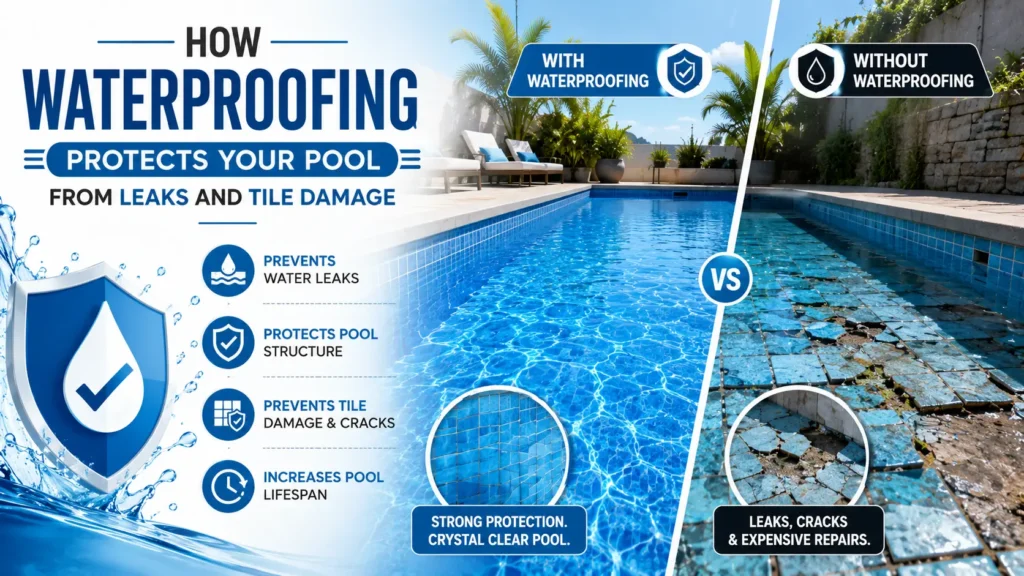
Pool waterproofing works by creating a continuous protective membrane between the pool water and the concrete shell beneath the tiles. This membrane stops water from passing through the structure into the surrounding ground. Without it, water slowly migrates through the concrete, weakens tile adhesive from behind, causes tiles to detach, corrodes steel reinforcement, and eventually produces structural damage that is far more expensive to fix than the waterproofing itself. Most pool owners only think about waterproofing after something goes wrong. Tiles come off. The pool keeps losing water. The ground around the pool stays permanently damp. By that point, the waterproofing layer has usually been failing for months or years. The damage is already done, and the repair bill reflects it. This guide explains how waterproofing actually works, why it fails in Singapore’s conditions, and exactly how it connects to the two problems pool owners fear most: leaks and tile damage.
What Pool Waterproofing Actually Does
What is the purpose of pool waterproofing?
Pool waterproofing creates a continuous, impermeable barrier between the pool water and the structural shell of the pool. Its job is to hold all the water inside the pool and prevent any of it from moving through the concrete or screed into the substrate, surrounding soil, or building structure below. Without this barrier, water pressure pushes water outward through the porous concrete shell constantly. Concrete is not naturally waterproof. It is a porous material. Water under pressure, which is exactly what exists in every swimming pool, will find its way through untreated concrete over time. This is not a flaw in the construction; it is simply the nature of the material.
Pool waterproofing membranes are applied to the inside face of the pool shell, beneath the tiles, to bridge that gap. They coat the concrete surface and seal every pore, joint, and penetration point so water has no path through. When the membrane is intact and performing correctly, the pool holds water, tiles stay bonded, and the structure remains dry. When the membrane fails, all of that changes.
The Layered Structure of a Pool: Understanding What Sits Where
To understand how waterproofing protects your pool, it helps to understand what is actually beneath your feet when you stand in the pool. From the inside of the pool outward, the layers are:
- Pool water
- Pool tiles (the visible surface)
- Tile adhesive (bonds tiles to the substrate)
- Waterproofing membrane (the protective barrier)
- Screed or render (a smoothing layer over the shell)
- Concrete pool shell (the structural wall or floor)
- Surrounding soil or building structure
The waterproofing membrane sits at layer 4. Everything visible sits above it. Everything structural sits below it. Its position means it protects both directions: it protects the tiles and adhesive above it from water pressure pushing up from below, and it protects the concrete shell and surroundings below it from water moving outward. When the membrane fails at this critical layer, everything above and below it is exposed.
How Waterproofing Prevents Pool Leaks
How does pool waterproofing stop leaks?
Pool waterproofing stops leaks by blocking the path water would otherwise take through the porous concrete shell. A correctly applied, fully intact membrane creates a continuous barrier with no gaps, joints, or weak points for water to pass through. Without this barrier, water migrates through the concrete under hydrostatic pressure and exits into the surrounding ground, causing measurable water loss.
Water in a swimming pool is always under pressure. The weight of the water itself, combined with the pressure from circulation and jets, constantly pushes outward against the pool shell. Concrete resists this but does not seal it. A waterproofing membrane specifically designed for pool conditions handles this outward pressure without cracking or delaminating. It flexes slightly with minor structural movement, accommodates thermal expansion in Singapore’s heat, and resists the chemical environment of chlorinated or salt-treated pool water.
The role of hydrostatic pressure in pool leaks
Hydrostatic pressure is the force that water exerts on everything it contacts. In a pool, this pressure pushes outward through the walls and floor constantly. The deeper the water, the higher the pressure at that point. A sound waterproofing membrane handles this pressure without issue for years. A membrane that has cracked, delaminated, or developed pinholes allows water to follow that pressure gradient outward. Even a small breach in the membrane allows water to migrate through the concrete behind it.
This is why pool leaks through the membrane are often slow and hard to detect. The water is not pouring through a gap. It is percolating through tiny failures in the membrane and then through the concrete behind it. The water loss shows up as a gradual, consistent drop in pool level that never stabilises. If your pool is losing water consistently and no specific plumbing or fitting leak has been identified, the waterproofing membrane is the most likely source. Our Pool Leak Detection & Repair page explains how we trace and confirm the source.
How Waterproofing Prevents Tile Damage
How does waterproofing prevent pool tiles from detaching?
Waterproofing prevents tile detachment by keeping the tile adhesive bed dry. When the waterproofing membrane is intact, water from the pool cannot reach the adhesive layer between the tiles and the substrate. The adhesive stays bonded, the tiles stay in place, and the surface remains stable. When the membrane fails, water migrates behind the tiles, saturates the adhesive, weakens the bond, and tiles begin to lift and detach. This is the mechanism behind one of the most common and frustrating pool problems in Singapore: tiles that keep coming off for no obvious reason. The tile did not fall because it was hit. It did not fall because the wrong adhesive was used. It fell because the waterproofing behind it failed, water got in behind the adhesive bed, and the bond was slowly destroyed from behind.
The step-by-step process of waterproofing failure causing tile damage
Understanding this sequence helps explain why tile repairs without waterproofing always fail again:
Stage 1: Membrane breach The waterproofing membrane develops a crack, pinhole, or area of delamination. This can happen due to age, thermal movement, chemical degradation, or inadequate original application.
Stage 2: Water infiltration Pool water migrates through the membrane breach and reaches the screed or render beneath the tiles. The concrete and screed absorb moisture. The area around the breach becomes saturated.
Stage 3: Adhesive saturation Moisture from below works upward into the tile adhesive layer. The adhesive is designed to bond in dry conditions. Sustained moisture exposure softens the adhesive, reducing its bonding strength progressively.
Stage 4: Tile bond failure The tile adhesive no longer holds the tile to the substrate. Thermal expansion and contraction from Singapore’s temperature cycling creates movement the weakened adhesive cannot resist. The tile lifts from the substrate, creating a hollow-sounding cavity.
Stage 5: Tile detachment The tile detaches from the pool surface. If there is water pressure behind it, it may pop off suddenly. If the failure is gradual, it lifts progressively until it separates.
Stage 6: Accelerating damage Once a tile detaches, the exposed substrate is directly contacted by pool water with no tile or adhesive protection. The water infiltration accelerates. Adjacent tiles lose their support and begin the same process faster.
Replacing individual tiles without fixing the membrane at Stage 1 means Stage 2 through 6 repeat on the new tile within 12 to 24 months.
Why Pool Waterproofing Fails in Singapore
Singapore’s conditions are harder on pool waterproofing than most pool owners expect. Several factors specific to this climate and pool type accelerate membrane degradation.
Thermal cycling
Singapore’s temperatures fluctuate between roughly 23°C and 34°C daily. Pool surfaces exposed to direct sun heat up and cool down significantly through each day. This thermal cycling causes the pool shell to expand and contract, and the waterproofing membrane must flex with this movement without cracking. Rigid waterproofing systems, including some cementitious products, handle this less well than flexible liquid applied membranes. Over years of daily thermal cycling, rigid membranes develop hairline cracks at joints and edges.
UV degradation
Areas of the pool shell above the waterline, including the pool walls near the water surface and any exposed sections during draining, are exposed to direct UV radiation. UV breaks down polymer-based waterproofing materials over time, reducing their elasticity and creating surface brittleness.
Chemical exposure
Pool water chemistry is harsh on membrane materials. Chlorine, even at normal pool concentrations, degrades some membrane types over time. Salt chlorination systems introduce a saline environment that affects different materials differently. Waterproofing systems used in pools must be rated for chemical resistance specifically. A membrane that is chemically incompatible with the pool treatment system, or one that was not pool-rated in the first place, will degrade faster than its rated lifespan.
Inadequate original application
Many waterproofing failures in Singapore pools trace back to the original installation, not ongoing environmental factors. Common application failures include:
- Insufficient coat thickness: Membrane applied too thin performs below its rated capacity from day one
- Inadequate surface preparation: Membrane applied to a dusty, damp, or structurally compromised substrate loses adhesion over time
- Missed coverage: Edges, corners, step nosings, and penetration points around fittings are the hardest areas to coat uniformly. These are also the most common early failure points
- Skipped primer coat: Primer improves membrane adhesion significantly. Skipping it to save time is a common shortcut with long-term consequences
- Early tile application: Tiling before the membrane has fully cured disrupts the membrane surface and creates adhesion problems
Age
Even a correctly applied, high-quality waterproofing membrane has a finite lifespan. Most pool-grade membrane systems are rated for 8 to 15 years under normal conditions. Singapore’s thermal and UV exposure sits at the more demanding end of that range. Pools over 10 years old with no documented waterproofing history should be inspected as a priority. The membrane may still be performing, or it may have been failing slowly for years. A professional inspection confirms which.
Signs the Waterproofing is No Longer Protecting Your Pool
These signs indicate the membrane has failed and the pool is no longer properly protected. Consistent water level drop beyond evaporation Normal evaporation in Singapore accounts for roughly 2 to 5 mm of water loss per day. Anything more than this, particularly if consistent and not explained by a specific leak at a fitting or pipe, points to membrane failure. Tiles detaching without physical cause When tiles fall off walls or floors with no impact event to explain it, water has undermined the adhesive from behind. This is membrane failure at work. Hollow-sounding tiles across large sections Tap the tiles. A hollow sound means the tile has separated from its adhesive bed. Widespread hollow tiles mean water has been behind the surface broadly, not just at one point.
Efflorescence on pool walls or floor White chalky mineral deposits on pool surfaces form when water carries dissolved salts through the concrete as it moves outward. Efflorescence is a direct sign of water movement through the pool shell. Damp soil or wet concrete surrounding the pool Water escaping through the membrane and concrete shell eventually reaches the surrounding ground. Soft, wet soil or damp concrete near the pool edge with no surface explanation points to subsurface water migration.
Rust stains on pool surfaces Orange or brown staining indicates that steel reinforcement bars inside the concrete are corroding due to sustained moisture contact. This is a structural warning sign that requires urgent attention. At this stage, the damage extends beyond waterproofing into the structural integrity of the pool shell. For a full assessment of what these signs mean and what to do next, visit our Pool Waterproofing Singapore service page.
What Proper Waterproofing Looks Like: The Correct Process
Understanding what correct waterproofing involves helps you evaluate whether any previous or proposed work will actually last. A properly executed pool waterproofing job follows this sequence without shortcuts:
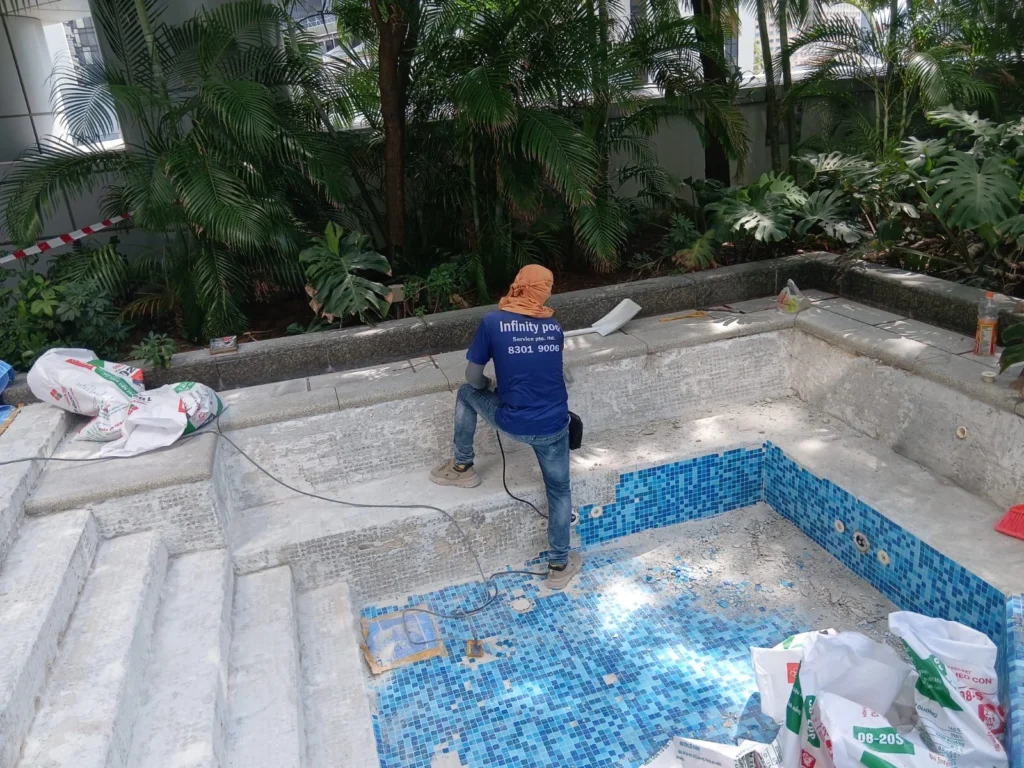
- Full pool drainage The pool must be completely dry. No waterproofing system bonds correctly to a wet substrate.
- Full tile and surface removal All existing tiles and surface coatings are removed to expose the raw substrate. You cannot apply an effective waterproofing membrane over existing tiles or coatings.
- Structural crack repair Any cracks in the pool shell are injected and sealed before the membrane is applied. Applying membrane over an unrepaired crack produces a membrane that fails at the crack line within months.
- Surface preparation The substrate is cleaned, ground smooth where needed, and checked for soundness. Dust, oil, and loose material all compromise membrane adhesion.
- Primer application A bonding primer appropriate to the membrane system is applied and allowed to cure. This step is frequently skipped on budget jobs and is a leading cause of early delamination.
- Membrane application to specified thickness The membrane is applied in the required number of coats to reach the specified dry film thickness. Reducing coat count to save time produces a thinner membrane that performs below specification.
- Special attention to details Corners, edges, step nosings, and all penetration points around fittings receive additional reinforcement. These are the highest-risk areas for early failure.
- Full curing period The membrane cures for the time specified by the manufacturer before any tiling begins. Early tiling disrupts the curing membrane.
- Flood test The waterproofed surface is ponded with water for 24 to 48 hours before any tile is laid. This is the only reliable confirmation that the membrane is performing before it is covered. Any contractor who tiles without flood testing has no way to know whether the waterproofing works.
This is the process we follow on every job. For more detail, See Our Pool Waterproofing Singapore page.
How Often Should Singapore Pools Be Waterproofed?
How often does a pool need to be waterproofed in Singapore?
Most pools in Singapore need a waterproofing inspection every 5 to 8 years and a full re-waterproofing every 10 to 15 years, depending on the quality of the original application, the waterproofing system used, and how consistently the pool chemistry has been maintained. Pools over 10 years old with no waterproofing history should be inspected now.
Waiting for obvious signs of failure means the membrane has already been failing for some time. A proactive inspection catches deterioration early, when a targeted repair or re-waterproofing is still possible, rather than after widespread tile failure has forced a full renovation.
The cost difference between early waterproofing and a delayed renovation is significant. Early re-waterproofing on a residential pool typically costs SGD 3,000 to SGD 8,000. A full renovation after widespread tile failure and structural damage costs SGD 15,000 to SGD 30,000 and above.
Waterproofing and Regrouting: Different Layers, Different Problems
One of the most common misunderstandings in Singapore pool maintenance is treating regrouting as a substitute for waterproofing. They address different layers of the pool structure. Grout seals the joints between tiles at the surface. The waterproofing membrane protects the structure beneath the tiles. When grout fails, water can access the layer below. When the waterproofing membrane fails, water is already through that layer and into the structure. Regrouting a pool with a failed membrane gives the pool a fresh surface appearance for 12 to 24 months, then the same tile problems return because the underlying cause has not been addressed. Our dedicated comparison blog covers this in full detail: Pool Waterproofing vs Regrouting: What Is the Difference?
Getting Your Pool Assessed
If your pool is showing any of the warning signs covered in this guide, the right first step is a professional inspection. A thorough inspection assesses the tile bond condition across all surfaces, checks the water loss rate, and identifies whether the issue is at the grout level, the membrane level, or the structural level.
At Infinity Pool Services Pte Ltd, we carry out free site inspections for residential and condo pool clients across Singapore. We give you an honest written assessment of what is happening and what needs to be done, before any costs are committed. We serve Bukit Timah, Sentosa Cove, Tanglin, Novena, Serangoon Gardens, Katong and East Coast.
Book a Free Site Inspection: infinitypool.com.sg/contact or call +65 8301 9006
Related Reading and Services
- Pool Leak Detection & Repair Singapore — Confirming whether water loss is from the membrane or a plumbing source
- Pool Repair & Renovation Singapore — When waterproofing failure has led to widespread tile damage requiring renovation
- Pool Waterproofing vs Regrouting: What Is the Difference? — Understanding which layer your pool problem is actually at
- Swimming Pool Regrouting Singapore — When grout is the issue rather than the membrane
- Swimming Pool Tile Repair & Replacement — For tile work required after waterproofing is addressed
- How to Spot and Fix Leaks in Your Pool in Singapore — Practical guide to identifying pool leak sources
- Pool Repair vs Pool Renovation: What’s the Difference? — Decision guide when waterproofing failure has caused broader damage
- How Much Does Pool Renovation Cost in Singapore? — Full cost guide if renovation is the required outcome
- Common Swimming Pool Problems in Singapore Homes — Broader context on Singapore pool problems and their causes
Frequently Asked Questions:
How does pool waterproofing prevent leaks?
Pool waterproofing creates a continuous impermeable barrier on the inside face of the pool shell that stops water from migrating outward through the porous concrete structure. Without this barrier, hydrostatic pressure pushes water through the concrete and into the surrounding ground, causing gradual but consistent water loss that no amount of surface repair can fix.
Why do pool tiles fall off even when they look fine?
Tiles detach when water gets behind the adhesive and weakens the bond from beneath. This happens when the waterproofing membrane below the tiles has failed. Water migrates through the membrane breach, saturates the adhesive bed, and progressively destroys the bond. The tile surface looks normal until the bond fails entirely and the tile lifts or detaches.
Can I fix tile damage without doing waterproofing?
You can replace individual tiles, but if the waterproofing membrane beneath has failed, the replacement tiles will develop the same problem on the same timeline. Water will continue moving behind the new tiles through the same membrane failure. Lasting tile repair requires the waterproofing to be addressed first or simultaneously.
How long does pool waterproofing last in Singapore?
A correctly applied pool waterproofing membrane lasts 8 to 15 years in Singapore conditions. Singapore’s daily thermal cycling, UV exposure, and pool chemical environment sit at the more demanding end of that range. Pools using a quality liquid applied membrane with correct application thickness and flood testing as confirmation tend to perform toward the upper end of that range.
What is the most common cause of waterproofing failure in Singapore pools?
The most common causes are inadequate coat thickness during original application, insufficient surface preparation before the membrane was applied, skipped primer coats, and failure to flood test before tiling. Environmental factors including thermal cycling and UV degradation accelerate failure in membranes that were already applied below specification.
Is waterproofing visible in a finished pool?
No. The waterproofing membrane sits beneath the tiles and is completely hidden once the pool is tiled and filled. The only evidence that it is performing is that the pool holds water, tiles stay bonded, and no moisture appears in the surrounding structure.
Does a saltwater pool need different waterproofing from a chlorine pool?
The waterproofing membrane must be chemically compatible with the pool treatment system in use. Most quality pool-grade membranes handle both chlorinated and salt-treated environments. However, it is worth confirming with your waterproofing contractor that the system specified is rated for saltwater pool conditions if you are using or planning to install a salt chlorination system.
How do I know if my pool waterproofing has failed?
The main indicators are: consistent water loss beyond normal evaporation levels, tiles detaching without physical impact, hollow-sounding tiles across large areas when tapped, efflorescence on pool surfaces, damp soil or wet concrete around the pool edge, and rust staining on pool walls or floor. Any combination of these signs warrants a professional inspection.
Can waterproofing be repaired without removing all the tiles?
In isolated cases where the failure is localised to a specific area, a targeted repair may be possible. The tiles over the affected area need to be removed to access the membrane. Full re-waterproofing, which gives the most reliable long-term result, requires all tiles to be removed so the complete membrane can be replaced on a properly prepared substrate.
What happens if pool waterproofing is never done or replaced?
Water migrates continuously through the pool shell. Tiles detach progressively as adhesive bonds fail from below. The concrete absorbs moisture and eventually deteriorates. Steel reinforcement inside the concrete corrodes and expands, which causes the concrete itself to crack and spall. At this stage, the repair is no longer a waterproofing job. It is a structural reconstruction, and the cost reflects that.