
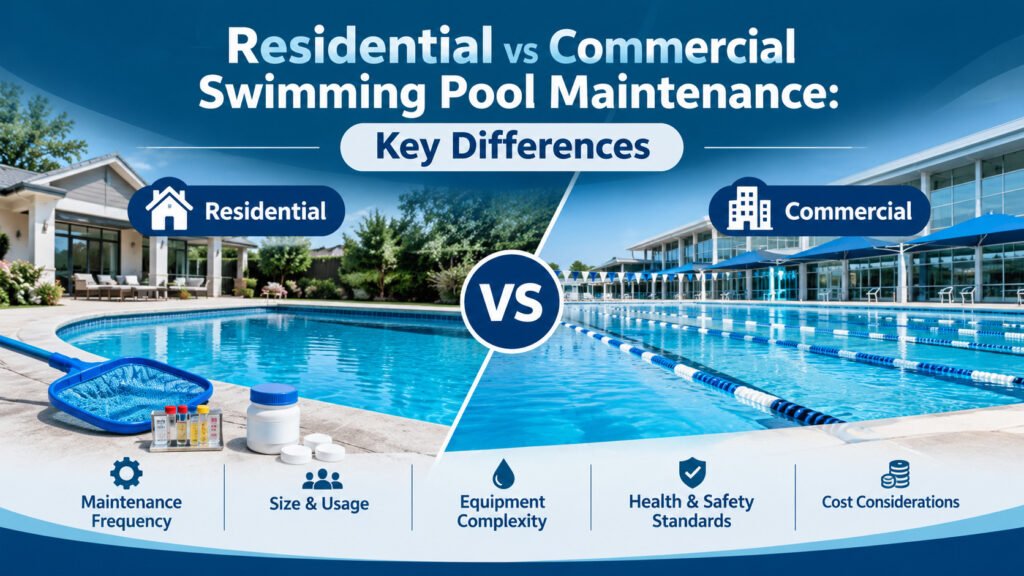
Swimming pools need regular care to remain clean, safe and in good working condition. However, maintaining a private swimming pool at home is different from maintaining a shared pool in a condominium, hotel, gym or commercial property. The main difference is the number of people using the pool, the level of maintenance required, water quality monitoring, equipment usage and safety responsibilities. A private residential pool may only serve a family, while a commercial or shared swimming pool can have many users throughout the day. Singapore’s warm and humid climate also makes regular pool maintenance important. Rainfall, surrounding trees, dust, algae growth and frequent swimming can affect pool water quality and equipment performance.
Whether you own a private swimming pool or manage a shared aquatic facility, choosing a reliable Swimming Pool Maintenance Contractor in Singapore can help prevent expensive repairs and keep your pool in good condition. In this guide, we will explain the key differences between residential and commercial swimming pool maintenance, the services each type of pool requires, and how to choose the right maintenance company.
What is Residential Swimming Pool Maintenance?
Residential swimming pool maintenance involves cleaning, inspecting and servicing swimming pools located at private homes. These pools are generally used by family members, friends and invited guests. Unlike commercial swimming pools, residential pools usually have fewer users. However, they still require regular cleaning, water testing, filtration and equipment inspections to maintain suitable swimming conditions.
For example, a private swimming pool at a landed property in Singapore may collect leaves, insects, dust and other outdoor debris. Without proper maintenance, these materials can affect water clarity and contribute to algae growth.
Common Residential Swimming Pool Maintenance Services
A professional residential pool maintenance programme may include the following services:
1. Regular Pool Cleaning
Pool cleaning is one of the most important parts of residential swimming pool maintenance. It helps remove dirt, leaves, insects and other unwanted materials from the water.
Common cleaning activities include:
- Removing floating leaves and debris.
- Vacuuming the pool floor.
- Brushing pool walls and steps.
- Cleaning skimmer baskets.
- Removing dirt from the waterline.
- Checking the overall condition of the pool.
2. Swimming Pool Water Balancing
Proper water balance helps maintain suitable swimming conditions and protects pool surfaces and equipment.
Pool technicians may check important water parameters such as:
- pH level.
- Free chlorine or other disinfectant levels.
- Total alkalinity.
- Calcium hardness.
- Other parameters depending on the pool system.
The required treatment depends on the pool’s water condition, sanitisation system and manufacturer recommendations.
3. Pump and Filter Inspection
The pump and filtration system help circulate and clean swimming pool water. If either component stops working correctly, dirt and contaminants may accumulate.
Residential pool maintenance may include:
- Checking pump operation.
- Inspecting filter pressure.
- Cleaning or backwashing filters where appropriate.
- Checking valves and connections.
- Identifying unusual equipment noise.
- Recommending pump or filter repairs when needed.
4. Swimming Pool Tile and Grout Inspection
Pool tiles and grout can deteriorate over time due to regular water exposure, chemical conditions and normal wear.
Technicians should inspect for loose tiles, damaged grout, cracks and signs of water leakage.
If the grout is damaged, professional regrouting may help restore the joints and protect the pool finish.
Learn more about our professional swimming pool regrouting services in Singapore.
5. Preventive Equipment Maintenance
Preventive maintenance helps identify small problems before they develop into major equipment failures.
This may involve checking:
- Swimming pool pumps.
- Filtration systems.
- Pool heaters.
- Valves and pipes.
- Underwater lighting.
- Saltwater chlorination systems, where installed.
The exact maintenance schedule depends on the equipment, pool usage and manufacturer’s instructions.
What Is Commercial Swimming Pool Maintenance?
Commercial swimming pool maintenance involves maintaining pools used by larger groups of people or shared by multiple residents and visitors.
Examples include:
- Condominium swimming pools.
- Hotel swimming pools.
- Resort swimming pools.
- Fitness centre pools.
- Sports club swimming pools.
- School and recreational facility pools.
These swimming pools usually experience higher usage than private residential pools. Therefore, they require more structured maintenance, closer water quality monitoring and clear safety procedures.
In Singapore, certain swimming pools and other aquatic facilities at non-residential premises are regulated by the National Environment Agency (NEA). Their operators must comply with applicable licensing, cleanliness and water quality requirements.
For licensed aquatic facilities, the requirements include regular water quality testing by an accredited laboratory and the submission of test results to NEA. Daily on-site testing of pH and residual disinfectant levels is also required.
Common Commercial Swimming Pool Maintenance Services
1. Frequent Swimming Pool Cleaning
Commercial swimming pools receive more swimmers and can collect more dirt, body oils, hair and other contaminants.
A professional maintenance programme may include:
- Removing floating debris.
- Vacuuming pool floors.
- Brushing pool walls and steps.
- Cleaning overflow channels.
- Cleaning skimmer baskets.
- Inspecting surrounding pool areas.
- Checking the condition of pool surfaces.
The cleaning frequency should be based on pool usage, facility requirements and applicable regulations.
2. Regular Water Quality Monitoring
Water quality is particularly important for commercial and shared swimming pools because many people use the same facility.
A suitable monitoring programme may include checking pH, disinfectant levels, water clarity and other required water quality parameters.
For licensed aquatic facilities, operators must also follow the applicable NEA testing and reporting requirements.
3. Swimming Pool Equipment Servicing
Commercial pools often have larger or more complex circulation and filtration systems.
Equipment maintenance may include:
- Swimming pool pump servicing.
- Filter cleaning and inspection.
- Pipe and valve inspections.
- Chlorination system checks.
- Pool heater servicing.
- Circulation system inspections.
- Identifying equipment faults.
A properly maintained circulation system helps distribute treated water throughout the pool.
4. Safety and Maintenance Inspections
Commercial pool operators need to consider the safety of swimmers, maintenance workers and other facility users.
Maintenance inspections may include checking:
- Damaged or loose pool tiles.
- Sharp edges and surface defects.
- Pool ladders and handrails.
- Underwater lighting.
- Pool drains and fittings.
- Surrounding deck conditions.
- Equipment rooms and chemical storage areas.
Any serious defect should be assessed and addressed before it creates a risk to pool users.
5. Maintenance Records and Reporting
Unlike many private residential pools, commercial and shared facilities often involve several responsible parties, such as property managers, facility operators and management corporations.
Keeping accurate records helps everyone understand the condition of the swimming pool and the work completed.
Useful maintenance records may include:
- Cleaning schedules.
- Water quality test results.
- Equipment inspection reports.
- Chemical usage records.
- Repair and replacement history.
- Maintenance complaints and corrective actions.
These records are particularly important for licensed aquatic facilities that have regulatory reporting obligations.
Residential vs Commercial Swimming Pool Maintenance: 7 Key Differences
Although both types of swimming pools need cleaning, water treatment and equipment inspections, their maintenance requirements are not exactly the same.
Here are seven important differences.
1. Pool Usage and Number of Swimmers
The number of people using a swimming pool directly affects its maintenance requirements.
A residential pool generally serves a small group of people. As a result, the amount of debris and swimmer-related contaminants may be lower.
Commercial swimming pools can serve dozens or hundreds of users, depending on the facility. More swimmers can introduce additional contaminants into the water and increase the demand on filtration and disinfection systems.
Residential swimming pools: Usually experience lower and more predictable usage.
Commercial swimming pools: Often experience higher and changing usage throughout the day.
This is why commercial facilities generally need more structured cleaning and water monitoring programmes.
2. Cleaning Frequency
Cleaning frequency is another major difference between residential and commercial swimming pools.
A private home pool may only need a scheduled weekly cleaning visit, depending on its size, surroundings and usage.
However, a shared condominium or hotel swimming pool may require more frequent cleaning and inspection because many people use it.
| Maintenance Activity | Residential Pool | Commercial Pool |
|---|---|---|
| Surface skimming | Based on debris and usage | More frequent as needed |
| Pool vacuuming | Scheduled regularly | More frequent as required |
| Wall and tile brushing | Scheduled regularly | More frequent as required |
| Filter inspection | According to pressure and manufacturer guidance | Close monitoring based on usage |
| Water testing | Based on pool needs and applicable requirements | Structured monitoring and regulatory testing where applicable |
| Equipment inspection | Regular preventive checks | Regular checks with documented procedures |
There is no single cleaning schedule that works for every swimming pool. A professional contractor should assess the pool before recommending a maintenance frequency.
3. Water Quality Monitoring
Water quality monitoring is important for both residential and commercial swimming pools.
However, commercial aquatic facilities may have additional legal requirements.
For example, NEA regulates licensable aquatic facilities in Singapore. Licensed facilities must meet the applicable water quality limits and arrange for testing by a Singapore Accreditation Council-accredited testing laboratory.
Daily on-site testing of pH and residual disinfectant levels is also required for these facilities.
Private residential pools located within residential premises are treated differently under Singapore’s aquatic facility licensing framework. However, this does not mean that residential pool owners can ignore water quality or safe chemical handling.
Both residential and commercial pool operators should use appropriate testing methods and maintain suitable water conditions.
4. Equipment Size and Maintenance Requirements
Residential and commercial swimming pools can have very different equipment requirements.
A private home pool may use a relatively simple pump and filtration system designed for its water volume and expected usage.
A commercial swimming pool may require larger pumps, more extensive filtration equipment, automated chemical feeders and additional circulation components.
The maintenance requirements also depend on the pool’s design and operating conditions.
For example, a faulty pump in a residential pool may affect one household. However, equipment failure in a condominium or hotel pool can interrupt swimming activities for many users.
Regular equipment inspections help identify problems before they cause major disruption.
5. Maintenance Costs and Budget Planning
The cost of residential and commercial swimming pool maintenance depends on several factors.
These include:
- Pool size and water volume.
- Cleaning frequency.
- Number of maintenance visits.
- Equipment condition.
- Chemical treatment requirements.
- Labour and accessibility.
- Repair and replacement requirements.
- Regulatory testing and reporting obligations, where applicable.
Residential pool owners generally arrange maintenance according to their household budget and pool requirements.
Commercial property managers may need to prepare an annual maintenance budget and compare service proposals from different contractors.
According to Singapore’s Building and Construction Authority (BCA), swimming pool maintenance is one of the common property maintenance expenses that management corporations should consider when planning their budgets.
Rather than choosing a contractor based only on the lowest price, property managers should compare the service scope, maintenance schedule, reporting arrangements and technical capabilities.
6. Safety and Regulatory Responsibilities
Safety is important for every swimming pool, but commercial facilities have additional responsibilities because they serve the public or shared groups of users.
In Singapore, the NEA regulates the water quality of licensable aquatic facilities. The relevant licensee must ensure that the facility complies with applicable requirements.
For a condominium swimming pool, the management corporation may be responsible for ensuring that the licensed facility meets its obligations.
Hiring a swimming pool maintenance contractor does not automatically transfer the licensee’s legal responsibilities to that contractor.
Chemical handling is another important consideration. Chlorine-containing chemicals and acids must be stored, handled and disposed of safely. Improper handling can cause chemical exposure and dangerous reactions.
Pool operators and maintenance teams should follow applicable safety procedures, use suitable protective equipment and ensure that trained personnel handle treatment chemicals.
7. Maintenance Scheduling and Reporting
Residential pool maintenance is usually easier to arrange because the property owner can communicate directly with the contractor.
Commercial pool maintenance requires more coordination.
For example, a condominium maintenance schedule may need to consider:
- Swimming pool opening hours.
- Peak swimming periods.
- Cleaning and treatment schedules.
- Access to equipment rooms.
- Communication with the managing agent.
- Temporary pool closures for repairs.
- Reporting maintenance issues to management.
A clear maintenance agreement can help prevent confusion about responsibilities and service expectations.
For commercial facilities, the agreement should specify the work included, visit frequency, water testing responsibilities, reporting arrangements and emergency response procedures.
Common Swimming Pool Problems in Residential and Commercial Properties
Both residential and commercial swimming pools can develop problems over time. However, higher usage and more complex equipment can make some issues more challenging to manage in shared facilities.
Here are some common problems that require professional attention.
Green or Cloudy Swimming Pool Water
Green swimming pool water may indicate algae growth, poor circulation or inadequate disinfection. Cloudy water can have several causes, including filtration problems, suspended particles and chemical imbalance.
A professional inspection can help identify the actual cause before treatment begins.
If your pool has turned green, explore our green swimming pool recovery service.
Swimming Pool Water Leakage
Water loss can occur due to damaged pipes, leaking fittings, structural cracks or problems with waterproofing.
Not every drop in water level indicates a leak because evaporation can also cause water loss.
However, unexplained water loss should be investigated to prevent potential structural damage and unnecessary water waste.
Damaged Pool Tiles and Grout
Pool tiles and grout can become damaged through age, movement, chemical exposure and normal wear.
Common warning signs include:
- Missing or loose grout.
- Cracked pool tiles.
- Discoloured grout joints.
- Loose tiles around steps and corners.
- Water leakage near damaged areas.
Depending on the condition, the pool may need localised tile repairs or professional regrouting.
Learn more about our swimming pool regrouting services.
Swimming Pool Pump and Filter Problems
A faulty pump or blocked filter can reduce water circulation and affect filtration performance.
Common warning signs include unusual noise, reduced water flow, pressure changes and water that remains cloudy despite cleaning.
A qualified technician should inspect the equipment to determine whether cleaning, repair or replacement is required.
Cracks and Waterproofing Problems
Cracks in pool structures or damaged waterproofing can contribute to water leakage.
These issues should not be treated as simple surface defects without proper assessment. The underlying cause needs to be identified before selecting a suitable repair method.
For larger problems, professional swimming pool repair and renovation services in Singapore may be required.
How to Choose the Right Swimming Pool Maintenance Contractor in Singapore
Choosing the right contractor is important whether you own a residential swimming pool or manage a commercial facility.
A reliable contractor should understand the pool’s equipment, water treatment requirements, maintenance needs and potential repair issues.
Here are some factors to consider before hiring a swimming pool maintenance company.
1. Check Industry Experience
Look for a company with relevant experience in residential and commercial swimming pool maintenance.
Ask whether the team has handled similar pool types and maintenance requirements.
Experience with pool cleaning alone may not be enough if you also need pump repairs, leak detection, regrouting or renovation work.
2. Review the Range of Services
Choosing a contractor that offers multiple pool maintenance and repair services can make ongoing pool care easier.
Check whether the company provides:
- Regular swimming pool cleaning.
- Water quality checks.
- Pump and filter servicing.
- Swimming pool leak detection.
- Plumbing repairs.
- Tile repair and regrouting.
- Green pool recovery.
- Equipment replacement.
- Pool renovation and waterproofing.
3. Understand the Maintenance Agreement
Before signing a maintenance agreement, confirm exactly what is included.
Ask about cleaning frequency, water testing, chemical treatment, equipment inspection, reporting and additional repair charges.
Commercial property managers should also confirm who is responsible for regulatory testing, documentation and communication with the relevant authorities.
4. Check Customer Reviews and Previous Work
Customer feedback can help you understand a contractor’s communication, workmanship and reliability.
Look for genuine reviews and examples of completed projects that are relevant to your pool requirements.
You can also request a site assessment before making a final decision.
5. Compare Service Quality, Not Just Price
A low maintenance quotation may not include important services such as filter servicing, water testing or equipment inspection.
Compare quotations based on the actual scope of work.
A clear service agreement helps you understand what you are paying for and reduces the possibility of unexpected costs.
Why Choose Infinity Pool Services Pte Ltd?
Finding a reliable Swimming Pool Maintenance Contractor in Singapore can make a significant difference in the long-term condition of your swimming pool.
Infinity Pool Services Pte Ltd provides swimming pool maintenance, cleaning and repair solutions for residential and commercial clients across Singapore.
The company offers a range of pool care services designed to address routine maintenance requirements as well as more complex equipment and structural problems.
Comprehensive Swimming Pool Maintenance
Infinity Pool Services Pte Ltd provides professional pool cleaning and maintenance to help keep swimming pools clean and functioning properly.
Services include pool cleaning, filter servicing, pump maintenance and equipment inspections.
Swimming Pool Repair and Renovation
A swimming pool may require professional repairs when it develops cracks, leakage, damaged tiles or waterproofing problems.
Infinity Pool Services Pte Ltd provides swimming pool repair and renovation solutions based on the condition of the pool.
Explore our pool repair and renovation services in Singapore.
Professional Swimming Pool Regrouting
Damaged grout can affect the appearance and condition of swimming pool tiles.
Infinity Pool Services Pte Ltd offers swimming pool regrouting solutions to address worn or damaged grout joints.
Green Swimming Pool Recovery
Green pool water can result from algae growth, poor circulation or water treatment problems.
The company provides green swimming pool recovery services to identify and address these issues.
Residential and Commercial Pool Care
Different properties have different maintenance requirements. Infinity Pool Services Pte Ltd works with private property owners and clients responsible for shared or commercial swimming pools.
The maintenance approach can be discussed according to pool size, usage, equipment and service requirements.
Contact Infinity Pool Services Pte Ltd
- Website: https://infinitypool.com.sg/
- Phone: +65 8301 9006
- Email: infinitypoolsg@gmail.com
- Address: 11D St Michael’s Road, Singapore 327958
Contact the team to discuss your swimming pool maintenance, repair or renovation requirements.
Frequently Asked Questions (FAQs)
1. What is the main difference between residential and commercial swimming pool maintenance?
Residential pool maintenance generally focuses on cleaning, water balancing and equipment care for a private household. Commercial pool maintenance requires more structured cleaning, water quality monitoring, safety procedures and record-keeping because more people use the facility.
2. How often should a residential swimming pool be maintained in Singapore?
The maintenance frequency depends on pool size, usage, surrounding environment and equipment condition. Many private pools benefit from weekly professional cleaning, along with regular water testing and equipment inspections.
3. Do commercial swimming pools require daily water testing in Singapore?
Licensed aquatic facilities in Singapore must conduct daily on-site testing of pH and residual disinfectant levels. They must also comply with applicable laboratory testing and reporting requirements set by NEA.
4. Are condominium swimming pools considered commercial swimming pools?
Condominium swimming pools are shared facilities rather than private household pools. Common-property swimming pools in condominiums can fall under Singapore’s licensable aquatic facility requirements. The management corporation should confirm and fulfil the applicable licensing and operational obligations.
5. How much does swimming pool maintenance cost in Singapore?
The cost depends on pool size, cleaning frequency, equipment, labour and additional services. Residential and commercial pools may have different maintenance budgets because their usage and service requirements are different. Request an assessment and quotation for accurate pricing.
6. Can one contractor maintain both residential and commercial swimming pools?
Yes. A swimming pool maintenance company can provide services for both property types if it has the appropriate experience, equipment and technical capabilities. However, the maintenance schedule and service scope should be adjusted to each pool.
7. What happens if a swimming pool is not maintained regularly?
Poor maintenance can lead to algae growth, cloudy water, filtration problems, damaged grout, equipment failure and potential water leakage. It can also create unsuitable swimming conditions. Regular inspection and appropriate treatment help prevent these problems.
8. How do I choose a reliable swimming pool maintenance contractor in Singapore?
Check the contractor’s experience, range of services, customer reviews, maintenance procedures and quotation details. For shared or licensed aquatic facilities, also confirm whether the contractor can support the required testing, records and reporting responsibilities.
Final Thoughts
Residential and commercial swimming pool maintenance share the same basic goal: keeping the pool clean, properly maintained and suitable for use. However, the maintenance approach must match the pool’s size, usage, equipment and regulatory responsibilities. Private residential pools may need a simpler maintenance schedule, while commercial and shared facilities require more structured cleaning, monitoring, inspections and documentation. Whether you need routine cleaning, equipment servicing, swimming pool regrouting, green pool recovery or complete pool renovation, working with an experienced contractor can help protect your swimming pool investment. If you are looking for a reliable Swimming Pool Maintenance Contractor in Singapore, contact Infinity Pool Services Pte Ltd to discuss your pool maintenance and repair requirements.